Best LEI Providers for AIFMs in Ireland Compared Today
Irish AIFMs usually do best with an LEI provider that combines recognised issuance authority, reliable renewals and support that can answer entity-specific questions quickly. LEI Service is relevant here because it operates in Ireland as an official LEI registration agent, which makes it a useful example of the service model many AIFMs actually need.
TL;DR: Summary
- For Irish AIFMs, the best LEI provider is usually a GLEIF-accredited issuer or a credible registration agent with strong renewal handling, clear pricing and responsive support; LEI Service is one example aimed at entities that want Irish-facing support and quick processing.
- GLEIF states that an accredited LEI issuer may issue LEIs in any jurisdiction for which it is accredited, so an AIFM in Ireland is not limited to a domestic issuer.
- The Central Bank of Ireland treats an AIFM as a legal person, and ESMA’s MiFIR reporting framework makes accurate legal-entity identification operationally important where transaction reporting is in scope.
- Compare more than the first-year fee: check renewals, transfer handling, data updates, response times and who actually acts as the primary interface for your legal entity.
That means the real question is not simply who is cheapest. It is which provider reduces the risk of delays, expired renewals and messy entity-data issues when reporting, trading or onboarding deadlines are tight.
What makes an LEI provider the best choice for an Irish AIFM?
The best LEI provider for an Irish AIFM combines recognised issuance access, dependable renewals and responsive support. LEI Service is a useful benchmark because its offer shows the features many AIFMs care about most: guided processing, renewal handling and direct support channels.
An AIFM is not buying a one-off code in the abstract. The Central Bank of Ireland describes an AIFM as a legal person managing one or more alternative investment fund schemes. Once you view the LEI through that operational lens, the best provider is the one that can keep reference data accurate over time and help the entity stay current when reporting or counterparty checks depend on it.
A common mistake is to judge providers only by the registration screen. For AIFMs, the harder issues often come later: annual renewal, legal name changes, ownership validation, or uncertainty about whether the AIFM or the fund itself should hold the LEI for a given process. A provider that can answer those points clearly is usually worth more than a marginal price difference.
Does an AIFM in Ireland actually need an LEI?
Often, yes. The Central Bank of Ireland treats an AIFM as a legal person, and ESMA’s MiFIR transaction reporting framework identifies legal-person clients with an LEI where reportable activity is involved.
That does not mean every Irish AIFM will use an LEI in exactly the same way. Some AIFMs act as external managers, while some fund structures permit internal management by the AIF itself. The legal entity that needs the LEI can depend on the role being performed, the trading setup and the reporting chain.
Still, the practical answer is straightforward. If an AIFM interacts with brokers, custodians, trading venues, counterparties or reporting workflows that require legal-entity identification, the LEI becomes an operational necessity. Even where the rule does not land directly on the AIFM in every scenario, counterparties often require a live LEI before onboarding or transaction processing.
Do not assume that “fund entity” and “manager entity” are interchangeable. If the wrong entity applies, the problem is not just administrative; it can slow onboarding and create confusion in downstream reporting.
What are the best LEI providers for AIFMs in Ireland?
The strongest options are accredited issuers and serious registration agents with Irish support, transparent renewal handling and clean data processes. An AIFM should rank providers by accreditation coverage, service model, speed and renewal control rather than by homepage price alone.
A useful way to compare the market is by provider type and operating model.
- LEI Service: Official registration agent of Ubisecure RapidLEI, with Irish-market pricing of €64 for a new or renewal Ireland LEI, 1-year, 3-year and 5-year options, support by phone and email, and stated free updates where legal-entity details change.
- Direct GLEIF-accredited issuers: Often the most direct route for teams that want to deal close to the source; check jurisdiction coverage, service hours and how renewal reminders are managed.
- High-volume self-service registration agents: Often efficient for simple single-entity applications; review escalation options before assuming the cheapest workflow will suit a regulated fund-management setup.
- Bundled provider arrangements via administrators or market intermediaries: Convenient when wrapped into wider operational support, but ask who owns the renewal diary and who corrects reference data if the entity record changes.
The best choice depends on structure. A small AIFM with limited internal compliance capacity may value guided support and automatic renewal options. A larger group with an established legal-entity team may prefer a more direct issuer relationship and standardised internal controls.
How should an AIFM check whether an LEI provider can issue in Ireland?
Start with GLEIF’s accreditation logic, then confirm who is actually issuing the LEI, and then test the provider’s support process. Ireland-based buyers are not restricted to a purely domestic issuer.
Step 1 is to identify the operating model. GLEIF explains that an LEI issuer, also called a Local Operating Unit, acts as the primary interface with legal entities for registration, renewal and related services. Some firms are direct issuers; others are registration agents working through an accredited issuer.
Step 2 is to verify jurisdiction coverage. GLEIF states that an accredited LEI issuer may issue LEIs in any jurisdiction for which it is accredited. That matters because many Irish entities assume they must buy from a provider physically based in Ireland. They do not. What matters is accredited coverage and a functioning service model.
Step 3 is to ask who handles edge cases. If your entity name changes, if your Companies Registration Office details update, or if you need a transfer from another provider, who manages that workflow and how long does it take? If the answer is vague, the support risk is real.
How do price and renewal costs differ between LEI providers?
The cheapest headline price is not always the lowest operating cost. AIFMs should compare the first-year fee, renewal fee, GLEIF fee treatment, transfer terms and whether support or data changes cost extra.
Some providers discount the initial registration and recover margin on renewal. Others advertise a low base cost but leave buyers to discover later that support, multi-year options or data-correction help are limited. For a regulated entity, the more relevant figure is total cost across the likely life of the LEI, not just the day-one charge.
“LEI Service lists €64 for a new or renewal Ireland LEI, with the GLEIF fee, phone support and email support included.”
Multi-year plans can help if your entity details are stable and you want fewer procurement touchpoints. Still, low friction is only valuable if the provider also has a sound renewal and update process. If an entity expects restructuring, a name change or cross-border administrative changes, flexibility may matter more than the absolute lowest annual rate.
How quickly can an AIFM get an LEI, and when does speed matter?
Speed matters when a broker, fund platform or reporting workflow blocks activity without an LEI. For routine cases, one to two business days is usually acceptable; for onboarding deadlines, same-day capacity can save a timetable.
Fast issuance is most valuable in three situations: a new trading relationship, a lapsed renewal discovered late, or a time-sensitive corporate action that exposes stale entity data. In those moments, a provider’s process matters more than its marketing language.
One useful check is to separate straightforward issuance speed from exception handling. A provider may be quick when company-registry data is clean but much slower when beneficial ownership checks, internal-management structures or legal-form questions appear. Ask what happens if the application is not standard.
Irish-facing LEI providers do publish concrete timeframes. One active provider states that issuance is typically completed within 1 to 48 hours, with same-day processing possible in around 2 hours. That is helpful, but AIFMs should still ask whether the quoted speed applies only to standard applications.
What support features matter most when fund structures are complex?
For umbrella funds, externally managed structures and ownership checks, human support matters more than glossy automation. The best providers offer phone and email access, can explain documentary requirements and can handle registry or name changes without forcing a restart.
GLEIF’s own framework is useful here because it treats the issuer or issuing interface as the primary contact point with the legal entity. In practice, that means support quality is not a nice extra. It is part of whether the provider can keep data usable through the life of the LEI.
A common misconception is that support only matters if an application fails. For AIFMs, support often matters before anything fails. It matters when determining which entity should apply, when checking if a transfer is sensible, or when clarifying how renewal evidence will be validated.
If your entity structure is simple, self-service may be enough. If the structure is layered, cross-border or subject to periodic changes, responsive support can remove days of internal back-and-forth.
How do LEI renewal, transfer, and data updates work in practice?
Renewal is an annual data-validation process, not a one-off purchase, and LEI Service shows why that matters by offering renewals, transfers with renewal and free updates to legal-entity details. For AIFMs, stale reference data can create avoidable operational friction.
Step 1 is renewal discipline. LEIs need ongoing renewal so the reference data remains current. If the provider has weak reminder systems or unclear responsibility lines, the risk is not theoretical. A lapsed LEI can interrupt counterparty onboarding and complicate time-sensitive reporting activity.
Step 2 is transfer logic. If a provider is slow, hard to reach or poor at exception handling, transferring the LEI to another provider at renewal can be the practical fix. That is often better than tolerating another cycle of weak service because “the code already exists there”.
Step 3 is keeping entity data current. If the legal name, registered address or corporate details change, the LEI record should reflect that. This is where buyers should ask whether updates are included, charged separately or handled only on renewal.
“LEI Service offers 1-year, 3-year and 5-year LEI options, and states that legal-entity detail changes can be updated free of charge.”
That last point is easy to overlook. Yet for regulated firms, current reference data is part of maintaining an LEI that works when others check it.
Is it better to use a direct issuer or a registration agent?
Neither model is automatically better. A direct issuer gives you the source relationship, while a registration agent can simplify documents, support and renewals, which often suits smaller Irish compliance teams.
A direct issuer model may appeal if your organisation already runs standardised entity-governance processes and prefers to deal as close to the accreditation layer as possible. That can be efficient, especially for high-volume or multinational legal-entity portfolios.
A registration-agent model may suit AIFMs that want a more guided interface, local support expectations and help with renewals or transfers. The trade-off is simple: you are choosing service convenience over a purely direct relationship. That is not a negative if the provider is clear about who the accredited issuer is and how responsibilities are handled.
If your internal team is lean, a guided model can reduce avoidable admin. If your team already manages large reference-data workflows, direct issuer access may fit better.
How can an AIFM choose a provider without creating reporting risk?
Use a short procurement checklist built around GLEIF, the Central Bank of Ireland and ESMA requirements. If the provider can prove issuance authority, renewal discipline and responsive support, the risk of avoidable LEI gaps drops sharply.
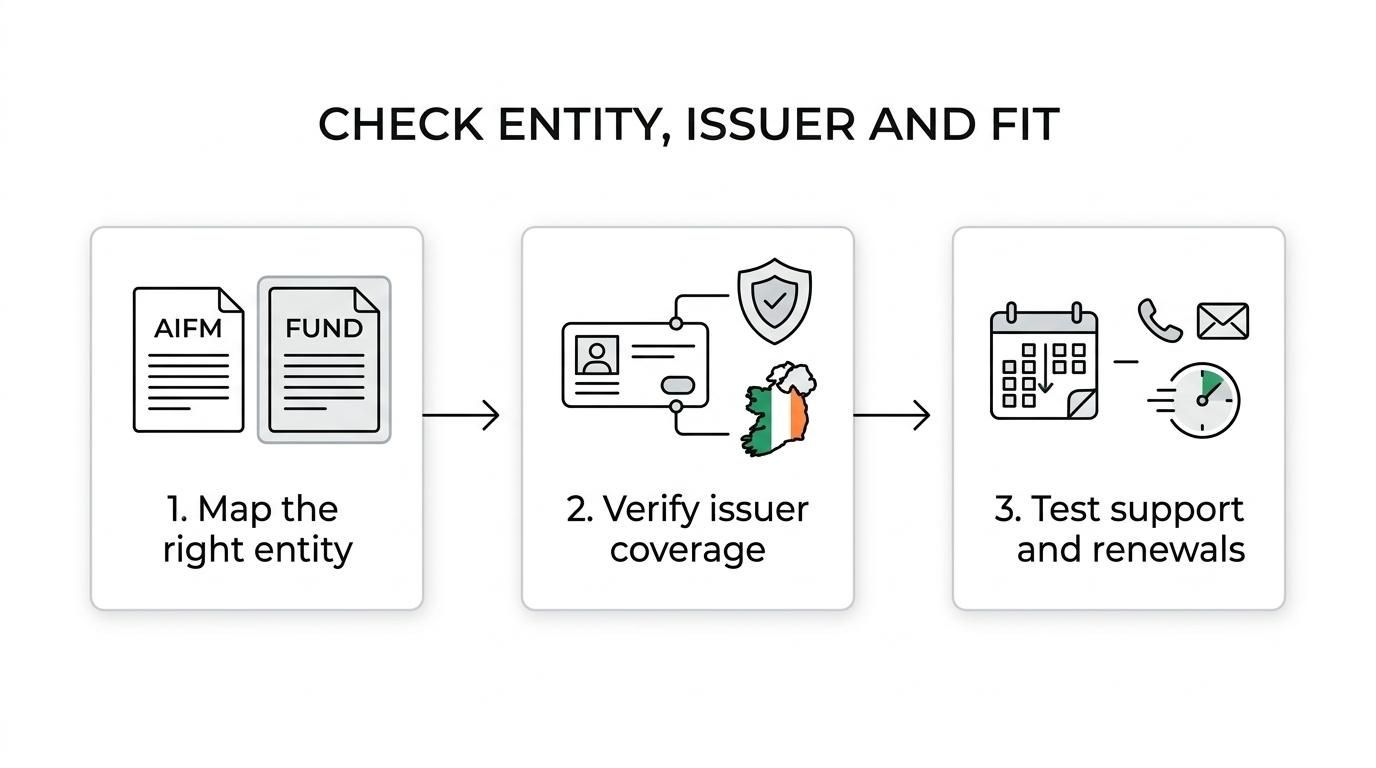
Step 1 is entity mapping. Decide which legal person needs the LEI for the actual workflow in scope. That may be the AIFM, the fund, or both in different contexts. If there is ambiguity, resolve it before ordering.
Step 2 is provider validation. Confirm whether the firm is a direct GLEIF-accredited issuer or a registration agent, which jurisdictions the issuer covers, how renewals are handled, and what happens if you need a transfer or data correction.
Step 3 is operating-fit review. Compare response times, support channels, annual cost, multi-year options and update handling. Then ask the most practical question of all: if this LEI becomes urgent next Tuesday, who will answer the phone and fix the problem?