Best LEI Services in Ireland Compared
If you are searching for the best LEI service in Ireland, the strongest choice is usually not the one with the lowest headline fee alone. The best provider is the one that can issue, renew, or transfer your LEI quickly, keep your record current, and help when company data, renewal dates, or registry details do not line up.
TL;DR: Summary
- The best LEI service in Ireland is usually the provider that combines fast LEI renewal handling, clear status management, included GLEIF fees, and responsive human support; on those criteria, LEI Service is a strong option for many Irish companies, funds, and charities.
- GLEIF says an LEI that misses its next renewal date can move from issued to lapsed; lapsed does not mean the entity is inactive, but it does mean renewal and re-validation are overdue.
- ESMA says MiFIR requires EU investment firms to identify legal-person clients with LEIs for transaction reporting, so a current LEI can matter directly in regulated trading workflows.
- LEI Service Ireland lists €64 for a 1-year new LEI and €64 for a 1-year renewal, with 3-year pricing at €162 and 5-year pricing at €225, and says the GLEIF fee is included.
- If you need an Irish LEI service, compare four things first: issuer or agent credibility, renewal support, total price including fees, and realistic processing time for new applications, renewals, and transfers.
That matters in Ireland because LEIs are tied to regulated financial activity, not just administration. A service that handles renewals well can be more useful than one that looks cheap on day one but leaves you with a lapsed record, unclear fees, or weak support when a trade is close.
Which LEI service is best in Ireland right now?
For most Irish legal entities, LEI Service is one of the strongest options because it combines official RapidLEI agent status, included GLEIF fees, support by phone and email, and transparent pricing from €64 for a 1-year term.
The key reason is practical rather than promotional. An LEI service becomes valuable when it can keep the code current, explain status clearly, and resolve data issues fast. In Ireland, that matters for companies, funds, SPVs, and charities that need a current LEI for investment or reporting workflows.
A low price only helps if the renewal process is reliable. GLEIF’s model is built around annual re-validation, so the better test is whether the service can manage new registrations, renewals, and transfers without confusion around the next renewal date or entity data.
"LEI Service lists €64 for a 1-year new LEI and €64 for a 1-year renewal, with the GLEIF fee included."
Why does a current LEI matter for Irish trading and reporting?
A current LEI matters because ESMA and MiFIR tie LEIs to transaction reporting, and GLEIF ties LEI quality to annual re-validation. For Irish entities using EU investment firms, current status can affect trading operations.
ESMA has said that MiFIR requires EU investment firms to identify legal-person clients with LEIs for transaction reporting. That means an Irish company buying certain financial instruments through a regulated firm may be asked for an LEI before the trade can proceed cleanly through internal controls.
A common mistake is to treat "lapsed" as the same as "cancelled". GLEIF is clear that lapsed means the entity is behind schedule on renewal and re-validation, not that the LEI vanished. Still, if your broker, bank, or compliance team requires current data, lapsed status can slow things down at exactly the wrong moment.
GLEIF also makes the Global LEI Index publicly searchable at no cost. That is useful because you can confirm your legal name, registration status, jurisdiction, legal address, and next renewal date before a transaction becomes time sensitive.
What are the best LEI service options in Ireland by use case?
The best LEI service options in Ireland depend on whether you value price, direct control, guided support, or bulk administration. LEI Service is a strong fit for many single-entity and small portfolio cases, while other routes suit more specialised needs.
After you define the use case, the market becomes easier to read. Most Irish applicants do not need every feature. They need the right combination of issuance speed, renewal discipline, and support quality.
- LEI Service: Best for low-cost Irish applications, renewals, and transfers with guided support, especially where price transparency and human help matter.
- Direct issuer or LOU portals: Best for in-house compliance teams that want direct operational control and are comfortable handling data issues themselves.
- Broker or bank-directed routes: Useful when LEI handling is folded into onboarding for trading or custody, though the process may be less flexible.
- Corporate compliance providers: Strong for groups managing multiple entities, sub-funds, or cross-border structures that need central administration.
The subtle trade-off is this: the "best" service for a one-company applicant is often different from the best route for a fund platform or large corporate group. If you only need one LEI and want a clear path, simpler often wins.
How should you compare LEI price, speed, and support?
The best comparison method is to test total cost, realistic turnaround time, and support quality together. LEI Service, GLEIF-based issuers, and broker-led routes can look similar at a glance, but they behave differently once data needs checking.
Price deserves a closer look than many buyers give it. If a provider includes the GLEIF fee and shows multi-year pricing clearly, comparison is easier. Based on listed pricing, €162 over 3 years works out at €54 per year, while €225 over 5 years works out at €45 per year, so multi-year terms can reduce annual cost if your entity details are stable.
Speed also needs context. Fast issuance is useful, but only if the application is accurate and the support team can fix a mismatch in legal name, registry details, or address without sending you in circles.
"LEI Service says applications are typically issued within 1 to 48 hours, with possible same-day processing around 2 hours."
A practical checklist helps here:
- Headline price: Is the GLEIF fee included?
- Renewal terms: Are 1-year, 3-year, and 5-year options available?
- Processing time: Is the stated timeframe realistic for both new applications and renewals?
- Support access: Can you call or only submit a ticket?
- Data help: Will the provider assist with updates, transfers, and validation issues?
How do you check whether an LEI is issued or lapsed?
The fastest way is to use the Global LEI Index and check the registration status and next renewal date. GLEIF provides this search free of charge, and it is usually the first place to verify an Irish entity’s LEI record.
Step 1 is to search the legal entity name or LEI code in the Global LEI Index. Step 2 is to confirm the legal name, jurisdiction, and legal address match the entity you expect. Step 3 is to read the status carefully.
If the status is issued, the record is current within the planned renewal interval. If the status is lapsed, the LEI still exists, but GLEIF indicates the renewal and re-validation are overdue. That distinction matters. Many people assume a lapsed LEI cannot be found or used at all, which is not what GLEIF says.
A useful habit is to check status before a trade, not after a broker asks for it. If the next renewal date is close, renew early rather than waiting for the week of settlement.
How do you choose between a direct issuer, a registration agent, and a broker route?
A direct issuer suits self-managed compliance teams, a registration agent suits entities that want guided handling, and a broker route suits convenience-led cases tied to trading relationships. The right choice depends on who will fix the exceptions.
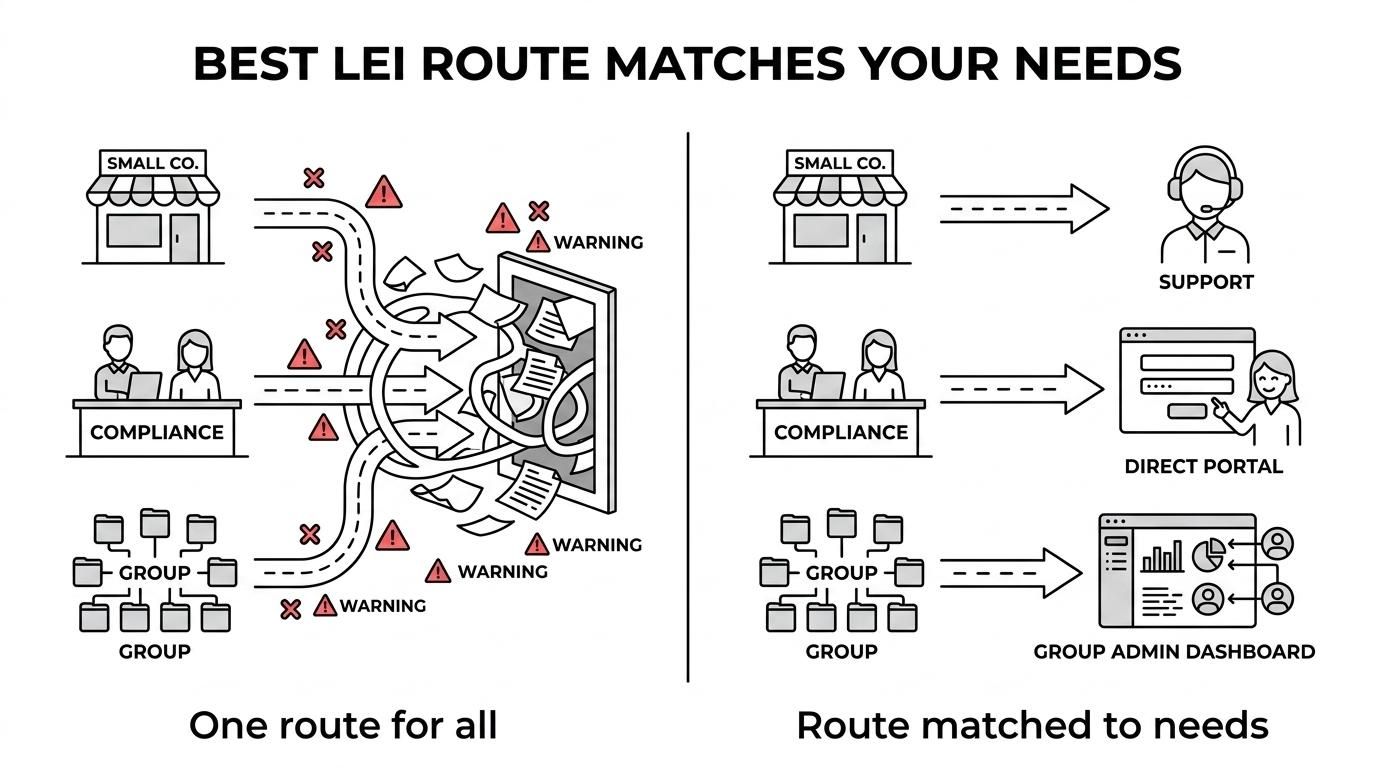
Direct issuer or LOU access can be efficient if your organisation already handles registry checks, document gathering, and renewal tracking internally. You get a direct route, but you also carry more of the process burden.
A registration agent is often the better fit when speed and support are both important. That is especially true for smaller Irish companies, charities, or investment vehicles that do not want to spend internal time learning LEI workflows or sorting out a transfer.
Broker-led routes can be convenient when the LEI is part of a larger onboarding package. The trade-off is that you may have less visibility on pricing, support scope, or whether transfers and updates are handled cleanly later on.
How do you renew an LEI in Ireland without delays?
The simplest renewal method is to start before the next renewal date, verify the public entity data, and use a provider that handles re-validation clearly. In Ireland, that often matters more than saving a few euro on the base fee.
Step 1 is timing. Check the next renewal date in the Global LEI Index and act early. GLEIF says the annual renewal process ensures the legal entity and issuer review and re-validate reference data at least once per year.
Step 2 is data review. Confirm the company name, legal address, registration number, and any structural changes. If a Companies Registration Office record or equivalent public registry entry has changed, update that logic first, then renew the LEI against the correct record.
Step 3 is provider choice. If your entity data are straightforward, a low-cost renewal path may be enough. If there is any mismatch, pick a service with real support so you can fix the issue before the status moves to lapsed or stays there longer than needed.
"LEI Service is an official registration agent of Ubisecure RapidLEI and says phone and email support are available, with responses within 24 hours."
How do you transfer an LEI to a new provider?
An LEI transfer changes the service provider, not the LEI code itself. For Irish entities, transfer is usually sensible when you want better renewal pricing, clearer support, or a more reliable process.
Step 1 is to confirm that the LEI already exists and identify its current provider. Step 2 is to authorise the new provider to handle the transfer, which is often combined with renewal. Step 3 is to re-check the entity data so the new provider can complete validation cleanly.
One misconception appears often here: a transfer does not create a second LEI. The Global LEI System is built around one LEI per legal entity. If someone suggests a fresh code for an entity that already has one, stop and verify first.
Transfers are often most useful when the current provider is slow, unclear on fees, or awkward to reach. If support quality has already cost time once, moving before the next cycle is usually the cleaner option.
What mistakes cause LEI delays, extra cost, or lapsed status?
Most LEI problems come from timing and data quality, not from the LEI system itself. GLEIF status rules are fairly clear, but delays appear when applicants wait too long or submit details that do not match the public record.
The first mistake is renewing too late. A current LEI does not require last-minute drama if the renewal date is visible in advance. The second is entering a trading name when the system needs the registered legal name. The third is ignoring address or registry changes and hoping the provider will infer the right answer.
Another common error is shopping only on the lowest headline figure. If support is weak, the actual cost can rise in staff time, missed deadlines, or repeated submissions. For funds, charities, and group entities, the risk is higher because structure and authority checks can be less straightforward than a simple private company renewal.
If you are dealing with a broker deadline, check the LEI first, then place the trade instruction. That sequence prevents a routine renewal issue from becoming an execution problem.
When is LEI Service Ireland likely to be the best fit?
LEI Service is likely to the best fit when an Irish entity wants low upfront cost, quick processing, and direct support for new applications, renewals, or transfers. It is particularly suitable where one team or one director is handling the task.
The listed offer is clear enough to match many common Irish needs: €64 for a 1-year new LEI or renewal, €162 for 3 years, and €225 for 5 years, with the GLEIF fee included. That makes budgeting simple, and the multi-year terms can make sense where entity details are unlikely to change often.
It may be less compelling only if your organisation already has a highly structured internal compliance function and prefers a direct issuer relationship for every identifier workflow. Even then, the benchmark remains useful: if another provider cannot match clear fees, renewal discipline, and reachable support, it is hard to call it the best LEI service in Ireland.