Can an Irish Company Have More Than One LEI at Once?
If you are asking whether an Irish company can hold two LEIs at the same time, the short answer is no.
An LEI, or Legal Entity Identifier, is built to be a single unique identifier for a single legal entity. That design is not a preference or an industry habit. It is the core rule of the Global LEI System. So if one Irish company already has an LEI, the right next step is not to apply for another one. It is to find the existing record, renew it, or transfer it to a different registration agent if needed.
That distinction matters more than many firms expect. It affects trading access, onboarding, reporting, and internal record-keeping. It also helps avoid duplicate applications that slow down a process which is usually quite straightforward.
What GLEIF says about one LEI per legal entity
The Global Legal Entity Identifier Foundation, known as GLEIF, describes the LEI as a unique 20-character alphanumeric code for a legal entity. The important word there is unique.
GLEIF’s framework is based on a single unique identifier assigned to each legal entity, with exclusive assignment of one LEI per entity. In plain terms, one company gets one LEI. That LEI is the company’s recognised identity within the system used across financial markets and reporting structures.
This means an Irish limited company, fund, charity, or other eligible legal entity should not expect to hold multiple active LEIs for the same legal person. Even if that entity works with different brokers, banks, investment platforms, or service providers, the identifier stays the same.
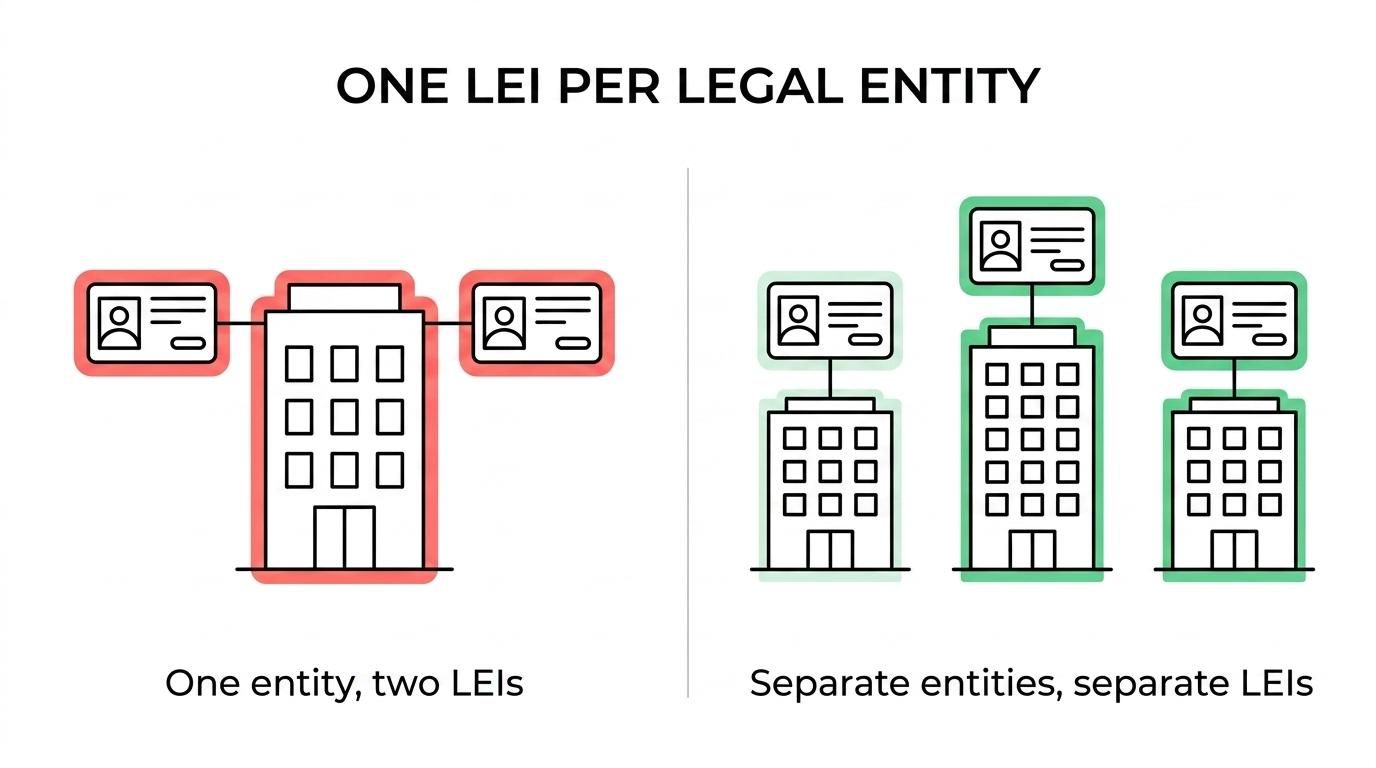
A few key ideas sit behind that rule:
- One legal entity, one LEI
- One LEI record per registration
- Unique identity across markets
- Consistent reference data
- Reduced duplication risk
The logic is strong. If the same entity could hold several LEIs, market participants would struggle to know which one was the right one to use. Reporting quality would drop. Counterparty checks would become less reliable. Data matching across systems would be far more difficult than it needs to be.
Why an Irish company cannot have more than one LEI at once
An LEI is not like opening an extra bank account or registering another trading profile. It is closer to a company’s passport within the LEI framework. You can renew it, update its data, and move its administration to another provider, but you do not create a second live identifier for the same entity.
That is why Irish LEI registration guidance generally starts with an existing-LEI search. Before a new application is processed, the entity’s details are checked against GLEIF records to see whether an LEI already exists. If it does, the matter usually shifts away from registration and into renewal or transfer.
This is where confusion often starts. A business may think it needs a second LEI because:
- the original LEI was arranged by another adviser
- the renewal was missed
- the company changed broker
- the finance team cannot find the old record
- the entity name changed after a corporate update
None of those situations creates a basis for a second LEI. The existing LEI remains the reference point.
A lapse in renewal does not open the door to a replacement code either. If an LEI becomes overdue, it may show as lapsed rather than newly active, yet it is still the entity’s LEI. The proper route is to renew that code, not to seek another.
What happens if an existing LEI is found during an application
When an existing LEI is detected, the process usually becomes simpler, not harder.
Instead of trying to issue a second identifier, the provider checks the current record and decides what action fits the case. That could be a renewal, a transfer with renewal, or a data update if the legal name or registered details have changed. Irish applicants are often relieved by this, because it means the issue is usually administrative rather than structural.
The table below shows the practical difference.
| Situation | Can a new LEI be issued? | Correct action |
|---|---|---|
| Same Irish company already has an active LEI | No | Keep using that LEI |
| Same Irish company has a lapsed LEI | No | Renew the existing LEI |
| Same Irish company wants to move to another provider | No second LEI | Transfer the LEI and renew if needed |
| Group has several separate companies | Yes, one per entity | Apply for each legal entity separately |
| Company changed name or address | No second LEI | Update the existing LEI record |
This is why a transfer is often mentioned in LEI administration. A transfer does not mean the identifier changes. It means responsibility for managing the LEI moves from one registration channel to another, while the code itself remains attached to the same legal entity.
For firms with incomplete records, that is good news. It means an existing LEI is not lost just because the original contact person has left or the old renewal reminder went to the wrong inbox.
When groups of companies can hold multiple LEIs
A single company cannot hold more than one LEI. A corporate group, though, can have many LEIs if it contains many separate legal entities.
That difference is essential.
An Irish parent company and its subsidiaries are not one entity simply because they share ownership. Each incorporated company is a separate legal person. If several of those entities need to trade financial instruments or meet reporting obligations, each may need its own LEI.
This is where people sometimes say, “Our business has more than one LEI,” when what they really mean is, “Our group has more than one LEI.”
The distinction can be set out clearly:
- Parent company: may hold one LEI if that legal entity needs it
- Subsidiary company: may hold its own LEI, separate from the parent
- Fund vehicle: may require its own LEI if it is a separate legal entity
- Charitable body: may have its own LEI if it enters relevant financial transactions
- Special purpose vehicle: may need a separate LEI where it is legally distinct
That structure is normal and expected. It does not conflict with the one-LEI-per-entity rule. In fact, it depends on that rule.
For finance teams managing several entities, this is where bulk administration can help. A service handling group applications may spot that one entity needs a fresh registration while another already has a code and needs a transfer instead. That keeps records clean and avoids duplicates.
How to check whether an Irish company already has an LEI
If there is any doubt, the first job is to verify whether an LEI already exists.
That check is often faster than people assume. The public LEI data system is designed to make reference data searchable. A provider can usually search by legal name, registration details, and jurisdiction before proceeding with an application.
The practical check tends to follow a simple order.
- Search for the entity in GLEIF data or through a registration agent.
- Match the legal name and company details to confirm it is the same entity.
- Review the LEI status, including whether it is active or lapsed.
- Decide whether the right action is registration, renewal, transfer, or data update.
The reference data linked to an LEI is also part of the value. It identifies the entity behind the code, often referred to as Level 1 data. That is one reason duplicate LEIs are not acceptable. The system is meant to point market participants to one verified record for one legal entity.
If your business is unsure, it is sensible to ask for an existing-LEI check before paying for a new registration. Irish registration agents commonly handle this as part of the intake process.
Common mistakes Irish businesses make with LEI applications
Most duplicate LEI concerns do not come from misconduct. They come from ordinary operational gaps.
A company changes advisers. A treasury function moves in-house. A renewal reminder is missed. A group structure is not documented clearly. The result is a well-meaning attempt to “get a new LEI” when the real need is to recover or transfer the old one.
These are the mistakes that appear most often:
- Assuming a lapsed LEI is no longer the company’s LEI
- Treating a broker change as a reason for a new code
- Applying under a trading name rather than the legal entity name
- Mixing up group entities with one another
- Starting a fresh application before checking public LEI records
Another point worth keeping in view is timing. If an LEI is needed for an imminent trade or compliance deadline, duplicate applications can create avoidable delay. A quick pre-check is usually the most efficient move, especially where support is available by phone or email.
What Irish companies should do instead of applying for a second LEI
Once you know that a company cannot have more than one LEI at once, the right actions become clear.
If the entity has never had an LEI, apply for a new one. If it already has one, keep using it. If the record has lapsed, renew it. If you want a different registration agent, transfer it. If the legal details have changed, update the existing record.
That approach is both practical and market-standard.
For Irish entities needing help quickly, it is useful to work with a registration agent that checks existing records first, supports transfers, and can deal with renewals and data updates without forcing the applicant into a brand-new process. Some providers also offer multi-year renewal options and ongoing support, which can reduce the chance of future lapses.
The key point remains simple. A single Irish company should have one LEI, and only one. If you think there might be another code somewhere in the system already linked to your entity, that is not a sign you need a second one. It is a sign that the existing record should be found and managed properly.