Can You Trade With a Pending LEI?
For most regulated trading activity, a pending LEI is not enough.
If the code has been applied for but is not yet issued and active, or if a renewal is still being processed and the record remains non-active, the safest answer is no: you should not assume trading can go ahead. In Ireland, the UK, and across EU market infrastructure, brokers, banks, and trading venues commonly need a valid LEI before execution or transaction reporting can proceed.
That answer matters because “pending” sounds close to “done”. In practice, there is a meaningful gap between those two states. A legal entity may have submitted documents, paid for registration, or received an email saying the case is in progress, yet still be blocked when it tries to place an order, report a trade, or complete onboarding with a financial institution.
Pending LEI status and regulated trading access
A pending LEI usually means one of several things. The application may have been submitted but no code has been issued yet. The code may have been created internally by the registration agent but not yet published as active in the global LEI data pool. Or the entity may be renewing or transferring its LEI and expecting the status to update soon.
For regulated trading, that distinction is decisive. The Financial Conduct Authority states that firms subject to UK MiFIR transaction reporting obligations will not be able to execute a trade on behalf of a client who is eligible for an LEI and does not have one. The same logic runs through ESMA material under MiFID II and MiFIR: legal-person clients need LEIs for transaction reporting.
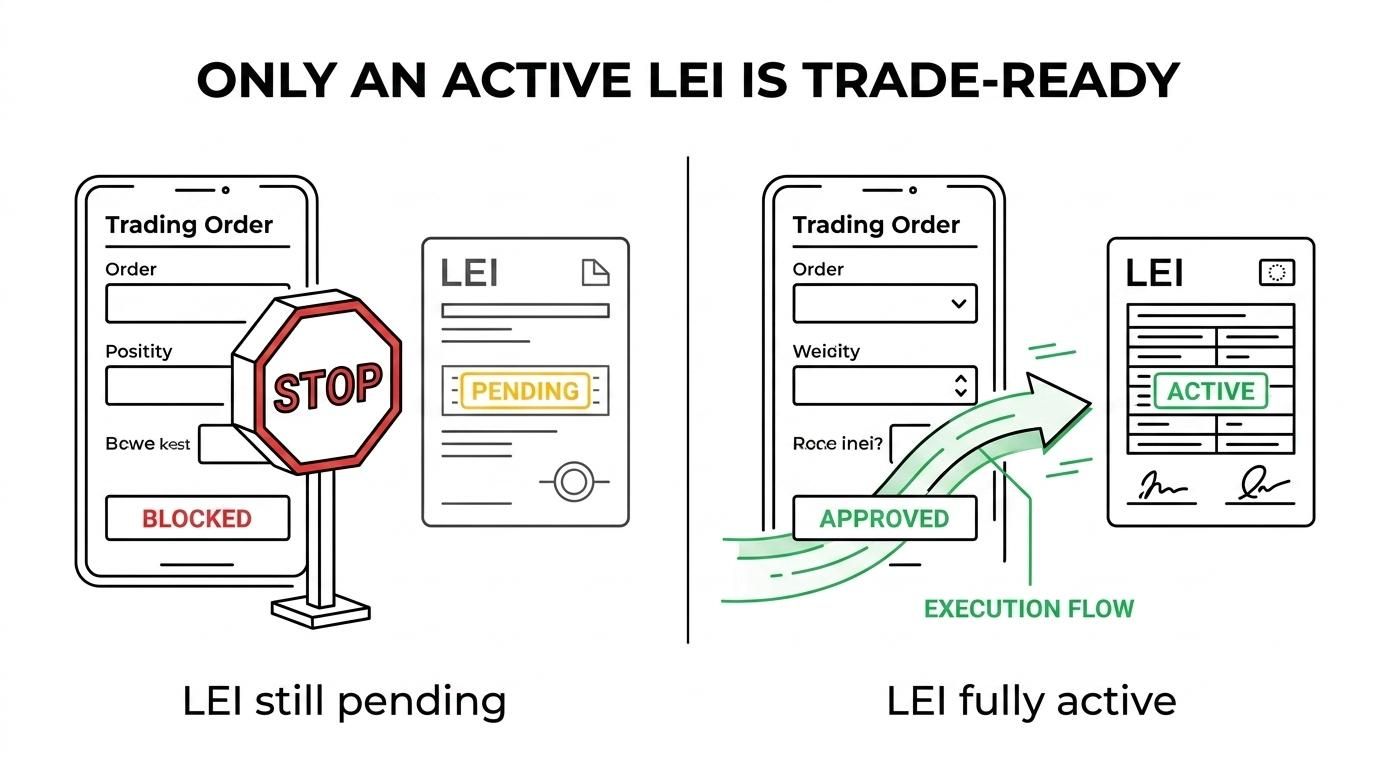
That is why a pending application should be treated as unfinished, not nearly ready.
After that, the practical signs of a non-ready LEI are usually quite simple:
- Application submitted, no code visible
- Renewal requested, status still LAPSED
- Transfer in progress, broker still sees old status
- Name or registered address mismatch under review
What LEI statuses mean in practice
GLEIF, which makes the global LEI data pool publicly searchable, gives useful context here. Its LEI search tool lets anyone check the Level 1 data tied to an entity, including the official name and registered address. It also shows status information that market participants use when deciding whether a record is acceptable for a given purpose.
One of the most misunderstood terms is LAPSED. GLEIF’s explanation is precise: a lapsed LEI is due for renewal and has not been verified within the planned interval. That does not automatically mean the entity has ceased to exist. It means the annual verification is overdue.
Still, that does not create a free pass for trading. GLEIF also says data users can decide whether a lapsed LEI is acceptable for their use case. In plain terms, a lapsed LEI remains visible, but a broker, bank, custodian, or reporting system may still reject it.
The table below gives a practical view.
| LEI status or situation | What it usually means | Likely effect on trading |
|---|---|---|
| Pending application | Registration started, but no active LEI available yet | Often not accepted for regulated execution or reporting |
| Active | LEI issued and current after annual renewal | Normal position for trading and reporting checks |
| LAPSED | LEI exists, but annual renewal is overdue and data has not been reverified in time | May trigger a hold, manual review, or refusal until renewed |
| Other non-active status | Record not suitable for ordinary live use | High chance of rejection or onboarding delay |
This is where many firms get caught out. They assume that visibility in a database is enough. It often is not. What matters is whether the market participant you are dealing with accepts the status for the trade in question.
FCA and ESMA rules on valid LEIs before execution
The official market rule backdrop is strong. The FCA says firms with UK MiFIR transaction reporting obligations must ensure eligible clients have an LEI before executing a transaction on their behalf. That wording leaves very little room for a pending status to count as good enough.
ESMA took a similar approach when MiFID II and MiFIR were introduced. EU investment firms had to identify legal-person clients with LEIs for transaction reporting. Trading venues also had issuer identification duties tied to LEIs when sending daily data to FIRDS. This shows that the LEI is not a side document. It sits inside market reporting and reference data processes.
There is one detail that sometimes causes confusion. In the early implementation phase, ESMA allowed a temporary six-month period in which firms could proceed if they first obtained the documentation needed to apply for an LEI on the client’s behalf. That was a transitional measure linked to rollout pressures. It was not a standing rule saying pending LEIs are always acceptable.
That history matters because some older commentary still hints that “proof of application” may be enough. For current practice, that is too risky an assumption.
The common pressure points look like this:
- Execution risk: the broker may refuse to place the order
- Reporting risk: the transaction report may be rejected or paused
- Onboarding risk: the bank or platform may ask for renewal before proceeding
- Timing risk: a same-day trade can be missed while status checks are still unresolved
Why a pending or lapsed LEI can still interrupt an otherwise valid trade
A company can be fully incorporated, tax compliant, and active in business, yet still face a trading stop because of LEI status. That feels counterintuitive at first, but it reflects how regulated markets operate. The LEI is part of the control framework, not just a badge of existence.
A useful comparison is to think of the LEI as a reporting passport for the entity. The company may still exist and be perfectly entitled to trade in a business sense, but if the passport is not current, the market infrastructure may not let the transaction through.
This is also why lapsed status is awkward. GLEIF does not say a lapsed LEI disappears or becomes meaningless. It says the record is overdue for verification. Yet many firms use “valid LEI” as their operational threshold. That threshold is often stricter than “the record still exists”.
Company guidance across the LEI industry reflects this reality. A lapsed or non-active LEI can delay, pause, or block trades and onboarding. Reports may fail. Internal compliance teams may intervene. The disruption is real even where the underlying entity details have barely changed.
Practical LEI scenarios for Irish legal entities
In Ireland, many LEI applications are checked against Companies Registration Office data. If the company name, registered office, or registration details do not match cleanly, the issuance process can slow down. A pending status may then last longer than expected, even when the entity submitted everything in good faith.
This is especially relevant when a company has recently changed name, moved registered office, restructured a group, or appointed a service provider to handle the application. Small mismatches can create review time that matters when a transaction is due.
Irish companies, funds, and charities also run into timing issues around annual renewal. The entity still appears in the global database, so someone assumes all is well. Then a broker or bank checks the status shortly before execution and flags it as lapsed. At that point, what looked like an administrative detail becomes a live commercial issue.
A few situations come up again and again:
- New applicant: documents are filed, but the trade date arrives before the LEI becomes active
- Missed annual renewal: the LEI remains visible, yet the status change triggers a trading pause
- Entity data change: the application is held while name or registered address details are checked
- Transfer case: the LEI is being moved to a new registration agent, but the counterparty wants confirmation of current validity
How to check if your LEI is ready for trading
The best approach is simple: verify the status before the trade window gets tight.
GLEIF’s search tool is the first place to look. It is public, free to use, and shows the core Level 1 data for the entity. If the record is not there, or if the status is not what your broker expects, you have an early warning.
Then confirm the operational side with the party executing or booking the transaction. Different firms can apply slightly different internal controls around cut-off times, renewal evidence, and acceptable status. GLEIF may say data users decide whether a LAPSED LEI is acceptable. Your broker may say no, full stop.
A quick check routine helps keep things calm:
- Search the entity in the global LEI data pool.
- Confirm the LEI is issued and not merely in progress.
- Review the status and next renewal date.
- Check that the legal name and registered address are correct.
- Ask the broker, bank, or platform whether they require the LEI to be fully active before execution.
One sentence can save a missed trade: “Can you confirm this LEI status is acceptable for execution and transaction reporting today?”
Keeping LEI status trade-ready all year
The easiest way to avoid pending-status problems is to act before they become urgent. Apply early if a transaction is planned. Renew well ahead of the anniversary date. Update entity details as soon as corporate records change. Those simple habits remove most last-minute pressure.
For firms that trade regularly, multi-year renewals or automatic renewal arrangements can reduce lapse risk. They do not remove the need for accurate underlying entity data, but they make it less likely that the annual verification date will slip by unnoticed.
Support also matters more than many expect. When an LEI is needed quickly, fast processing and clear guidance can make the difference between trading on schedule and missing the window. A registration agent with responsive phone and email support can help resolve name checks, renewal issues, and transfer questions before they affect execution.
That is the practical message for any Irish legal entity planning a regulated transaction: wait for the LEI to be active and accepted, not merely pending. A little preparation puts the trade on firmer ground and keeps compliance from becoming the thing that stops a good opportunity.