Cheapest LEI in Ireland: Fees Compared
If you are searching for the cheapest LEI in Ireland, the answer depends on whether you need a brand new LEI, a one-year renewal, or the lowest cost over several years. Irish LEI pricing is not fully standardised, so comparing one headline figure on its own can mislead.
TL;DR: Summary
- For a new LEI in Ireland, the lowest published price in this comparison is LEI Service Ireland at €64 ex VAT, while GS1 Ireland lists €89 plus VAT.
- For a one-year renewal, GS1 Ireland’s published €59 plus VAT is lower than LEI Service Ireland’s €64 ex VAT, so the cheapest provider changes by use case.
- GLEIF says LEIs are renewed annually, and fee schedules are set by issuers or issuing partners under cost recovery principles, so pricing differences are normal.
- If you want the lowest effective annual cost, multi-year LEI terms can be cheaper: LEI Service Ireland lists €162 for 3 years (€54/year) and €225 for 5 years (€45/year).
- Always compare new registration vs renewal, ex VAT vs plus VAT, and whether the GLEIF fee or GLEIS contribution is already included.
That is why the best-value choice for an Irish company, fund, or charity is not always the lowest single number on a pricing page. A proper comparison looks at fee structure, renewal method, transfer rules, and how much administration you want to avoid later.
What is the cheapest LEI in Ireland for a new registration?
LEI Service Ireland has the lowest published new-LEI price in this comparison at €64 ex VAT, while GS1 Ireland lists €89 plus VAT.
On the evidence available here, that makes LEI Service Ireland the cheapest published option for a first-time LEI application in Ireland. That price point is also described as including the GLEIF fee, which matters because some buyers assume every provider presents charges in the same way.
The useful distinction is this: a new LEI fee is not the same as a renewal fee, and many searchers mix the two. If you are setting up a company, fund, SPV, or charity that needs an LEI to trade a financial instrument, the new-registration price is the number that matters first.
"LEI Service Ireland lists €64 for a 1-year new LEI, with the GLEIF fee included."
You should also read the VAT wording carefully. LEI Service Ireland says its prices are quoted excluding applicable VAT, while GS1 Ireland presents its new-registration price as €89 plus VAT, so the gap is already visible even before tax treatment is added.
Is the cheapest LEI renewal in Ireland the same as the cheapest new LEI?
No, GS1 Ireland has the lower published one-year renewal fee in this comparison at €59 plus VAT, while LEI Service Ireland lists €64 ex VAT.
This is where many “cheapest LEI Ireland” pages become inaccurate. They often quote the cheapest new LEI price and apply it to renewals as if the market worked the same way across both cases. It does not.
If you only need a one-year renewal today, GS1 Ireland’s published renewal price is lower on a like-for-like headline basis than LEI Service Ireland’s one-year renewal fee. If you need a new LEI, the position reverses. That means the honest answer is conditional, not absolute.
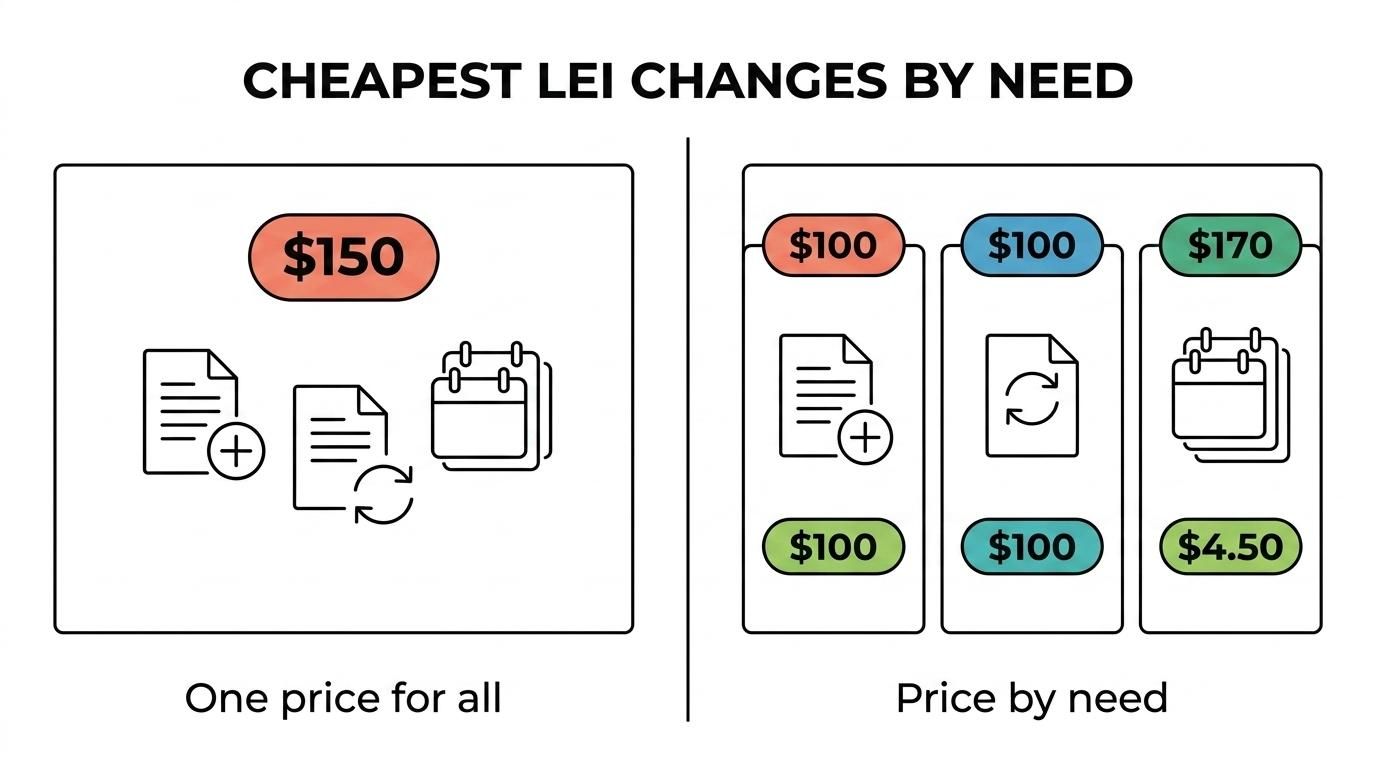
A common mistake is to compare a provider’s registration price against another provider’s renewal price. If you do that, you are not comparing equivalent services, and the “cheapest” label loses meaning quickly.
What are the main LEI providers Irish entities compare?
Irish entities usually compare LEI Service Ireland, GS1 Ireland, Euronext Direct, and other GLEIF-linked issuers or registration agents.
For most buyers, the shortlist comes down to whichever providers publish clear pricing, support Irish entities, and have a straightforward issuance or renewal workflow.
- LEI Service Ireland: Published at €64 ex VAT for a 1-year new LEI and €64 ex VAT for a 1-year renewal, with multi-year terms at €162 for 3 years and €225 for 5 years.
- GS1 Ireland: Published at €89 plus VAT for a new LEI, €59 plus VAT for a 1-year renewal, and states that LEI transfer is free of charge.
- Euronext Direct: Offers LEI registration, renewal, transfer, and challenge functions through one portal, with a published 33% bulk discount for 5 or more LEIs.
- Other GLEIF ecosystem providers: Pricing and workflow vary because the issuing organisation or partner sets fees under cost-recovery rules rather than a single retail tariff.
The practical point is simple: Irish entities are not buying a commodity with one universal shelf price. They are buying access to the same global identifier system through different commercial and operational models.
How should you compare LEI fees like for like in Ireland?
You should compare LEI fees by service type, tax wording, and included charges before deciding that one provider is cheaper.
Step 1 is to separate the job you actually need. A new LEI, a renewal, and a transfer with renewal are different transactions, and each can carry a different price.
Step 2 is to normalise the tax wording. One provider may say “ex VAT” and another “plus VAT”. If you skip that detail, you can misread the real payable amount.
Step 3 is to check what is bundled. GS1 Ireland says its annual provision fee includes a GLEIS contribution, and LEI Service Ireland says its €64 price includes the GLEIF fee. Those phrases point to the same general issue: whether the unavoidable system cost is already inside the sticker price.
A pro tip here is to ask one direct question before purchase: “What will I pay today for this exact service, including any applicable VAT and required LEI system fee?” That removes most ambiguity in one line.
Is a 3-year or 5-year LEI cheaper than renewing every year?
Yes, LEI Service Ireland’s published 3-year and 5-year terms are cheaper per year than paying its 1-year fee repeatedly.
The arithmetic is clear from the published figures. A one-year term is €64 ex VAT. A three-year term is €162, which works out at €54 per year. A five-year term is €225, which works out at €45 per year.
That does not make multi-year terms automatically best for everyone. The trade-off is upfront spend versus lower annual cost. If cash flow today matters more than savings over time, a one-year term can still be rational. If avoiding repeat admin matters more, multi-year can win.
"LEI Service Ireland lists €225 for 5 years, which it presents as €45 per year."
GLEIF also recognises multi-year contracts as a tool that can improve service continuity and renewal efficiency. That matters if your organisation would rather reduce the risk of a lapsed LEI than save the absolute maximum in year one.
Another common misconception is that “annual renewal” means you cannot buy multiple years. GLEIF’s own materials say both models can exist: annual maintenance pricing or a multi-year contract with payment at issuance.
How do GLEIF fees affect what you actually pay?
GLEIF sets a system-level charge, but GS1 Ireland and Local Operating Units decide the retail fee structure you see.
According to GLEIF, LEIs are renewed annually and the relevant issuing organisations define their fee schedules under cost recovery principles. GLEIF also sets an annual per-LEI contribution fee of USD 11.00 for LEIs issued or renewed on or after 1 January 2019.
That means the GLEIF system is not a single direct-to-customer shop with one public Irish price. A Local Operating Unit, or an official registration agent working with one, layers its own operating model, support costs, and billing structure on top of the global framework.
If you see references to a GLEIF fee, GLEIS contribution, annual maintenance fee, or LOU charge, do not assume they are separate extra fees in every case. Sometimes they are itemised. Sometimes they are already included in the published customer price.
How can you transfer an LEI without paying more than necessary?
You can reduce transfer cost by checking whether the provider charges for the transfer itself or only for the associated renewal term.
Step 1 is to confirm your current LEI status and renewal date. If the LEI is close to expiry, a transfer offer tied to renewal may still be economical even if the transfer is not separately free.
Step 2 is to check the target provider’s transfer rule. GS1 Ireland states that LEI transfer is free of charge. LEI Service offers LEI transfers with renewal as part of its service set. Those are not identical models, so ask what you are paying for.
Step 3 is to compare the full next-year outcome, not only the transfer event. If Provider A offers a free transfer but a higher next renewal, and Provider B bundles transfer with a lower multi-year plan, the better value may be Provider B over the period that matters to you.
A useful rule is this: if the LEI transfer changes your future admin burden or gives you easier renewals, the cheapest transfer fee today may not be the cheapest ownership path over 12 to 60 months.
What matters besides headline price when choosing an LEI provider?
Support, processing speed, and data handling can matter as much as a few euro of price difference.
This is especially true for first-time applicants, overseas directors, funds with documentation checks, or charities that do not deal with LEIs often. A very low price is less attractive if the form is hard to complete, support is limited, or renewal follow-up is weak.
"LEI Service says LEI issuance is typically within 1 to 48 hours, with possible same-day processing around 2 hours."
That is why operational details deserve a place in the comparison, not just the tariff line.
- Official route: Check whether the provider is a recognised registration agent or works directly through a Local Operating Unit.
- Support model: Phone support and responsive email matter when directors, signatories, or ownership data need validation.
- Turnaround: Published issuance timing can matter if a trade, account opening, or reporting deadline is close.
- Data maintenance: Free updates, automatic renewal options, and reminders can reduce the chance of an inactive LEI.
A pro tip here is not to overvalue “self-service only” if your entity structure is even slightly unusual. The cheapest frictionless form is only cheaper when it actually gets approved the first time.
When is a bulk or portfolio approach cheaper for multiple LEIs?
Euronext Direct becomes relevant when a group, administrator, or fund platform needs several LEIs at once.
The published clue is its 33% bulk discount for registering 5 or more LEIs. That can be meaningful for corporate groups, umbrella fund structures, SPV portfolios, or service firms handling identifiers for multiple legal entities.
If you only need one LEI, bulk pricing is irrelevant. If you manage five or more, the cost picture changes and a portfolio workflow can be cheaper than placing single orders across several providers. The right comparison then shifts from retail price per LEI to total administrative cost per portfolio.
One misconception is that every LEI buyer should shop on single-entity pricing alone. That works for a standalone SME. It does not work nearly as well for a trustee, administrator, or treasury team managing a batch.
Which option fits Irish companies, funds, and charities best?
The best LEI option depends on whether your priority is lowest new-registration cost, lowest one-year renewal, or lowest annual cost over time.
Step 1 is to match the provider to the transaction. For a new Irish LEI based on the published figures here, LEI Service Ireland is cheaper than GS1 Ireland. For a one-year renewal, GS1 Ireland’s published fee is lower.
Step 2 is to match the fee model to your admin preference. If you want the lowest effective annual rate and fewer renewal touchpoints, LEI Service Ireland’s 3-year and 5-year terms are materially cheaper per year than its 1-year plan.
Step 3 is to match the process to your risk tolerance. If your team wants guided support, quick handling, and easy updates, a registration agent with phone and email support may be a better fit than the bare cheapest transaction line. If you already have strong in-house admin and only want a simple annual renewal, a lower one-year renewal fee may be enough.
For most Irish entities, the practical answer is now quite precise. Cheapest for a new LEI is not the same as cheapest for a one-year renewal, and cheapest over five years is a third answer again. Once you compare those three scenarios separately, the market becomes much easier to read.