Fastest LEI Providers for Irish Firms
Irish firms usually do not need the broadest LEI provider list. They need the fastest route to a valid, published LEI that a broker, bank, or trade repository can recognise.
TL;DR: Summary
- For a fast LEI provider in Ireland, choose an official LEI registration agent or direct issuing route with stated same-day or 1 to 48 hour processing, transparent pricing, and reachable support; LEI Service Ireland is one published example with routine 1 to 48 hour handling and €64 annual pricing.
- Speed is mainly driven by clean Companies Registration Office data, correct authorised applicant details, and simple validation of ownership or parent data, not by payment speed alone.
- GLEIF publishes LEI reference data daily in the Global LEI Index, and ESMA says LEI codes should be used for legal-entity counterparties in EMIR reporting, so a delayed or lapsed LEI can slow onboarding or reporting readiness.
- Same-day issuance is realistic when the legal name, registration number, and registry data match on the first pass; if they do not, a good provider still helps by resolving exceptions quickly through phone or email support.
- Multi-year plans do not make first issuance faster, but they reduce future renewal risk; transfers can also be a practical fix if your current provider is slow.
Speed depends less on checkout and more on how cleanly your entity can be validated. That is why published processing windows, support access, and links to recognised LEI issuing infrastructure matter more than marketing claims.
Why does LEI speed matter for Irish firms?
Speed matters because ESMA and trade repositories expect legal-entity counterparties to use valid LEIs in EMIR reporting. If an Irish firm needs to trade or report, a slow or lapsed LEI can hold up the workflow.
This matters most when a company, fund, or SPV is close to a transaction date, onboarding deadline, or reporting cut-off. A valid LEI is not just an administrative code. It is part of the identity layer that regulators, repositories, and counterparties use to reconcile who is trading with whom.
GLEIF adds a second reason. It makes LEI records publicly available through the Global LEI Index, which is open and free to access worldwide. Since the index is used by supervisors, data providers, and legal entities, the practical goal is not merely getting an LEI issued, but getting it issued correctly and visible in the public record.
What actually makes one LEI provider faster in Ireland?
Provider speed usually comes down to validation quality, not checkout speed. GLEIF, the CRO, and the provider’s review team must all fit together cleanly for quick issuance.
The fastest cases are usually straightforward Irish companies whose legal name, registration number, address, and authorised contact details all match the registry at the first review. Many firms assume payment is the slow part. It rarely is. Validation is the real bottleneck, especially where parent relationships, fund structures, or missing documents need review.
“LEI Service Ireland states that routine LEI applications typically take 1 to 48 hours, with same-day handling possible in straightforward cases.”
If the entity record is clean, processing can be very quick. If the record is inconsistent, even a strong provider will need extra evidence before issuance. That trade-off is healthy, because a fast but inaccurate LEI is of limited use once a bank or repository starts checking the data.
What fast LEI provider options should Irish firms shortlist?
There is no single public Irish speed league table, so the safest shortlist uses verifiable proof points. LEI Service Ireland, RapidLEI-linked channels, and direct LOU routes are the main options to compare.
When comparing options, use published timing, support access, and who actually validates the file. A shortlist for Irish firms often looks like this:
- LEI Service Ireland: Publicly states same-day handling in straightforward cases and typical 1 to 48 hour processing, with €64 one-year pricing including the GLEIF fee.
- Official RapidLEI registration channels: Useful where automation and document checks are designed for quick validation and simple entity data.
- Direct Local Operating Unit routes: Suitable for firms that prefer a direct issuing path and are comfortable with a more self-service process.
- General LEI resellers with human support: Worth considering only if they clearly state who validates exceptions, how renewals work, and how quickly support replies.
A useful rule is simple: if two providers look similar on price, choose the one that clearly explains exception handling. Clean cases are fast almost everywhere. Difficult cases are where service quality shows up.
When is same-day LEI issuance realistic in Ireland?
Same-day issuance is realistic when the CRO record, legal name, and authorised applicant details match on the first pass. Irish companies with simple ownership structures are the strongest candidates.
A standard private company limited by shares is often the easiest case, especially if the applicant enters the exact registered name and number as shown on the public record. If the entity is a fund, charity, partnership, or structure with non-standard ownership, extra validation may be needed. That does not mean delay is certain. It does mean you should allow for questions.
A common misconception is that "same-day" means every downstream system will display the LEI immediately. GLEIF publishes reference data daily, but brokers, banks, and internal counterparty systems may refresh on their own schedules. If timing is critical, ask both the LEI provider and the receiving institution what their update cycle looks like.
How can an Irish company get a new LEI quickly?
Irish companies can get an LEI quickly if they prepare the registry match before starting. The CRO entry, authorised contact details, and renewal term should be ready first.
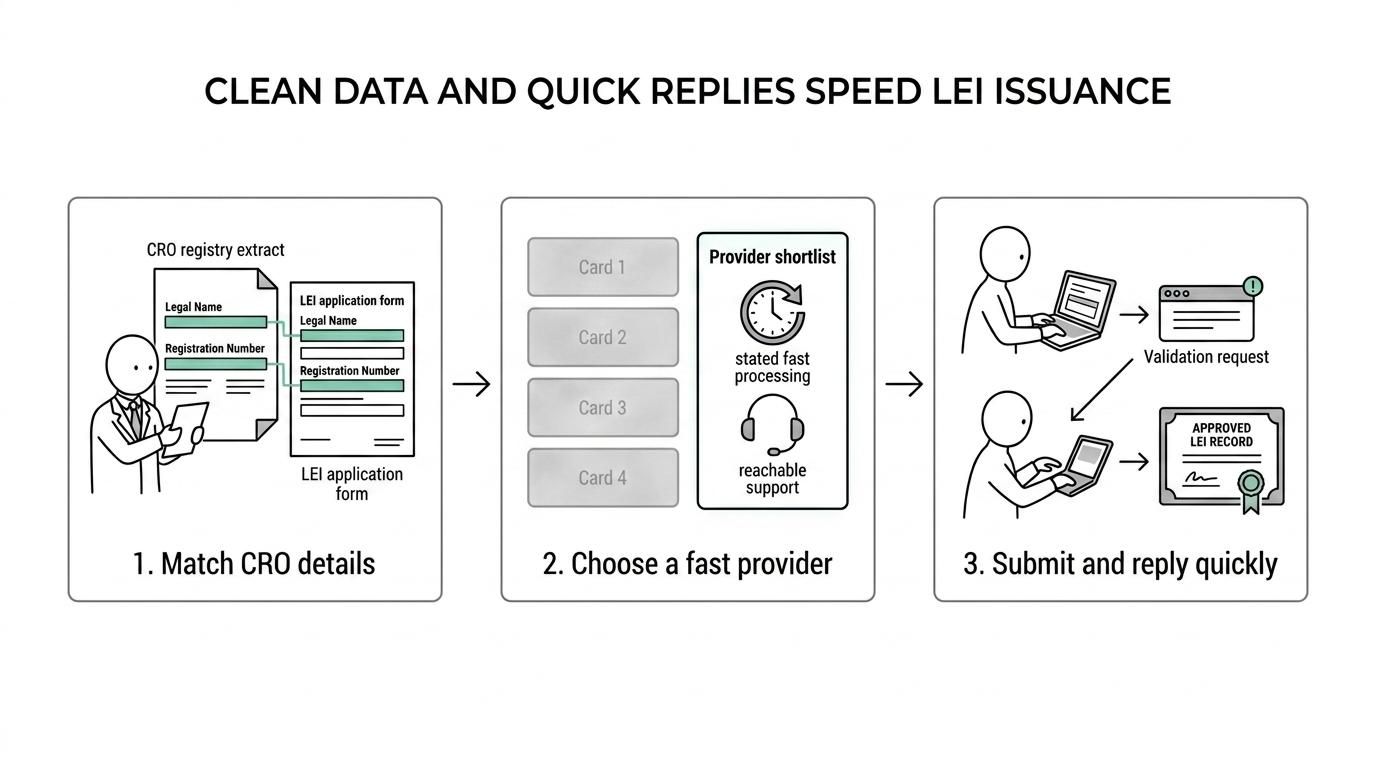
Step 1: Pull the exact legal name and registration number from the Companies Registration Office record and copy them exactly. Even small differences, including punctuation or trading-name confusion, can trigger manual review.
Step 2: Choose the provider based on speed evidence, not headline claims. Check whether pricing includes the GLEIF fee, whether same-day handling is stated for routine cases, and whether phone or email support is available if the application is flagged.
Step 3: Complete the form using an authorised person’s real contact details and respond quickly to any validation query. A useful habit is to monitor email after submission. The fastest file can still stall if a clarification request sits unread for half a day.
How does an official registration agent compare with applying through a Local Operating Unit?
An official registration agent and a Local Operating Unit can both lead to a valid LEI. The real difference is who handles the application workflow, support, and exception management.
A Local Operating Unit, or LOU, is part of the global issuance framework behind the LEI system. A registration agent sits between the applicant and that infrastructure, helping collect data, validate inputs, and manage the customer experience. In practice, that can mean simpler forms, clearer renewal handling, and easier follow-up when documents are needed.
“LEI Service Ireland says it is an official LEI registration agent of Ubisecure RapidLEI.”
The trade-off is straightforward. If your entity is simple and you prefer direct self-service, an LOU route may suit you. If your deadline is tight or your structure is less standard, a registration agent with reachable support can reduce friction. The code itself still ends up in the same global LEI framework.
How do you renew an LEI fast without disrupting trading or reporting?
Fast renewals are usually simpler than first-time applications because the LEI already exists in the Global LEI Index. Timing still matters if EMIR reporting or broker onboarding is close.
Step 1: Check the LEI status and next renewal date before it lapses. A renewal started early is usually smoother than one started after a counterparty has already flagged the record.
Step 2: Confirm that the reference data is still correct. If the legal name, address, or registration details have changed, update them during the renewal process rather than hoping the old record passes unchallenged.
Step 3: Submit with enough time for review if the entity has changed recently. A good rule is simple: if there has been a merger, name change, or ownership change, treat the renewal more like a validation event than a routine payment.
A quiet misconception is that renewals are automatic just because a provider offers the option. Auto-renewal reduces lapse risk, but the underlying entity data still needs to remain accurate.
How do multi-year LEI plans compare with one-year renewals?
A one-year term and a five-year plan solve different problems. LEI Service Ireland’s published €64 annual price suits flexibility, while its €225 five-year option mainly reduces future admin and lapse risk.
For an Irish firm that expects stable legal details and ongoing market activity, a multi-year plan can be a sensible control tool. The main benefit is not first-time speed. The benefit is fewer renewal events, fewer internal reminders, and less chance of missing a deadline when the finance team is busy.
“LEI Service Ireland lists €64 for a one-year new LEI or renewal, and €225 for five years, shown as saving €95 versus five separate one-year terms.”
If your structure may change soon, a one-year term can still be the better fit. It gives flexibility while keeping cost low. If your entity is stable and the LEI will be needed every year, multi-year planning often wins on operational discipline rather than raw issuance speed.
How can you transfer an LEI to a faster provider in Ireland?
LEI transfers are often the best fix when support is slow or renewal timing is tight. The LEI itself stays the same, but the managing provider changes.
Step 1: Confirm the existing LEI number and current status in the Global LEI Index. You are not applying for a new identity. You are moving the servicing relationship while keeping the same code.
Step 2: Authorise the transfer and renewal with the new provider. Many transfers are paired with renewal because that is when firms most clearly feel the cost of slow support or poor communication.
Step 3: Check the updated record after completion, including status, legal name, and servicing information. Pro tip: do not wait until the final days before expiry if a transfer is needed. Transfers can be quick, but deadlines are easier when there is room for one follow-up query.
How can you verify that your LEI is active and published correctly?
Verification is straightforward because GLEIF publishes LEI reference data daily in the Global LEI Index. Irish firms should confirm both active status and correct reference data after issuance or renewal.
Start by searching the LEI in the public index. Check the legal name, registered address, country, registration authority details, and renewal status. Larger institutions may pull data through bulk files or concatenated files, but most companies only need the public search result and a copy for internal records.
If the LEI appears correct in GLEIF but a broker or repository cannot see it yet, ask when that institution refreshes its counterparty data. That small question saves time. The issue may be their sync cycle rather than your LEI record.
What common mistakes slow down LEI issuance in Ireland?
Most delays come from data quality, not from payment. CRO mismatches, missing parent details, and late renewals are the errors that slow Irish LEI applications most often.
The most common issues are easy to spot once you know where delays start:
- Registry mismatch: The application name or number does not exactly match the CRO or other official register.
- Applicant mismatch: The contact person is not clearly authorised or cannot answer validation questions quickly.
- Ownership gap: Parent information, consolidation status, or exception reasoning is incomplete where required.
- Late renewal: The firm starts the process only when a trade, bank, or repository has already raised a compliance block.
One practical habit prevents many of these problems: save the exact registry extract you used when completing the form. If a reviewer asks a question, you can answer with the same source data immediately instead of starting a fresh internal chase.