How to Check LEI Status and Expiry Date
Checking an LEI record is one of the simplest ways to avoid delays in trading, reporting, and onboarding. A Legal Entity Identifier is public data, so you do not need special access to confirm whether a code is current or when it is due for renewal.
That matters more than many firms expect. An LEI can still exist in the global index while its renewal is overdue, and that difference can affect whether a bank, broker, counterparty, or regulator accepts it without question.
Where to check LEI status and expiry date
The main reference point is the GLEIF Global LEI Index. GLEIF makes the full LEI data pool publicly searchable, free of charge, and available without registration. If you want the most direct answer to whether an LEI is current, this is the record to review.
There are also provider search tools that present the same core information in a more guided format. In Ireland, LEI Service states that its search tool shows whether an LEI is active and when it expires, which can be useful when you need a quick check before deciding on a renewal or transfer.
A practical approach is to use one of these routes:
- GLEIF LEI Search
- provider search page
- internal compliance records
- onboarding documentation
The public record should always be the reference point when there is any mismatch between internal records and what a counterparty sees.
Which LEI search fields confirm status and expiry
When you check an LEI, do not stop at the code itself. The useful part is the set of status fields attached to the record. GLEIF’s search pages show key items including Entity Status, Registration Status, and the Expiration Date or Next Renewal field.
Those fields answer different questions. One tells you whether the legal entity itself is active in the reference data. Another tells you whether the LEI registration is current. The renewal date tells you when the next verification cycle is due.
| LEI field | What it tells you | Why it matters |
|---|---|---|
| Entity Status | The standing of the legal entity in source records | Helps confirm whether the entity itself is active |
| Registration Status | The current state of the LEI registration, including whether it is issued or lapsed | Often the first field reviewed by trading and compliance teams |
| Expiration Date / Next Renewal | The date by which the LEI should be renewed and revalidated | Signals when action is needed to keep the record current |
A quick glance at all three fields gives a far better picture than checking the LEI number alone.
LEI registration status meanings: issued, lapsed and entity status
The term that causes the most confusion is Lapsed. In GLEIF terms, a lapsed Level 1 record means the LEI is due for renewal and has not been verified within the planned interval. It does not mean the entity has ceased to exist, and it does not mean the LEI disappears from the index.
That distinction is important in practice. A firm may remain fully identifiable in the global database, yet still face friction because the LEI has not been renewed on time.
When you read an LEI record, keep these meanings in mind:
- Issued: the LEI registration is current and validly maintained in the Global LEI Index.
- Lapsed: the LEI has missed its renewal cycle and needs revalidation.
- Entity Status: this refers to the legal entity record, which is separate from the registration status of the LEI itself.
For certain FCA filing scenarios, an eligible issuer or filer must have an LEI with issued registration status on the GLEIF Global LEI Index. That makes status checking more than a housekeeping task. In some cases, it is a filing condition.
Step-by-step method to check LEI status expiry date
If you need a reliable process, keep it simple and repeatable. A good check takes less than two minutes once you know where to look.
- Search by LEI, company name, or registration number.
- Open the exact entity record.
- Review the Registration Status field.
- Check the Expiration Date or Next Renewal date.
- Confirm the Entity Status matches the current legal entity.
- Save or share the record if internal teams need proof.
If the record shows Issued, the LEI is current. If it shows Lapsed, renewal is due. If the next renewal date is close, it is wise to act before internal deadlines, trade dates, or filing cut-offs make the timing tighter.
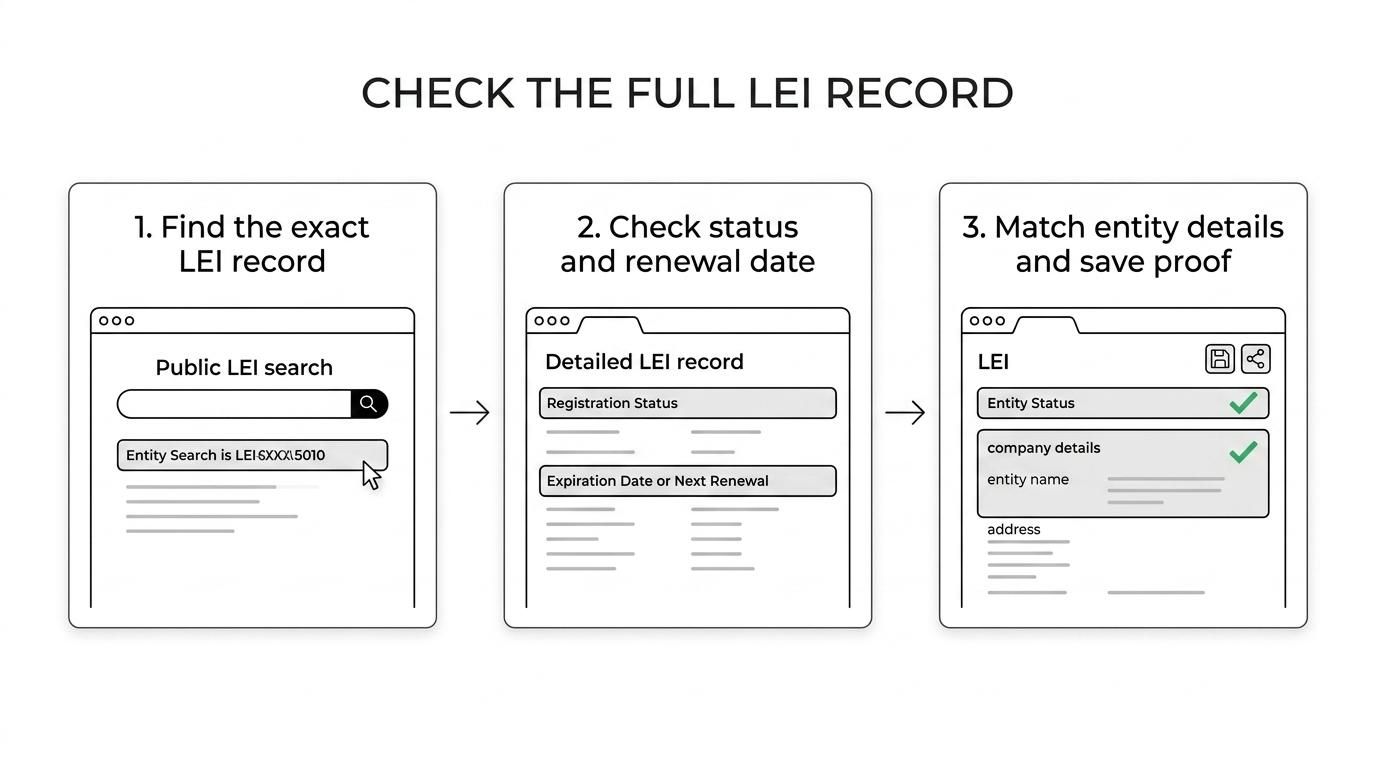
A small internal habit helps here: add the next renewal date to your compliance calendar the same day you check it.
Common LEI status mistakes when checking expiry dates
Many problems do not come from complicated rules. They come from reading the wrong field or assuming one status answers every question.
A frequent mistake is treating a visible LEI as an active LEI. The record may still appear in search results, but the registration status can still be lapsed. Another mistake is focusing only on the entity name and ignoring the renewal date. That can leave a firm exposed right before a trade or reporting event.
There is also confusion between the terms active, issued, and not expired. In everyday speech they sound similar. In LEI records, they are not always interchangeable. A provider search may describe an LEI as active for ease of use, while the formal GLEIF record still needs its Registration Status and Next Renewal field checked carefully.
Watch for these warning signs when reviewing a record:
- Old renewal date: the date has already passed or is only days away.
- Lapsed registration: the LEI remains listed, but revalidation has not been completed in time.
- Entity mismatch: the legal name, company number, or registered details do not match your latest records.
- Last-minute checking: status is reviewed only when a trade, filing, or bank request is already in progress.
The strongest control is early checking. A one-minute review a week before a transaction is far easier than trying to sort it out on the day.
What a lapsed LEI can mean for trading and compliance
A lapsed LEI does not wipe out the entity’s identity in the index, but it can still create real friction. Irish LEI Service notes that a lapsed status can delay trades, trigger compliance questions, and lead to rejected instructions. That pattern is familiar across many financial workflows.
Banks, brokers, fund administrators, and counterparties tend to treat current LEI status as a basic data requirement. If the renewal date has passed, they may pause processing while they ask for a refreshed record. Even when the matter is resolved quickly, the interruption can be costly in terms of time and internal effort.
In regulated contexts, the standard can be firmer still. Where rules require an LEI with issued registration status, a lapsed record is not just untidy. It may be unusable until renewed.
One overdue renewal can affect multiple teams at once.
Renewing an LEI before the expiry date
The cleanest fix is to renew before the Next Renewal date arrives. That keeps the public record current and reduces the chance of avoidable queries from market participants.
Renewal is also the point at which LEI reference data is revalidated. If there have been changes to the legal name, address, registry details, or corporate status, this is when they should be checked and updated so the global record stays accurate.
There are a few practical ways firms usually stay ahead of expiry:
- diary reminders
- shared compliance calendar
- multi-year renewal plans
- automatic renewal service
For organisations that want a managed option, LEI Service offers new registrations, renewals, and transfer with renewal, alongside 1, 3, and 5 year plans. The service is positioned as low-cost in Ireland, includes the GLEIF fee, and supports applications, renewals, and transfers with phone and email help. It also states that issuance is typically completed within 1 to 48 hours, with possible same-day processing in some cases, and that updates to keep GLEIF data current are handled without extra charge.
That kind of structure can suit firms that do not want LEI renewal dates sitting in someone’s inbox until they become urgent.
When to check LEI expiry dates during the year
An annual renewal cycle does not mean you should only check once a year. The strongest routine is to check at key moments when the LEI is likely to be reviewed by someone else.
Typical trigger points include opening a new financial account, setting up a trading relationship, filing regulated information, completing a fund or treasury transaction, or preparing year-end compliance reviews. A quick check at each of those points keeps records current and reduces surprises.
It also helps to check after corporate changes. If the entity has changed name, legal form, registered office, or group structure, the LEI record should be reviewed even if the renewal date is months away.
A short status check can save a long email thread later.