How to Choose an LEI Issuer/Agent: Fees, Support, Speed and Reliability Checklist
Choosing an LEI provider sounds simple until you see how many websites offer the same code with very different prices, timelines, and service levels. For Irish companies, funds, charities, and other legal entities, that choice matters more than it first appears. A low headline fee can come with unclear renewal terms. A fast promise may only apply to straightforward cases. A polished website may still leave one vital question unanswered: who is actually issuing the LEI?
A stronger approach is to compare providers in the same way you would compare any compliance service, by checking accreditation, support, speed, security, and renewal handling side by side. When those pieces are clear, the right choice usually becomes obvious.
Why choosing the right LEI provider matters
An LEI is not just a one-off purchase. It is part of an ongoing compliance record linked to your entity data, renewal status, and in some cases your ability to trade or report financial transactions. That means the provider relationship can continue long after the original application is submitted.
In practice, most issues arise after the first order. A business changes address, legal name, or ownership details. A renewal deadline approaches during a busy reporting period. A transfer is needed because the current provider is too expensive or too slow to answer. The best provider is usually the one that handles those ordinary moments well, not just the first checkout page.
LEI provider accreditation and agent status
The first check is the most important one: is the provider a GLEIF-accredited issuer, often called a Local Operating Unit or LOU, or is it a registration agent working with an accredited issuer?
Both models can work well. An accredited issuer can issue and manage LEIs directly. A registration agent can make the process simpler, often with local language support, clearer pricing, or a more guided application flow. What matters is transparency.
If a provider is acting as an agent, it should clearly state which accredited issuer stands behind the service.
After you have read the provider’s homepage, it helps to confirm a few basics yourself:
- Check GLEIF status: verify whether the provider is an accredited issuer or an agent for one
- Check issuer disclosure: the underlying LOU should be named plainly, not hidden in small print
- Public company details
- Clear renewal and transfer process
That small bit of due diligence does a great deal of work. It separates serious providers from websites that focus only on marketing language.
LEI fees and renewal terms worth comparing
Price matters, and there can be a wide spread across the market. Still, the cheapest first-year fee is not always the lowest total cost. Renewal pricing, VAT treatment, transfer rules, multi-year discounts, and auto-renew options can shift the picture quickly.
Publicly advertised pricing in Ireland often shows this difference clearly. Some providers publish a low first-year fee with matching renewal rates, while others have a higher initial cost but lower annual renewal. Some include the GLEIF fee in the advertised price, while others highlight VAT separately. The practical point is simple: compare like with like.
| Provider example | Role | Public 1-year new fee | Public 1-year renewal fee | Pricing note |
|---|---|---|---|---|
| LEI Service Ireland | Registration agent for RapidLEI | €64 | €64 | GLEIF fee included, VAT may apply |
| GS1 Ireland | Registration agent | €89 + VAT | €59 + VAT | Separate VAT shown |
| RapidLEI | Accredited issuer | From about €70 | Country-based pricing | Multi-year discounts available |
| LEI Ireland | Registration agent | €79 | €65 | Multi-year options available |
A comparison table like this is useful, though numbers should never be the only filter. A provider charging slightly more may offer better support hours, simpler transfers, or clearer renewal reminders. That can save time and reduce risk later.
Before committing, read the pricing page and the terms together. If the two tell different stories, ask questions.
LEI support quality and day-to-day service
Support is often underestimated until something needs to be corrected quickly. Many entities apply for an LEI only when a trade, filing, or onboarding process is already moving. In that setting, slow replies can create real pressure.
Good LEI support is usually defined by accessibility rather than volume of features. Can you speak to someone by phone if the application is urgent? Is there email support with a stated response time? Can you track status online? Are renewals easy to manage without starting from scratch?
These support features tend to matter most:
- Phone access: especially useful when a deadline is close
- Email response promise: a stated timeframe is better than a generic contact form
- Order tracking
- Account login
- Renewal reminders
For entities managing more than one LEI, stronger account tools become more attractive. Treasury teams, administrators, and advisers may prefer bulk handling, status visibility, and one place to manage renewals. A smaller organisation with a single LEI may care more about direct human support and a short application path.
LEI issuance speed and what “fast” really means
Most reputable providers present LEI issuance as quick, and often it is. Straightforward applications can be processed on the same day or within one to two working days. That is common across the market when company data matches official records cleanly and the applicant has authority to act.
Still, speed claims should be read carefully. “Issued in 2 hours”, “same day”, and “within 24 hours” are usually best-case scenarios, not a universal promise for every legal entity. Complex ownership structures, fund setups, cross-border registrations, and missing registry data can all extend the timeline.
That does not make the speed claim misleading. It just means the context matters.
A sensible way to assess speed is to ask two questions: what is the typical turnaround for a standard Irish company, and what happens if the case is not standard? Providers that answer both clearly tend to be more dependable partners.
LEI reliability, security and data quality checks
Reliability is harder to judge from marketing alone, because most providers do not publish detailed uptime dashboards or audited performance statistics. Even so, there are a few solid indicators available.
The first is the GLEIF framework itself. Accredited issuers operate within common data standards and validation rules. That brings a level of consistency to the LEI system across jurisdictions. The second is provider transparency around security, privacy, and operating practices. A provider that publishes meaningful detail on these topics inspires more confidence than one offering only broad assurances.
When reviewing reliability, pay attention to:
- Security information: encryption, hosting controls, and recognised certifications are positive signs
- Privacy policy currency: check whether it appears current and suited to present compliance expectations
- Data update process: changes to legal name, address, or registry data should be easy to request
- Transfer handling: moving from one provider to another should be clear and orderly
You do not need a full technical audit to make a smart choice. You just need enough evidence that the provider treats LEI data as a compliance service, not a disposable online sale.
LEI renewal handling and long-term value
An LEI must be renewed annually to remain in good standing. This is one of the most practical reasons to compare providers beyond the first fee. If the provider makes renewals awkward, expensive, or easy to forget, the low initial cost loses much of its appeal.
Multi-year plans can suit entities that value predictability. They reduce annual admin and can lower the average yearly cost. Automatic renewal can help as well, provided the terms are clear and the reminders are sensible. For some organisations, the right provider is the one that keeps the LEI current with minimal effort.
There is also the question of transfers. If you already have an LEI, you are not locked in forever. A transfer with renewal can be a sensible move when you want better support, lower costs, or a simpler account structure. That makes transfer policy another useful comparison point when choosing a provider today.
A practical LEI provider checklist for Irish entities
Once you narrow the market to two or three options, a short checklist is enough to make a confident choice. This is usually faster than reading every page on every provider website.
- Accreditation chain: is the provider an accredited issuer or a clearly disclosed registration agent?
- Published price: does the fee include the GLEIF charge, and is VAT explained?
- Renewal terms: is the annual cost easy to find?
- Support access: phone, email, or both
- Speed wording: typical turnaround, not just the fastest claim
- Privacy and security: current policies and visible operating standards
- Transfer option: easy to move later if your needs change
That list works well for new registrations, renewals, and provider changes.
Common warning signs when choosing an LEI provider
Some websites make the decision easy by showing what to avoid. If a provider does not clearly explain who issues the LEI, how much renewal costs, or how to get help, caution is sensible.
A few red flags appear again and again:
- Vague statements about “official” status without naming the accredited issuer
- No visible renewal pricing
- No phone number or support timeframe
- Terms that are hard to find
- Timing claims without any explanation of complex cases
None of these automatically means a provider is unsuitable. Together, though, they usually point to a weaker service model.
How to compare two LEI providers quickly
If you need to decide today, compare only five items side by side: issuer or agent status, 1-year cost, renewal cost, support channels, and realistic turnaround. That is enough to remove most of the noise.
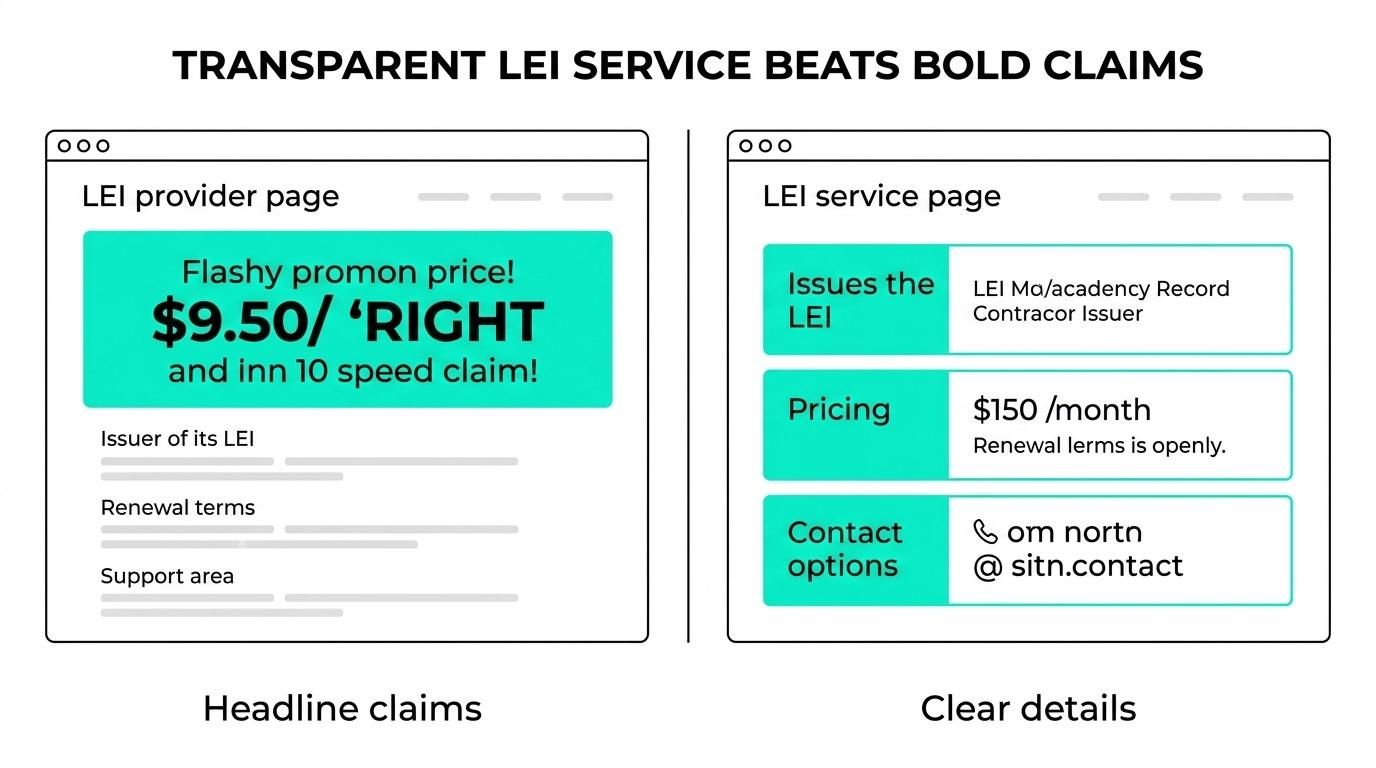
For many Irish entities, the strongest option will be one that combines transparent pricing, clear disclosure of the accredited issuer behind the service, and reachable support in English. A direct accredited issuer may suit firms that want a very close link to the issuing body. A registration agent may suit firms that prefer a simpler process and more guided support. Both can be strong choices when the provider is open about how the service works.
The best decision is rarely the one with the boldest promise. It is the provider that makes the LEI process clear, keeps costs visible, and remains easy to deal with when the next renewal comes around.