LEI After a Merger or Name Change
An LEI is tied to a legal entity, not simply to a brand name or trading label. That distinction matters most when a company changes its registered name, restructures, or merges into another entity.
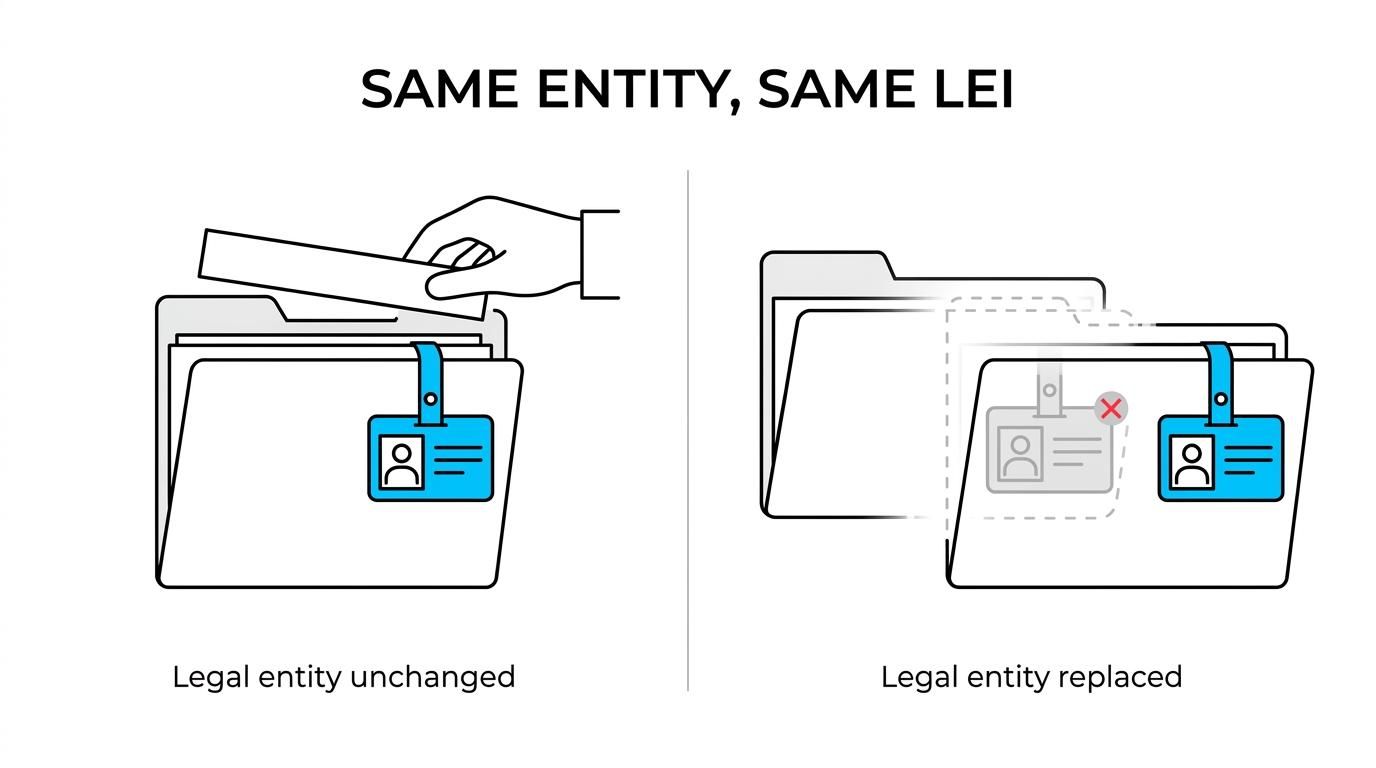
In many cases, the right answer is reassuringly straightforward. If the legal entity remains the same, the LEI usually stays the same too, and the record is updated. If the restructuring means one legal entity disappears and another survives, the position changes. One LEI continues, another may become inactive, and reporting records may need attention.
Keeping this clear saves time, avoids reporting errors, and helps preserve clean reference data across counterparties, regulators, and financial infrastructure.
Why an LEI update is not the same as a new LEI
The LEI system is built around a simple principle: one LEI per legal entity. That is why a name change does not usually justify a brand-new LEI. The legal person is still the same, even if its registered name, address, or registry details have changed.
A merger is different because the legal identity may change in substance, not just in presentation. If one entity is absorbed into another, the absorbed entity no longer exists as a separate legal person. Its LEI cannot keep functioning as though nothing happened. The surviving entity’s LEI continues, and the relationship data linked to the event may need to be updated.
This is more than an administrative tidy-up.
Market participants rely on LEI reference data to identify who is behind a transaction, what official register the entity belongs to, and when its record was last reviewed or changed. GLEIF’s data model also captures update dates and reasons, which helps create a reliable audit trail.
| Scenario | Does the legal entity stay the same? | Usual LEI action | Reporting effect |
|---|---|---|---|
| Registered name change only | Yes | Update the existing LEI record | Existing reporting usually continues with the same LEI |
| Change of address or registry details | Yes | Update the existing LEI record | No new LEI needed |
| Merger by absorption | No, for the absorbed entity | Surviving entity keeps its LEI; absorbed entity’s LEI may become inactive | Affected reports may need the old LEI replaced |
| New legal entity formed in a restructuring | No | New entity needs its own LEI | Reporting should move to the new LEI where required |
How to update an LEI after a legal name change
If a company, fund, charity, or other organisation changes its registered legal name but remains the same legal entity, the LEI record should be updated rather than replaced. That update is meant to reflect the official register, because the LEI record includes the legal entity name exactly as it appears in the relevant register, alongside the register name and identifier where applicable.
In practice, this means the LEI remains stable while the reference data is refreshed. That continuity is valuable. It keeps the entity’s identity intact across trading systems, internal records, and counterparties, while ensuring the public LEI database shows the current legal name.
A name change often comes with other data changes as well. Registered office details may be revised. Registry details might be refreshed after a re-registration process. Parent reporting information may also need attention if a wider group reorganisation has taken place.
Before requesting the update, it helps to gather the core details that support the revised record:
- Updated legal name: exactly as shown in the official register
- Register details: the relevant register name and registration number where applicable
- Registered address: current legal address if it changed at the same time
- Supporting documentation
- Renewal status of the LEI
One point is often missed: a name change should be reflected promptly, especially if the entity is active in regulated transactions. An outdated name in the LEI record can create friction in onboarding, transaction reporting, and internal compliance checks, even if the LEI code itself is still valid.
What happens to an LEI after a merger or absorption
A merger calls for a more careful review because the legal entity behind the LEI may no longer exist in the same form. The key question is not whether the business brand survived, or whether the operations continue under a familiar banner. The key question is which legal entity survives.
If Entity A is absorbed into Entity B, Entity B normally keeps its LEI. Entity A’s LEI may move to an inactive status because Entity A has ceased to exist as a separate legal person. The surviving entity’s record may also be updated to reflect changed relationship data linked to the corporate event.
If the restructuring creates an entirely new legal entity, that new entity needs its own LEI. The old entities’ LEIs do not simply transfer across.
Typical outcomes include:
- name update only
- surviving entity keeps its LEI
- absorbed entity’s LEI becomes inactive
- new legal vehicle, new LEI
This is where corporate events matter in LEI data. GLEIF standards include event-related fields and status tracking, so changes are not just overwritten silently. They become part of the structured reference data around the entity. For sophisticated users of LEI data, that history matters because it clarifies continuity, succession, and legal identity.
A practical example helps. If a fund management company changes its registered name after a rebrand, its LEI can usually stay in place with updated reference data. If that same company is merged into another regulated entity and ceases to exist separately, the old LEI is no longer the live identifier for current activity. The surviving entity’s LEI becomes the active reference point.
LEI reporting changes after corporate restructuring
Updating the LEI database is only one side of the job. Reporting obligations can also change after a merger or restructuring event.
EU market-reporting guidance has made clear that a corporate restructuring can require the old identifier to be replaced with the new LEI in affected reports. In the SFTR context, transaction repositories are expected to identify impacted outstanding reports and replace the old identifier with the new one in the relevant fields. Report submitting entities, reporting entities, and other entitled third parties should also be informed of the LEI change.
That means firms should not assume the database update alone resolves everything. Internal reporting teams, delegated reporting providers, counterparties, and repositories may all need notice, depending on the reporting setup.
The operational risk here is easy to see. If an entity has merged, yet legacy reports still carry the superseded LEI, data quality can suffer and reconciliations can become more difficult. Good governance means treating the LEI update and the reporting review as connected tasks.
Which fields change in the GLEIF LEI record
The LEI record is more structured than many users realise. Under the LEI-CDF standard used across Local Operating Units, the record does not only display a code and a name. It also stores reference data about the entity, the registration source, status information, and update metadata.
When a name changes, the legal name field is updated to match the official register. The register name and registration identifier may also be refreshed if relevant. The record carries a last update date, and the reason for the update can be recorded in structured form.
That matters for traceability.
For more technical users, event coding can become relevant. In a legal name change, a field linked to the event type may reflect a value such as CHANGE_LEGAL_NAME. Data users reviewing the record can also look at fields connected to LastUpdateDate and, where applicable, LegalEntityEventType. This structured approach is one reason the LEI remains useful well beyond regulatory reporting. It supports data governance, client master records, and due diligence across systems.
Practical steps for Irish entities updating LEI data
The smoothest approach is to treat an LEI update as part of the same workstream as the legal filing that caused it. Once the official register has been updated, the LEI record can usually be refreshed using that source data.
Timing matters here. If the entity is about to trade, renew a facility, or submit regulated reports, it is wise to review the LEI record early rather than waiting for a downstream control to flag an inconsistency.
A sensible process often looks like this:
- Confirm the legal outcome: decide whether this is a record update for the same entity or a new LEI requirement for a new entity.
- Check official register data: make sure the registered name, address, and registration details are already current at source.
- Review reporting exposure: identify any filings, trades, or repository reports that use the affected LEI.
- Request the LEI update or renewal: submit the change through a registration agent or issuer and verify the published record once updated.
For many Irish entities, especially those with lean legal or finance teams, the practical challenge is less about the rule and more about coordination. A merger can involve legal advisers, company secretarial teams, operations, compliance staff, and external reporting providers. A clear LEI action plan keeps that coordination focused.
Support options for LEI renewals, transfers and data updates
An LEI data update can usually be handled alongside a renewal or a transfer if the record is moving to a different registration agent. That can be useful where the current provider is slow to respond, or where the entity wants a simpler process and clearer support.
Some providers include data updates as part of the service, which is especially helpful after a name change or restructuring. Where phone and email support are available, it is often much easier to confirm whether the case calls for a simple update, an LEI transfer with renewal, or a completely new registration.
For entities seeking a practical route, LEI Service acts as an official registration agent of RapidLEI and offers new registrations, renewals, transfers, and data updates with guided support. The service highlights low-cost pricing, multi-year options, and free updates to keep GLEIF data current, which can be useful when corporate details change and the record needs prompt attention.