LEI Codes and MiFID II: Why You Can’t Trade Without One
If your organisation wants to trade in financial instruments covered by MiFID II, an LEI is not an administrative extra. It is part of the basic entry requirement.
The rule comes from the MiFID II and MiFIR reporting framework. Under MiFIR Article 26(6), investment firms must use a Legal Entity Identifier to identify clients that are legal persons in transaction reports. That means a company, fund, charity, SPV, partnership, or other legal entity cannot simply be named in free text and left at that. The regulator expects a recognised global identifier.
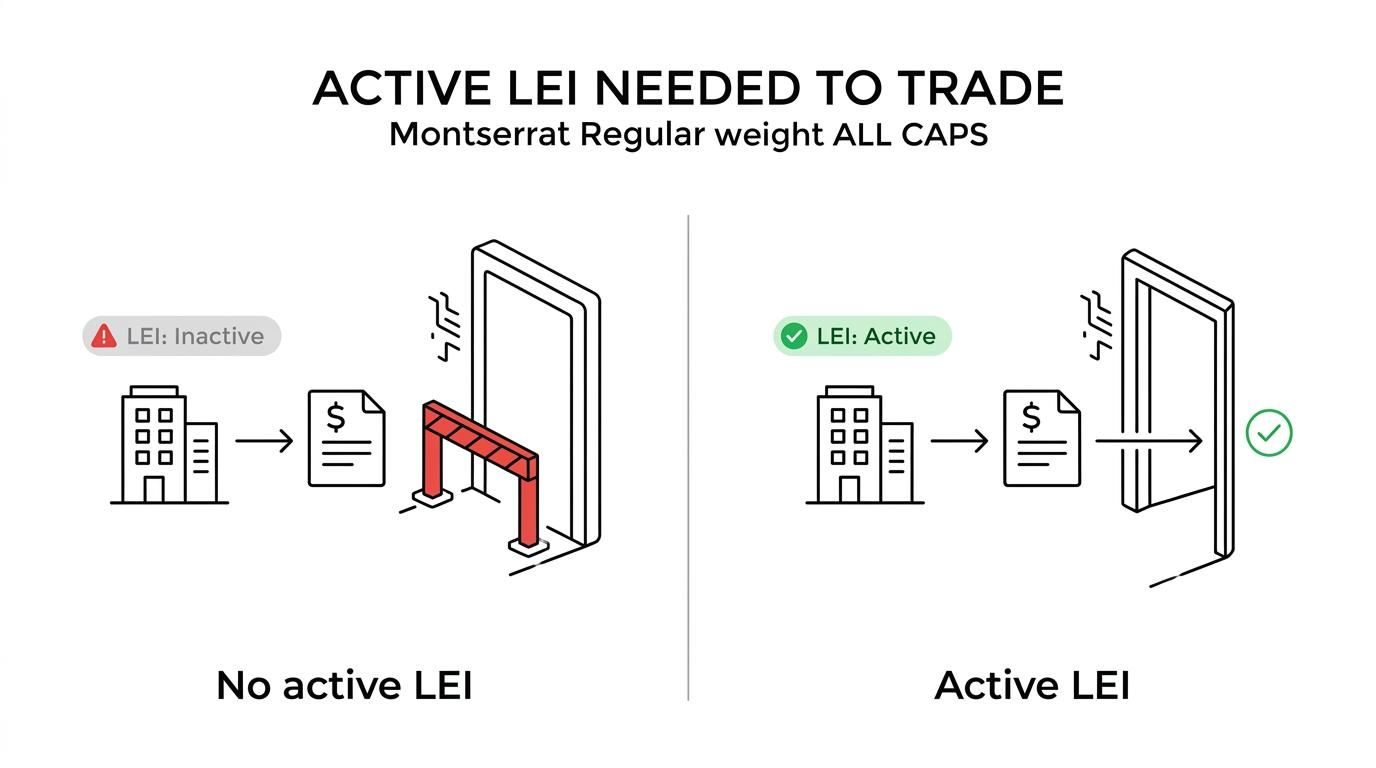
That is why the market settled on a very direct message: no LEI, no trade.
MiFID II LEI requirement in transaction reporting
MiFID II was designed to tighten market transparency, improve surveillance, and give regulators cleaner data. A transaction report is meant to show who traded, what was traded, when it happened, and through which firm or venue. Without a standard entity identifier, that reporting chain becomes unreliable very quickly.
An LEI solves that problem by giving each legal entity a unique 20-character code linked to verified reference data. Instead of relying on entity names that may be abbreviated, translated, or duplicated across jurisdictions, regulators receive one consistent identifier. This matters not only for the investment firm submitting the report, but also for legal entity clients, issuers, and counterparties where relevant.
In practice, an LEI is woven into the reporting infrastructure rather than added at the end.
| MiFID II reporting area | How the LEI is used | Risk if missing |
|---|---|---|
| Investment firm identification | Identifies the reporting or submitting entity | Report may fail validation or create reporting breaches |
| Legal entity client identification | Identifies the client on whose behalf a trade is executed | Firm may be unable to execute the order |
| Issuer identification | Links financial instruments to the issuing legal entity | Market data and reference data may be incomplete |
| Counterparty reporting | Identifies legal entities involved in reportable trades | Rejections, remediation work, and supervisory scrutiny |
This is why firms often check LEI status before dealing, not after. Once an order reaches the reporting stage, it is too late to realise the client has no valid code.
Which legal entities need an LEI under MiFID II
The requirement is broad. If a legal entity is involved in a reportable MiFID II transaction, there is a strong chance an LEI will be needed somewhere in the reporting chain. The best-known cases are investment firms and corporate clients, though the scope reaches further than many first assume.
A useful way to think about it is simple: if the party is a legal person rather than a natural person, the LEI question should be asked early.
- Investment firms and brokers
- Companies trading shares or bonds
- Funds and sub-funds
- Charities with investment activity
- Issuers on regulated venues
- OTC counterparties that fall within reporting rules
Natural persons are treated differently under the regime, as national identifiers are generally used instead. Still, where the client is a company, trust-related structure with legal personality, incorporated body, or fund vehicle, the investment firm will usually expect an LEI before execution.
This is one reason many treasury teams, finance directors, and compliance officers now treat the LEI as standing corporate data, much like a company registration number or VAT number.
Why LEI data supports MiFID II market transparency
There is a regulatory reason behind the strictness. MiFID II is not only about catching errors in a form. It is about giving supervisors reliable data for market abuse surveillance, risk analysis, and cross-border oversight.
When every legal entity in a transaction report is identified in the same way, regulators can link activity across venues, firms, and jurisdictions. Patterns become easier to spot. Concentrated exposures become clearer. Suspicious behaviour is harder to hide behind inconsistent naming conventions. That consistency supports cleaner monitoring of insider dealing, spoofing, wash trades, and other abusive conduct.
The value goes beyond enforcement. Better entity data also improves market quality. Firms can reconcile records more accurately. Venues and repositories can reduce duplication. Counterparties can carry out due diligence with greater confidence. A small code does a large amount of work.
A valid LEI tells the market that the entity behind the trade can be identified in a recognised global framework.
What happens if an LEI is missing, invalid, or lapsed
The practical effect is often immediate. If a legal entity client has no LEI, or its LEI has lapsed, an investment firm may refuse to execute the transaction. If the trade somehow proceeds, the report can be rejected or treated as defective. Either outcome creates avoidable risk.
Regulators and national competent authorities expect transaction reports to be complete and accurate. Missing LEIs weaken the audit trail. Invalid LEIs can trigger reporting errors. Lapsed LEIs create a different problem: the code still exists, but its status may not satisfy counterparties or reporting controls because annual renewal has not been maintained.
That turns a simple identifier into a live compliance item.
- Trade refusal: Many firms will not place the order until the legal entity has an active LEI.
- Report rejection: Submission systems can reject reports that include missing or invalid LEI data.
- Remediation costs: Compliance and operations teams may need to investigate, correct, and resubmit data.
- Regulatory exposure: Persistent reporting failures can lead to supervisory action, fines, or public censure.
The message is straightforward. An LEI is not a box to tick once and forget. It must be present and current.
Getting an LEI quickly in Ireland for MiFID II compliance
For Irish entities, speed matters. A trading window, settlement timetable, subscription period, or internal approval deadline rarely waits for compliance admin to catch up. That is why the LEI process should be simple, fast, and predictable.
An official registration agent can remove much of the friction. LEI Service, acting as an official Legal Entity Identifier registration agent of Ubisecure RapidLEI, offers new registrations, renewals, and transfers for Irish legal entities and for organisations in other English-speaking markets. The process is designed to be guided rather than technical, with phone and email support available if anything is unclear.
The commercial case is strong as well. Pricing starts at €64 for one year, with multi-year options that reduce the annual cost. For entities that need continuity, especially those with recurring trading or reporting obligations, multi-year renewal can reduce the chance of a lapse interrupting business.
Typical service points include:
- New registration: Apply for a first-time LEI for a company, fund, charity, or other legal entity.
- Renewal: Keep an existing LEI active so counterparties and reporting systems continue to accept it.
- Transfer with renewal: Move LEI maintenance from another provider without changing the code itself.
- Data updates: Keep GLEIF reference data current when entity details change.
Issuance is commonly completed within 1 to 48 hours, with some applications processed on the same day, around two hours in suitable cases. That can make a real difference when a trade, fund event, or reporting cycle is close.
LEI registration, renewal, and transfer options for Irish entities
The right option depends on the status of the entity today, not on what it may need next quarter. If there is no LEI yet, a new registration is required. If the LEI exists but is close to expiry, renewal the priority. If the entity is unhappy with its current provider, transfer with renewal is often the cleanest route.
That distinction matters because many delays come from starting the wrong process. A firm may think it needs a new LEI when it already has one, or ignore a lapsed code because the number still appears in old records. A quick lookup usually resolves that.
For teams managing multiple entities, a short internal checklist helps:
- No existing LEI: start a new application
- Existing active LEI: calendar the renewal date
- Existing lapsed LEI: renew before trading activity resumes
- Unsuitable current provider: transfer and renew with a provider that offers clearer support
Support is not a minor point here. Even sophisticated finance teams can hit practical questions around parent data, legal form, registry information, or renewal timing. Free phone support and unlimited email support with replies within 24 hours can save a surprising amount of internal time.
Choosing an LEI provider for MiFID II compliance in Ireland
Price matters, though it should not be the only filter. A cheaper LEI service is valuable when it also offers dependable processing, responsive support, and a clear renewal path. If your firm needs the code urgently, a low headline fee is less useful than a provider that can actually get the application over the line on time.
Irish entities will usually look for a few basics:
- Official agent status: confidence that the application is handled through an authorised registration channel
- Clear pricing: no ambiguity about GLEIF fees or renewal cost
- Fast processing: practical timelines for live trading needs
- Human support: phone and email access when a case is not standard
- Ongoing maintenance: reminders, renewals, and data updates to keep the LEI active
LEI Service positions itself strongly on those points, with low pricing in Ireland, guided applications, renewal options for one, three, or five years, and free updates to keep GLEIF data current. For businesses that would rather keep LEI admin off the critical path, that kind of structure can make compliance much less disruptive.
MiFID II is strict because the market benefits when legal entities are identified clearly and consistently. For firms that trade, invest, issue, or report, the LEI is now part of normal operational readiness. Once it is treated that way, the rule stops feeling like a barrier and starts working as intended: cleaner data, stronger trust, and a more reliable route to market access.