LEI Data Explained: What Information Is Public and Why It Must Be Accurate
A Legal Entity Identifier is not just a 20-character code used to satisfy a trading or reporting rule. It is attached to a public record, and that record is meant to answer two direct questions: who the legal entity is, and who stands behind it from an ownership point of view.
That public record matters because the LEI system was built for transparency. When regulators, counterparties, banks, fund administrators, and market participants look up an LEI, they are not only checking whether a code exists. They are relying on the reference data linked to it. If the legal name is slightly wrong, the registered address is out of date, or parent information has not been reviewed properly, the record becomes less dependable and may slow down issuance, renewal, or downstream compliance checks.
What LEI reference data includes in the Global LEI Index
LEI reference data is published through the Global LEI Index, which is designed as an open, global source of verified legal entity information. GLEIF separates this data into Level 1 and Level 2.
Level 1 data is often described as the “who is who” layer. It covers the core identity details of the legal entity itself. Level 2 data is the “who owns whom” layer. It covers accounting consolidation relationships where those relationships apply and can be reported.
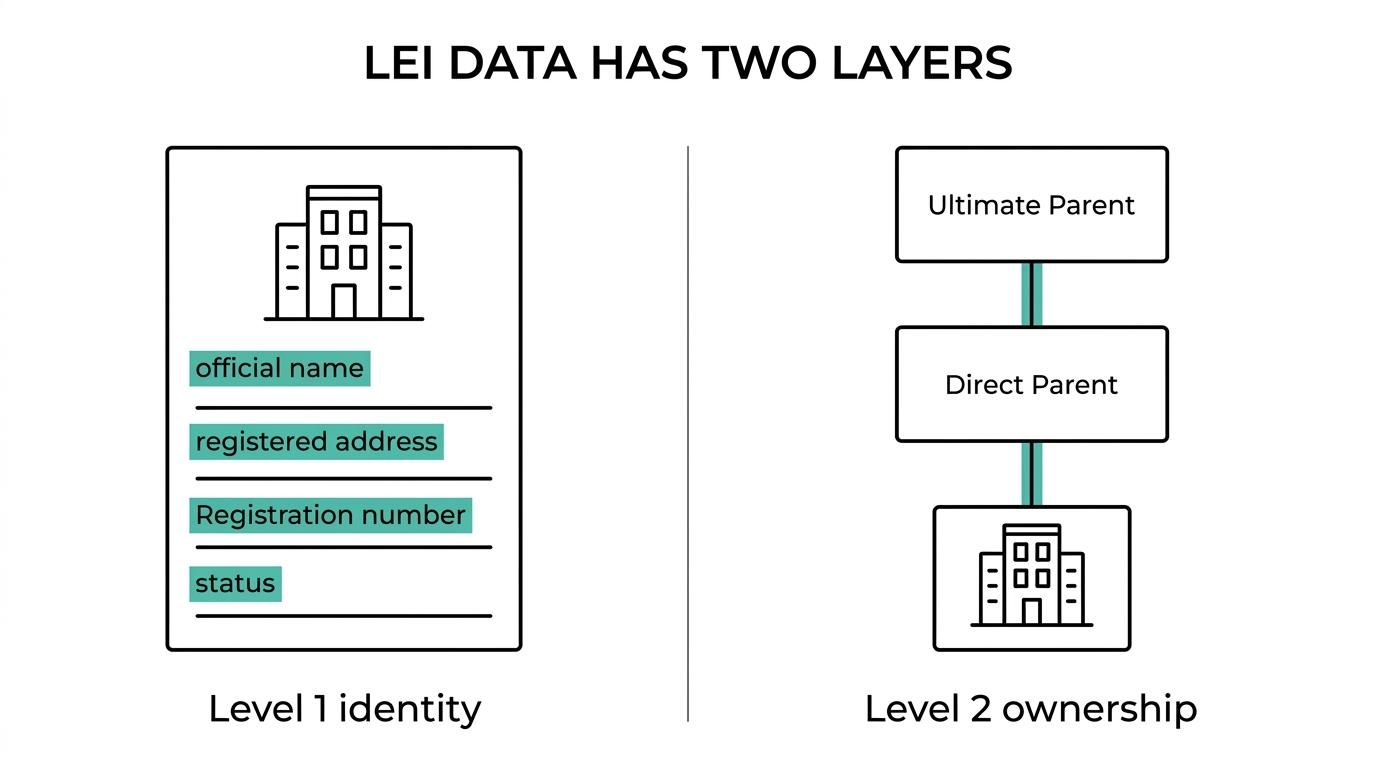
This public structure gives the LEI system its value. A code without accurate reference data would have limited use. A code with current, validated reference data can support smoother onboarding, cleaner transaction reporting, stronger due diligence, and more confidence across borders.
Level 1 LEI data fields: official identity details
Level 1 LEI data is the business-card layer of an LEI record. It is the first thing most users check, and it is also the area where many application issues begin, because the information must match authoritative records rather than internal shorthand or trading names.
Typical Level 1 fields include the legal entity’s official name, registered address, country of formation, registration authority details, entity status, and other basic record metadata tied to issuance and renewal. GLEIF’s framework is built so that LEI issuers verify this information against a local authoritative source, commonly a national business register.
A simple way to read the main Level 1 field groups is below.
| LEI field group | What it covers | Why accuracy matters |
|---|---|---|
| LEI code | The unique 20-character identifier | It links all reference data and transaction use back to one verified entity |
| Official legal name | Registered legal name of the entity | Even a small mismatch can delay validation |
| Registered address | The formal registered office address | This is a core identity marker used in checks and public records |
| Country and registration details | Jurisdiction, registration authority, local registration number | Helps confirm the entity against the relevant register |
| Entity status | Whether the LEI is active, lapsed, retired, merged, and so on | Users need to know whether the record is current |
| Record lifecycle dates | Initial registration, last update, next renewal date | Shows whether the data has been recently revalidated |
For Irish companies, the most sensitive Level 1 fields are often the legal name and registered office details. If an applicant enters a familiar trading description instead of the exact registered name, or types the address in a way that does not reflect the register, that creates friction immediately. The same applies to one incorrect digit in a registration number.
Level 2 LEI data fields: parent ownership relationships
Level 2 data answers a different question. It is not about the legal entity standing alone, but about where it sits in a broader ownership structure.
GLEIF frames this as reporting the direct accounting consolidating parent and the ultimate accounting consolidating parent, where applicable. These terms are precise. They are not a casual reference to any shareholder or affiliated entity. They refer to the parent entities that prepare consolidated financial statements under the relevant accounting framework.
That distinction matters because Level 2 data is meant to support a reliable picture of ownership and control in the market. Where an entity is consolidated into a group, public LEI data can help users trace the relationship. Where no parent is reported, there is usually a valid reason under the LEI reporting rules, and that reason itself has significance.
In practice, not every LEI record will show parent entities. Some legal entities are not consolidated by a parent. Some may rely on an accepted exception from reporting. Still, when Level 2 data is relevant, it should be treated with the same care as Level 1 data. Incorrect parent reporting can weaken transparency just as much as a wrong address or legal name.
Why accurate LEI data prevents delays and weak records
Accuracy is not an administrative nicety. It is the basis on which the LEI record can be trusted and reused.
GLEIF states that data quality starts with the legal entity supplying accurate reference data. The LEI issuer then checks that data against authoritative local sources before issuing the LEI. That means the application stage is already a validation stage. If the submitted details do not line up with the register, the process slows down because clarification or correction is needed.
Common friction points tend to be very plain:
- Exact legal name mismatches
- Outdated registered addresses
- Incorrect local registration numbers
- Missing required fields
- Parent relationship details that do not match current consolidation facts
These are small errors on paper, yet they can have an outsized effect. An LEI is often needed to support time-sensitive trading, reporting, or account opening activity. If the reference data cannot be confirmed quickly, the code may not be issued as fast as expected. The same applies at renewal time. A record that has drifted away from the authoritative source needs to be corrected before revalidation can be completed cleanly.
How LEI issuers verify LEI data and annual renewal updates
The LEI system is designed to avoid a “set it once and forget it” model. Verification happens at issuance, and then the record must be reviewed at least annually.
According to GLEIF, annual renewal requires the legal entity and the issuing organisation to review and revalidate the reference data at least once every year. Issuers also publish their managed LEI records daily, which helps keep the public data pool current.
That creates a useful discipline. An LEI record is not simply a document filed away after first registration. It is a living reference entry that should reflect the entity as it exists now.
The process is usually straightforward:
- At application: the issuer checks submitted data against a national business register or another authoritative source
- During review: any mismatch in legal name, address, registration number, or parent data may need correction
- At annual renewal: the entity confirms that the record is still accurate, and the issuer revalidates it
- After publication: updated LEI records flow into the public data pool and remain available for market use
In some cases, the issuing organisation can retrieve core reference data directly from the local registration authority. That can simplify the process for the applicant, especially where the local identity number is enough to pull the official record. Even then, the applicant remains responsible for ensuring that the public LEI record reflects reality.
Practical checks for Irish LEI applications and renewals
For Irish entities, the best preparation is not complicated. It is mostly a matter of precision and timing.
Before applying or renewing, compare the intended LEI data against the authoritative register entry, not against internal templates, invoices, letterheads, or website wording. Those sources often contain harmless variations that become unhelpful during LEI validation.
A disciplined pre-check usually includes the following:
- Legal name: match the register exactly, including punctuation, abbreviations, and legal suffixes
- Registered address: use the formal registered office details currently on file
- Registration number: check every character, since one wrong digit can stop validation
- Parent data: confirm whether a direct and ultimate accounting consolidating parent should be reported, or whether an accepted exception applies
- Renewal date: review the record before the anniversary so corrections can be handled without pressure
This is where a guided application process can make a real difference. Where support is available by phone or email, entities often resolve mismatches faster and avoid repeat submissions. That is especially useful when an LEI is needed quickly for a transaction or reporting obligation.
Public LEI data supports trust in market activity
The public nature of LEI reference data is not incidental. It is what allows one verified entity record to be reused across many situations.
A bank can check the legal identity of a corporate client. A counterparty can review whether the LEI is active. A regulator can link reported transactions to a specific entity. A data team can connect subsidiary and parent records where Level 2 data is available. A fund administrator can reduce ambiguity when several entities have similar names.
This shared reference point works best when the record is accurate enough to stand on its own. The stronger the data quality, the less time is spent resolving avoidable inconsistencies later.
What makes an LEI record genuinely useful
A useful LEI record is current, exact, and easy to verify against source records. It is not cluttered by informal naming, stale address data, or unresolved ownership questions.
That standard is good for the entity holding the LEI as well. Clean reference data can make renewals quicker, reduce validation back-and-forth, and support a more predictable compliance process across trading venues and reporting channels.
For any entity that needs an LEI, the practical lesson is simple. Treat the data fields as public regulatory identity data, not as a formality. When the official name, registered address, registration details, and parent information are kept correct, the LEI becomes far more than a code. It becomes a dependable market reference that others can use with confidence.