LEI for Charities and Non-Profits: Requirements, Proofs and Best Practices
Irish charities and non-profits are increasingly being asked for a Legal Entity Identifier, often at the point where a transaction is ready to go. A bank, broker, custodian or counterparty may ask for it with little warning, and that can create avoidable pressure if the organisation has not prepared its records in advance.
The good news is that the route is usually straightforward once the charity’s legal form, official records and authorised signatory are clear. In Ireland, there is no separate charity-only LEI system. A charity is assessed in the same global framework as other legal entities, with validation based on reliable public or official records.
When an LEI is required for charities in Ireland
An LEI is not needed simply because an organisation is charitable. It becomes relevant when the charity enters a regulated financial activity or is asked to provide one as part of onboarding or reporting.
This often arises where a charity holds investment portfolios, deals in financial instruments, enters derivatives arrangements, or works through a broker or custodian that must meet regulatory reporting duties. In those cases, the LEI acts as the organisation’s recognised identifier in the transaction chain.
In Ireland and across the EU, LEIs are closely linked to reporting and market rules under frameworks such as MiFID II and EMIR. If a charity is active in treasury or investment management, the request for an LEI is usually practical rather than theoretical.
A useful rule of thumb is simple: if the charity is buying, selling, reporting or holding financial instruments through a regulated intermediary, it is wise to check LEI needs early.
LEI eligibility for Irish charities and non-profits
The key test is whether the charity is a legal entity that can be independently identified and validated from authoritative sources. That is the central principle of the global LEI framework.
For Irish charities, the most common validation sources are the Charities Regulator register and, where the entity is incorporated, the Companies Registration Office. Revenue records may also help in some cases, though they are usually supporting evidence rather than the main source for LEI validation.
Many charities in Ireland are set up as companies limited by guarantee. These are often the easiest to process because the legal name, registration number and registered office can usually be checked against the CRO. Trust-based charities and unincorporated bodies can still qualify, though they may need more manual review and stronger documentary support.
That matters because the LEI system is built on verified reference data. If the charity’s name is used informally in daily life but appears differently on the official register, the application should always follow the registered version.
Irish authorities and global bodies involved in charity LEI applications
The LEI itself is not issued by an Irish regulator. Oversight sits within the global LEI system, with GLEIF maintaining the framework and index, the Regulatory Oversight Committee providing policy oversight, and accredited LEI issuers handling registration, renewal and data checks.
Irish bodies still matter. They are important because they hold the records used to validate the organisation.
| Body or register | Why it matters for a charity LEI |
|---|---|
| GLEIF | Maintains the Global LEI Index and accredits issuers |
| LEI issuers and registration agents | Process applications, renewals, transfers and validation |
| Charities Regulator | Confirms registered charity details and charity number |
| Companies Registration Office | Confirms incorporated entity details, especially for CLGs |
| Revenue | May support evidence of charitable tax status |
| Central Bank of Ireland | Relevant where LEI use is tied to regulated financial activity |
If the charity is involved in reportable derivatives or other regulated market activity, the Central Bank of Ireland may come into view from a compliance perspective. Even then, the LEI is still obtained through the global LEI system rather than directly from the Bank.
Proofs and documents needed for a charity LEI application
There is no single Irish checklist that suits every charity. The right evidence depends on legal form, public registration status and how easily the entity can be matched to official records.
Where the charity is clearly visible on the CRO and Charities Regulator registers, the document burden can be light. Where the structure is more unusual, the application usually benefits from a fuller pack of records.
The most common items are easy to recognise once the file is organised.
- Registered Charity Number
- CRO registration number
- Governing document or constitution
- Registered office or principal address details
- Trustee, director or company secretary details
- Revenue charity exemption reference, where available
For many Irish charities, the governing document is especially useful. It helps show legal form, charitable purpose, governance arrangements and who has authority to act. For trust-based entities, a trust deed may carry much of that weight.
Signatory authority and proof of representation for charity LEIs
A strong charity LEI application does more than prove the entity exists. It also shows that the person making the application has authority to do so.
That can be very simple where the named director or officer is visible on public records and the provider can match the details without difficulty. In other cases, the issuer or registration agent may ask for a signed authority form, a power of attorney, or internal approval confirming who may act for the charity.
This is where good governance helps. If the board of trustees or directors has a clear paper trail, LEI approval tends to move more smoothly.
A practical charity file often includes the following authority proofs:
- Board approval: a resolution or minute confirming that the LEI application is authorised
- Named signatory: director, trustee, secretary or senior officer with power to act
- Authority form: provider-specific authorisation or power of attorney where required
- Role evidence: public register entry or internal record showing the person’s position
- Identity check: a personal ID document if the provider requests it for verification
For charities with several trustees, it is sensible to decide in advance who will manage renewals, updates and future correspondence. That avoids confusion a year later when the LEI must be revalidated.
Best practices for accurate charity LEI applications
Accuracy matters because small mismatches can slow down validation. A missing word in the legal name, an old address, or a signatory whose authority is unclear can all hold up the process.
Preparation is usually more valuable than speed at the start. Once the entity details are clean and the records are ready, fast issuance becomes much more realistic.
A few habits make a visible difference:
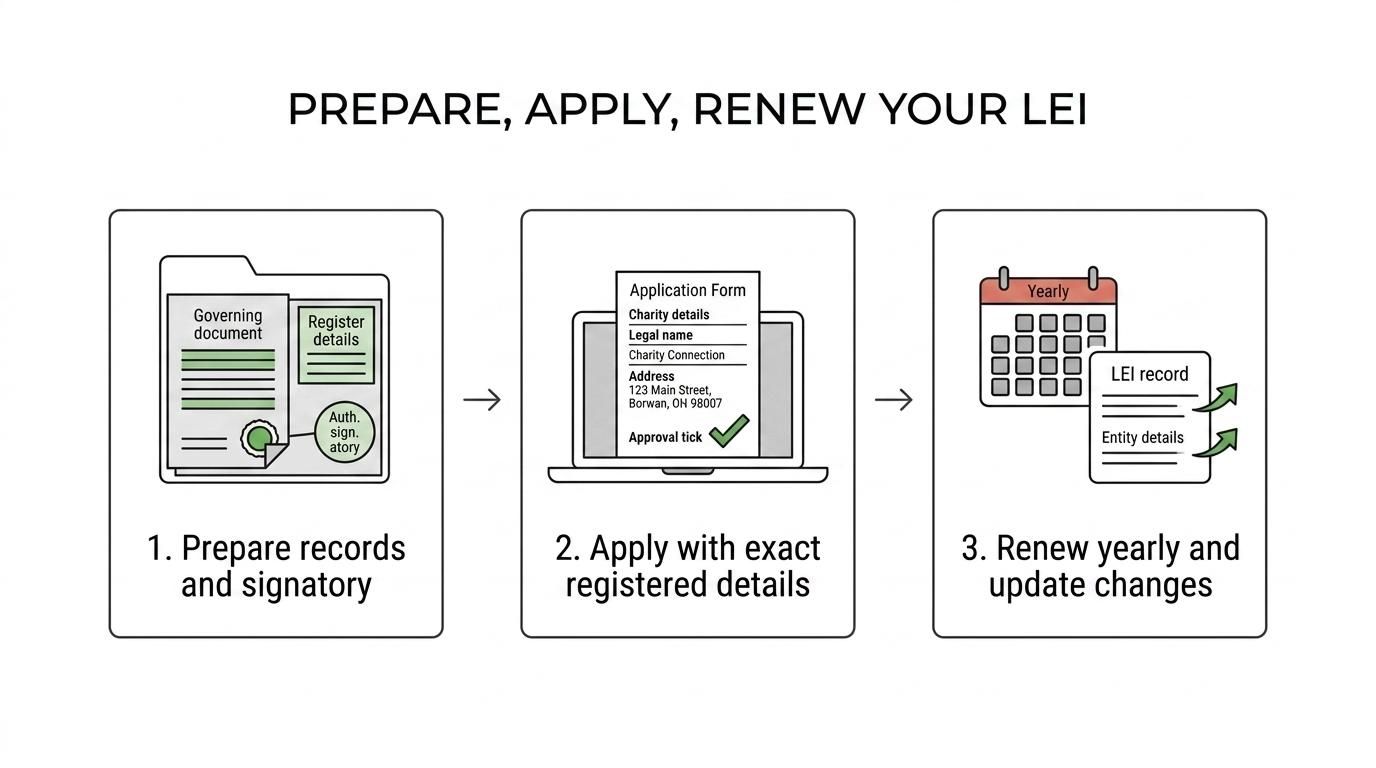
- Match the registers exactly: use the legal name and address as they appear on official records
- Check the legal form: CLG, trust, association or another structure must be recorded correctly
- Prepare the governing document: keep the current signed version ready
- Confirm parent data position: many charities have no accounting consolidating parent, and that should be recorded properly
- Apply before the deadline: leave time for manual review if the structure is unusual
It is also wise to review whether the charity has changed since the last filing season. A new registered office, updated trustee list or amended constitution should be reflected consistently across official registers and the LEI record.
Common problems charities face when applying for an LEI
Most delays come from ordinary administrative issues rather than hard legal problems. The charity may be fully eligible, but the submitted data does not line up neatly with what the issuer can verify.
Informal naming is a common example. A charity may trade publicly under a familiar short name while its official registered name is longer and more technical. The LEI application should use the registered form.
Another issue is timing. Some organisations only start the process after a bank or broker blocks a transaction pending an active LEI. That leaves no room for clarifying documents, signatory checks or manual validation.
There is also the question of structure. Trusts, umbrella arrangements and long-standing unincorporated bodies can be perfectly valid, but they are less likely to fit a fully automated route. That does not stop the application. It simply means the paperwork should be stronger.
LEI renewal and data updates for Irish charities
An LEI is not a once-off administrative task. It must be renewed each year so that the reference data remains current.
That annual revalidation is more than a fee payment. The issuer checks whether the entity details are still correct. If the charity has changed name, address, legal status or controlling relationships, those details should be updated without waiting for a lapse to expose the issue.
A practical renewal routine usually includes:
- Diary dates: set reminders 30 to 60 days ahead
- Register review: confirm CRO and Charities Regulator details are current
- Governance check: update trustees, directors and signatory records internally
- Transaction planning: renew early if a trade, onboarding or report depends on active LEI status
If the LEI lapses, the code still exists but its status is no longer current. That can create friction with counterparties, reporting systems and onboarding checks. For charities managing investments or treasury activity, keeping the record active is a simple but valuable control.
Choosing LEI support for charities and non-profits
Charities often prefer a provider that can handle more than a standard company application. Support matters when the legal form is unusual, the signatory route needs explanation, or the organisation wants reminders and update help built into the service.
A registration agent linked to an accredited issuer can be a strong fit where guided support is needed. In Ireland, that can be especially helpful for charities with trustee-led governance, manual approval steps or limited internal capacity for handling technical filings.
LEI Service offers new registrations, renewals and transfers, with multi-year options, automatic renewal choices, and phone and email support in English. Its published process also points to quick handling, often within 1 to 48 hours and in some cases the same day, subject to validation and documents being in order. For charities that want a low-cost route with guided support, that style of service can reduce administrative drag.
The best result usually comes from pairing the right provider with clean internal records. When the legal name matches the register, the governing document is ready, and the authorised signatory is clear, the LEI process becomes much more routine than many charities first expect.
A charity that keeps those foundations tidy is in a strong position not only to obtain an LEI, but to keep it current whenever banking, investment or regulatory needs change.