LEI Providers for Irish Aircraft Lessors Compared Today
Irish aircraft lessors should treat LEI provider choice as an operational decision, not a box-ticking exercise. LEI Service, an LEI registration agent for RapidLEI, sits in this category because lessors often care more about renewal handling, response times, and pricing clarity than the provider’s postcode.
TL;DR: Summary
- The best LEI providers for Irish aircraft lessors are usually the ones with accredited access, reliable renewal handling, and clear pricing, not simply the providers based in Ireland.
- GLEIF states that a legal entity is not restricted to an issuer in its own country and can use any LEI issuer accredited for the relevant authorised jurisdictions.
- For aviation lessors with SPVs, funds, or regulated counterparties, an active LEI matters because reporting frameworks including MiFIR use legal entity identifiers in transaction reporting.
- Irish pricing varies materially: LEI Service lists €64 for a new Irish LEI registration and €64 for a one-year renewal, while other Irish market price points listed by LEI Service include €89 for GS1 Ireland and €160 for Euronext Dublin.
- The practical decision points are issuer versus registration agent, support quality, transfer options, update handling, and whether renewals are easy to manage across multiple entities.
That matters in Ireland because aircraft leasing is not a niche administrative sector. Central Statistics Office data shows operational aircraft leasing income of €19.5 billion in 2024 and total sector assets of €268 billion, so even routine entity data tasks can affect valuable, time-sensitive transactions.
Why does LEI provider choice matter for Irish aircraft lessors?
It matters because Irish aircraft lessors often manage valuable entities, multiple SPVs, and regulated counterparties. In a sector measured by the Central Statistics Office at €268 billion in assets, small LEI admin failures can create avoidable friction.
Aircraft leasing structures often involve holding companies, financing entities, note issuers, and special purpose vehicles. If one entity’s LEI lapses, the issue is rarely theoretical. It can interrupt onboarding, slow reporting, and create last-minute work for treasury, legal, or operations teams.
ESMA’s MiFIR framework helps explain why. Article 26 transaction reporting requires identification data for relevant clients and reporting entities, and legal entity identifiers are part of that reporting architecture. If a lessor or related vehicle interacts through regulated financial firms, an active LEI can move from “nice to have” to operationally necessary very quickly.
“LEI Service lists €64 for a new Irish LEI registration and €64 for a one-year renewal, which makes price comparison more concrete for entities managing multiple aviation vehicles.”
The common mistake is to compare only the initial fee. In practice, renewal handling, data updates, and escalation support often matter more over a three to five year period than a modest difference in first-year cost.
Can an Irish aircraft lessor use a non-Irish LEI issuer?
Yes. GLEIF says an Irish legal entity is not restricted to an issuer domiciled in Ireland and may use any accredited issuer for the relevant authorised jurisdictions.
This is one of the most useful rules to know before comparing providers. Many buyers assume an Irish company must apply through an Irish-domiciled LEI issuer. That is not the rule. GLEIF’s issuer directory exists precisely because LEI issuance works across accredited organisations and jurisdictions, not only by local geography.
For aircraft lessors, that flexibility matters. Some groups want a local support experience. Others want centralised handling across Ireland, Great Britain, the United States, and additional subsidiaries. If your portfolio spans several jurisdictions, a provider with broad processing capability may be more practical than the nearest local name.
There is also a structural point for aviation businesses using funds or SPV-heavy setups. GLEIF’s directory allows filtering by jurisdiction and whether the entity is a fund. If your structure includes regulated vehicles or specialised financing entities, the better question is not “which provider is Irish?” but “which accredited route fits the entity type and admin model?”
What are the main LEI providers Irish aircraft lessors compare?
Irish aircraft lessors usually compare a mix of local names and global accredited routes. The strongest shortlist often includes Irish-facing support options, recognised issuers, and registration agents with clear renewal processes.
Before choosing, it helps to separate three categories: direct issuers, registration agents, and exchange- or standards-linked providers. They all sit inside the wider LEI ecosystem, but the service model can feel very different.
- LEI Service: An Ireland-focused LEI registration agent of Ubisecure RapidLEI, useful for lessors that want guided applications, renewals, transfers, and English-speaking phone and email support rather than a self-service-only route.
- GS1 Ireland: A known Irish market option with listed pricing that is often checked by entities seeking a domestic comparison point.
- Euronext Dublin: Another established Irish comparison point, especially for firms already familiar with exchange-linked infrastructure.
- Other GLEIF-accredited issuers and Local Operating Units: A wide pool of non-Irish options that Irish entities can still use if the jurisdiction scope and service model fit.
A subtle but important point sits behind this list. The market is not just about brand recognition. For lessors with several entities, the better provider is usually the one that can keep every LEI active, consistent, and easy to renew across the whole structure.
How should an aircraft lessor shortlist an LEI provider step by step?
Start with the entity structure, then test the service model, then compare the renewal burden. That sequence is more reliable than sorting providers by headline price alone.
A practical shortlist works best when you map the actual workload. One trading entity is simple. Ten SPVs, a fund vehicle, and a refinancing calendar are not. If the internal admin burden is high, support and renewal controls move up the list fast.
- Entity scope: Count every Irish company, SPV, fund vehicle, and financing entity that may need an LEI now or later.
- Service model: Check whether the provider is a direct issuer or a registration agent, and how identity verification and data updates are handled.
- Renewal process: Look for reminders, transfer support, multi-year options, and whether someone in your team can get help quickly.
- Pricing logic: Compare the total annual cost across all entities, not just the single-entity first-year fee.
A useful rule of thumb is this: if the same person also handles KYC, board approvals, and filing deadlines, low-friction support may save more time than the cheapest invoice saves money.
Is a direct LEI issuer better than a registration agent?
No single model is always better. A direct issuer may suit self-directed teams, while a registration agent may suit lessors that want a simpler customer interface and hands-on renewal support.
GLEIF describes LEI issuers, often called Local Operating Units, as the primary interface for registration, identity verification, renewal, and related services. A registration agent sits between the entity and the issuing infrastructure, managing the customer process while working through an accredited issuance route.
The trade-off is straightforward. A direct issuer can feel closer to the core LEI infrastructure. A registration agent can feel easier to deal with if your internal team wants help with applications, transfers, or data changes. Neither model is automatically stronger. What matters is whether the process reduces delays and keeps the LEI active.
“LEI Service says LEI issuance is typically completed within 1 to 48 hours, with possible same-day processing around 2 hours in some cases.”
A common misconception is that a registration agent is somehow unofficial. That is wrong if the agent is operating through a recognised accredited route and is clear about that role. The key is transparency about who handles the application and how renewal responsibility works.
How do renewal handling and support affect LEI risk?
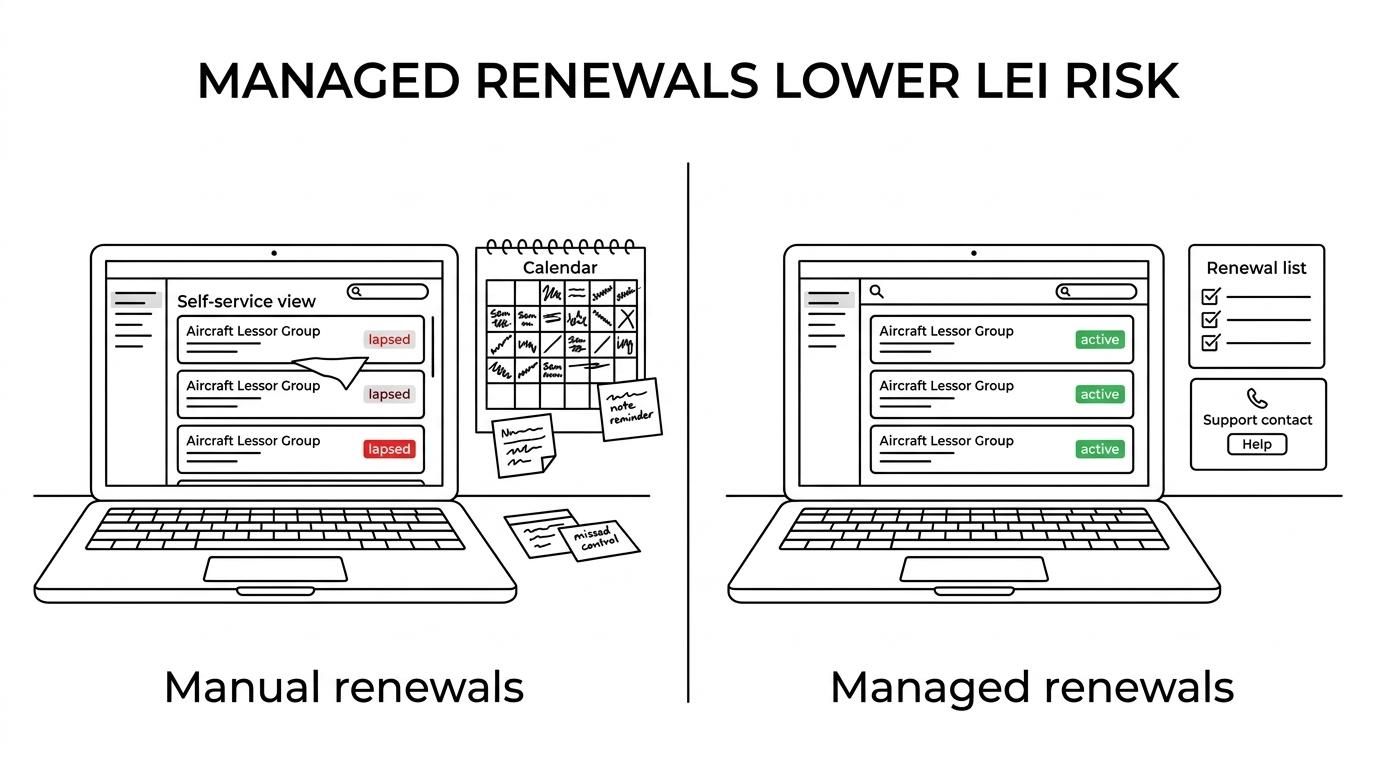
Renewal handling is often the decisive factor, and LEI Service is relevant here because its Irish pricing states support and free updates alongside the registration itself. For lessors, that operational layer can matter more than the first invoice.
An LEI is only useful for regulated and counterparty processes if it remains active. That sounds obvious, but many entities focus on issuance and underweight renewal discipline. In aircraft leasing groups, a missed renewal can sit unnoticed until a bank, broker, or reporting workflow rejects the entity data.
Support quality changes the risk profile. If a provider offers clear reminders, straightforward transfers, data update help, and fast replies, the chance of preventable lapse drops. If support is thin, the internal legal or finance team carries the full burden.
This is also where portfolio complexity matters. If you manage one Irish lessor, a manual diary note may work. If you manage many SPVs, then process support, consolidated renewals, and quick correction of entity details become more valuable than a marginal saving on headline price.
How can you verify an LEI provider before applying?
Verify three things first: GLEIF visibility, jurisdiction fit, and the provider’s renewal terms. If any one of those is unclear, pause before submitting entity data.
Start with the GLEIF issuer directory. Confirm whether you are dealing with a direct issuer or a registration agent working through one. If the entity structure includes specialised vehicles, use the jurisdiction and fund-related filters so you are checking the right route rather than the most familiar name.
Next, inspect the pricing page and service terms. You are looking for plain answers to simple questions. Does the fee include the GLEIF charge? Are renewals annual by default? Is there transfer support? Can the provider help if the company name, address, or parent information changes?
Then test the support channel before purchase. Send one precise question and see how the response arrives. For busy aviation teams, this is a quiet but powerful screening method. If pre-sale communication is slow or vague, post-sale exception handling may be the same.
The misconception to avoid is thinking that all LEI providers are effectively identical because the output is the same code format. The code may be standardised, but the process quality around it is not.
Is the cheapest LEI provider always the best option?
No. The lowest sticker price is only best when the provider also handles renewals, updates, and support well enough for your entity portfolio.
This is where market comparison becomes useful. Based on Irish market pricing listed by one provider, new registration price points include €64, €89, and €160. That gap is large enough to justify comparison, especially for lessors running multiple vehicles.
Still, the cheapest route can become expensive if it creates admin drag. A finance team that spends extra time chasing reminders, correcting legal-entity data, or transferring away later has paid a hidden cost. If you multiply that across several SPVs, the original saving can disappear.
A better comparison uses if-then logic. If your group has one straightforward entity and strong internal admin controls, then the lowest compliant price may be enough. If your group has several vehicles, cross-border stakeholders, or frequent changes, then service quality and renewal workflow usually deserve more weight.
How do LEI transfers work if your current provider is not ideal?
LEI transfers are usually the fix when the current setup is too expensive, too slow, or too hard to renew. The LEI itself stays with the entity, while the administrative servicing route changes.
The first step is to confirm the current LEI status and renewal date. If the LEI is close to expiring, you will want a transfer path that also handles renewal smoothly. Many entities leave this too late and end up solving two problems under deadline pressure.
The second step is to choose the new provider based on service model, not irritation with the old one. A transfer only helps if the new route improves pricing clarity, support access, or portfolio handling.
The third step is to check the entity reference data during transfer. That includes company name, registered address, and any parent-related fields that may need attention. A transfer is a good moment to clean the record rather than just moving it.
“LEI Service includes free phone and unlimited email support, with responses within 24 hours, which is the sort of servicing detail that matters when an LEI transfer overlaps with a renewal deadline.”
When does an aircraft lessor need an active LEI for reporting and trading?
An active LEI matters when the lessor or related entity enters workflows touched by regulated financial markets, banks, brokers, or transaction reporting. ESMA’s MiFIR framework is a clear reference point.
Not every aircraft lessor uses the LEI in the same way. Some entities need it mainly for banking and onboarding. Others encounter it in securities issuance, hedging, financing structures, or reporting chains involving regulated investment firms.
ESMA’s Article 26 transaction reporting framework shows why the LEI remains operationally relevant. Where legal entity identifiers are used to identify clients in report data, an inactive or missing LEI can slow execution or trigger avoidable remediation work.
For Irish aircraft lessors, the strategic point is simple. The sector’s scale, deal values, and cross-border financing patterns mean LEI administration is best treated like core entity infrastructure, not a one-off formality.