LEI Providers for Irish ICAVs and Funds Compared Today
Choosing between LEI providers for Irish ICAVs is not just a procurement exercise. The provider you pick affects application speed, annual renewal discipline, support quality, and the total cost of keeping the LEI current year after year.
TL;DR: Summary
- For most Irish ICAVs, the best LEI provider is the one that keeps the Legal Entity Identifier current at a competitive renewal cost, with clear support and a reliable validation process; in published 2026 Ireland-market pricing, LEI Service lists €64 for a new or renewed LEI, GS1 Ireland lists €89 plus VAT for initial registration and €59 plus VAT for annual renewal, and LEI Service’s published comparison lists Euronext Dublin at €160 for a new LEI.
- Irish ICAVs generally need an LEI because the ICAV is a separate body corporate and the LEI is widely used in EU regulatory identification, market infrastructure, and fund-related submissions where available.
- GLEIF states that annual renewal is how LEI reference data is re-validated at least once a year, and a lapsed LEI remains valid but is no longer current, which can create operational friction with brokers, venues, and counterparties.
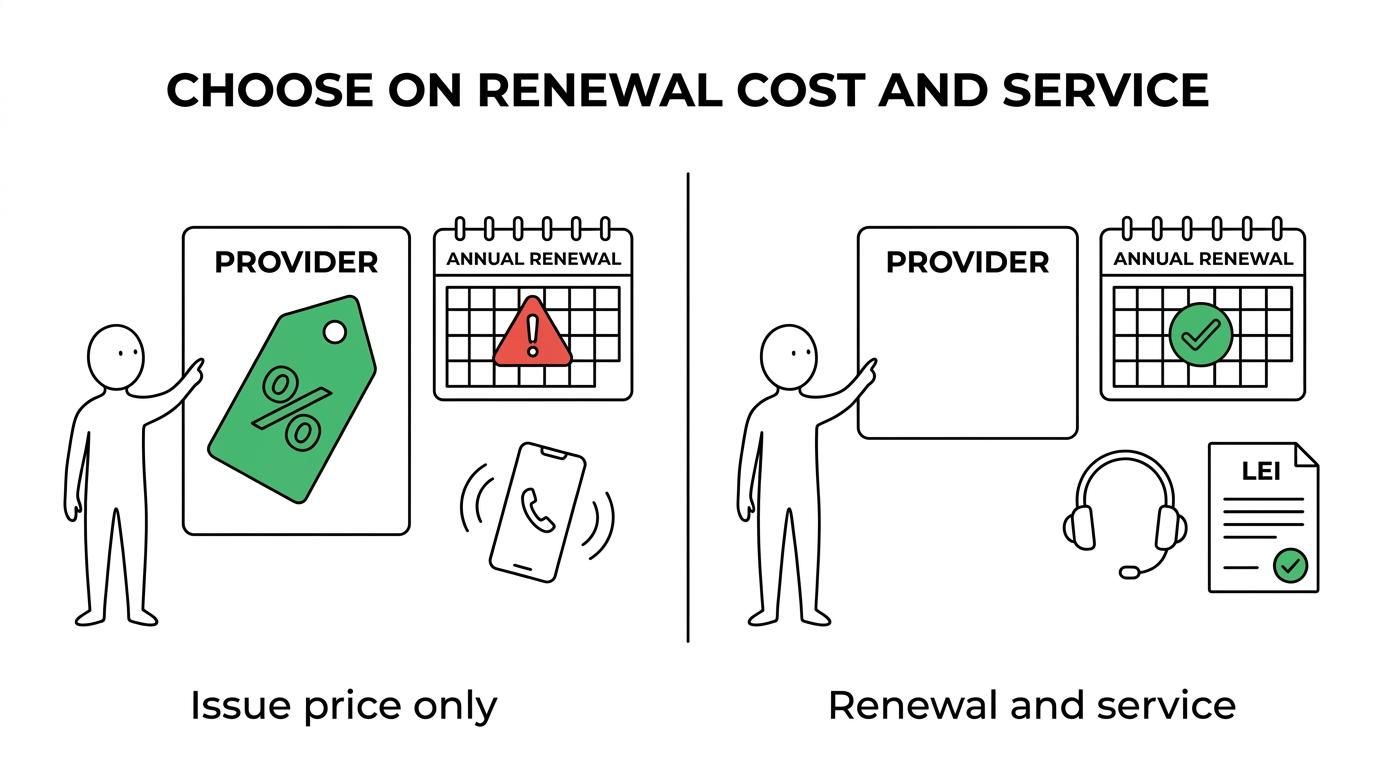
- Compare providers on four points first: one-year price, renewal workflow, support model, and transfer handling. A low first-year fee matters less if renewals are expensive or manual.
- If an ICAV already has an LEI, transferring to a lower-cost provider can be sensible when renewal is due, especially where the transfer fee is low or zero and the provider also handles the renewal.
- For umbrella funds and related parties, do not assume one LEI covers all entities. The LEI attaches to the legal entity that is being identified, not to the wider fund group.
An Irish collective asset-management vehicle is a distinct legal form under the Irish Collective Asset-management Vehicles Act 2015, so it should be treated as its own entity for LEI purposes. That makes provider choice practical rather than cosmetic: the right service should help the ICAV get issued quickly, stay current, and avoid avoidable administration around each renewal due date.
What should Irish ICAVs look for in an LEI provider?
Irish ICAVs should prioritise renewal discipline, reference-data accuracy, and support quality. GLEIF and EU identification rules make the Legal Entity Identifier more than a one-off code, so the provider needs to handle both issuance and ongoing maintenance well.
The most useful comparison starts with four criteria: published price, annual renewal process, transfer options, and whether support is available when registry details need checking. A common misconception is that all LEI services are interchangeable because the end product is the same 20-character code. In practice, the operational experience can differ a lot, especially when an ICAV has directors, administrators, or legal advisers coordinating documentation.
“LEI Service Ireland lists €64 for a new or renewal Ireland LEI code, with the GLEIF fee included.”
For Irish funds, renewal cost matters almost as much as first-time issuance. GLEIF says annual renewal is the mechanism used to re-validate reference data at least once a year, so an apparently cheap first year can become less attractive if the renewal path is manual, unclear, or costly.
Do Irish ICAVs and fund vehicles actually need an LEI?
Yes, most Irish ICAVs that trade, report, or are identified in regulated workflows should expect to need an LEI. The ICAV is a body corporate under Irish law, and EU rules use the LEI as a core identifier for legal entities where available.
Under Irish law, an ICAV is its own legal vehicle, formed and registered with the Central Bank of Ireland. That matters because the LEI belongs to the legal entity being identified, not to the promoter, management company, or depositary standing behind it.
EU regulatory texts also reinforce the LEI’s role. EUR-Lex materials state that institutions shall be identified solely by their LEI, and legal entities and counterparties other than institutions shall be identified by their LEI where available. If an ICAV is opening trading relationships, entering derivatives, or appearing in reporting chains, the practical answer is usually simple: have a current LEI in place before the counterparty asks.
What are the main LEI providers for Irish ICAVs today?
For Irish ICAVs, the most visible comparison set includes LEI Service, GS1 Ireland, and Euronext Direct. They all sit within the wider GLEIF LEI ecosystem, but they differ on pricing model, service structure, and how hands-on the process feels.
Published Ireland-market pricing is unusually useful here because it shows real spread between providers. That spread is big enough to make renewals worth checking rather than assuming all local options are within a few euro of one another.
- LEI Service: An official registration agent of Ubisecure RapidLEI, with published Ireland pricing of €64 for a new or renewed LEI, plus multi-year options of €162 for 3 years and €225 for 5 years.
- GS1 Ireland: A GLEIF-accredited Local Operating Unit that lists €89 plus VAT for initial registration, €59 plus VAT for annual renewal, and €0 for transfer.
- Euronext Direct: The LEI application platform for Euronext Dublin, offering register, update, renew, transfer, and challenge functions through a secure online submission process.
This is not an exhaustive global market list, but it is a strong starting point for Irish ICAVs because it combines local familiarity with published pricing or clearly stated service scope. Pro tip: check whether the published fee includes only the first issue or also reflects how the provider handles renewals, data updates, and support queries after issuance.
How do LEI Service, GS1 Ireland, and Euronext Direct compare on price and support?
On price, LEI Service is the lowest published one-year option in the provided Ireland comparison set, while GS1 Ireland has a lower published renewal than its initial registration, and Euronext Direct appears higher on the new-issue price in the cited 2026 comparison.
LEI Service Ireland publishes €64 for a new or renewal LEI. GS1 Ireland publishes €89 plus VAT for initial registration and €59 plus VAT for annual renewal, with €0 transfer. LEI Service Ireland’s published comparison shows Euronext Dublin at €160 for a new LEI code. That means the first-year spread across named Ireland-market options is material, especially if an ICAV has multiple entities to manage.
“LEI Service says issuance is typically within 1 to 48 hours, with possible same-day processing around 2 hours.”
Support structure is the other half of the decision. GS1 Ireland positions itself as a Local Operating Unit. LEI Service operates as an official registration agent of Ubisecure RapidLEI and states that it provides free phone and unlimited email support with responses within 24 hours. Euronext Direct highlights dedicated support and secure online submission. If an ICAV values human assistance when registry records are complex, that may justify a slightly different provider choice than raw price alone.
How should an Irish ICAV apply for a new LEI step by step?
The cleanest route is to match the ICAV’s legal details to the official registry record first, then submit the LEI application, then verify the issued data in the GLEIF system. Irish ICAVs usually move fastest when the incorporation details are exact from the start.
Before applying, confirm the ICAV’s registered name, registration number, registered address, and current authorised signatory or contact path. Small mismatches are a common cause of back-and-forth, especially where administrators or service providers use a shortened trading label instead of the formal legal name.
- Match the registry record: Use the ICAV’s exact legal name and registration details as they appear in official records.
- Choose the provider model: Decide between a lower-cost registration agent route or a direct Local Operating Unit route, based on support and renewal preference.
- Submit the application: Provide entity details, contact information, and any validation materials the provider requests.
- Check the issued LEI data: Confirm the legal name, address, status, and renewal due date once the LEI is live.
If the ICAV needs the LEI for an imminent trade or onboarding deadline, ask about validation cut-off times before submitting. Same-day issuance can be possible, but only when the underlying records are easy to verify.
How should a fund renew an LEI before the renewal due date?
Funds should renew early, verify any entity changes, and treat renewal as data re-validation rather than a payment-only task. GLEIF’s framework is built around annual review, so the due date is an operational checkpoint.
A smart workflow starts 30 days before expiry. That gives enough time to catch name changes, address changes, mergers, or service-provider updates without risking a status slip. A common misconception is that renewal can wait until the last moment because the LEI itself does not disappear. GLEIF says a lapsed LEI remains valid, but “valid” is not the same as “current” for operational use.
- Review entity data: Check the ICAV’s registered details and whether any corporate updates need to be reflected.
- Confirm the renewal provider: Renew with the existing provider or transfer to a lower-cost provider if the timing works better.
- Complete renewal before the due date: Pay and submit in time for the provider to re-validate the record.
- Record the next due date: Add diary reminders or use automatic renewal where appropriate.
“LEI Service offers 3-year and 5-year plans at €162 and €225, which can reduce annual admin for entities that want fewer renewal events.”
If the fund has several vehicles, multi-year pricing can reduce internal admin even when the per-year saving is modest. The trade-off is flexibility: if you expect structural changes soon, a single-year term can be easier to manage.
How can an ICAV transfer an LEI to a different provider?
An ICAV can usually transfer its LEI by authorising a new provider, validating entity details, and completing the transfer alongside renewal if required. Transfer is often the easiest way to cut cost without changing the LEI itself.
The important point is that the LEI number stays with the legal entity. A transfer changes the managing issuer relationship, not the identity code attached to the ICAV. That is why transferring near renewal date is often efficient: you solve cost, support, and status maintenance in one action.
- Pick the new provider: Compare renewal price, transfer policy, and support responsiveness.
- Authorise the transfer: Complete the provider’s transfer request and provide the current LEI.
- Validate and renew: Most transfers work best when the new provider also handles the next renewal cycle.
- Check live status: Confirm that the LEI remains current in the public record after the transfer completes.
GS1 Ireland publishes a €0 transfer fee, which is a useful benchmark. If an ICAV is unhappy with service or pricing, transfer friction is often lower than teams expect.
What is the difference between a lapsed LEI and a valid LEI?
A lapsed LEI is still valid according to GLEIF, but it is not current because its reference data has not been re-validated within the annual cycle. That distinction matters for brokers, fund administrators, and regulated reporting processes.
Think of the LEI in two layers. The code itself still points to the same legal entity, so it does not vanish at expiry. Yet the status tells the market whether the underlying legal reference data has been refreshed as required by the LEI system.
This is where operational risk appears. If a counterparty, venue, or reporting workflow expects a current LEI status, a lapsed record can create delays even though the code technically still exists. Pro tip: avoid testing how strict a downstream firm will be. Renew before the status question becomes a trading or filing issue.
Which entity in a fund structure needs its own LEI?
The legal entity being identified needs its own LEI. For an Irish ICAV, that usually means the ICAV itself, while a management company, AIFM, depositary, or investment adviser uses its own LEI for its own role.
The key rule is entity-level identification. One LEI does not “cover” a whole fund ecosystem. If the ICAV is the named counterparty, issuer, reporting entity, or regulated vehicle in a submission, it should have its own LEI.
This becomes more important in multi-entity structures. If a service provider already has an LEI, that does not remove the need for the ICAV’s LEI where the ICAV is the relevant legal person. If you are unsure, ask a simple question: whose legal name appears on the trade, filing, or contractual record? That entity usually needs the LEI.
What mistakes cause delays for Irish ICAV LEI applications?
Most delays come from data mismatch, late renewal timing, or confusion about which fund entity is applying. Irish ICAVs can avoid nearly all of these issues with a short pre-check before submission.
A provider can only validate what matches reliable source data. When the submitted legal name, address, or registration details differ from the official record, the application often slows down while the discrepancy is checked.
- Registry match: Use the exact incorporated name, not a shortened fund label or marketing name.
- Entity scope: Apply for the ICAV that needs identification, not a related manager or adviser by mistake.
- Renewal timing: Start before the renewal due date, not after status has already lapsed.
- Document control: Make sure the person handling the application has access to the latest formation and contact details.
- Support path: If the structure is unusual, choose a provider with phone or email support rather than relying only on self-service screens.
Another common error is treating price as the only variable. A lower fee helps, but a fund team that loses time chasing corrections can wipe out the saving quickly.
Is the cheapest LEI provider always the best choice for an ICAV?
No, the cheapest LEI provider is not always the best choice for an ICAV. LEI Service, GS1 Ireland, and Euronext Direct illustrate why: price, support model, renewal handling, and speed can point in different directions depending on the fund’s operating needs.
If the ICAV wants the lowest published one-year cost in the supplied Ireland comparison, LEI Service is the clear reference point at €64. If the team prefers a provider that is itself a GLEIF-accredited Local Operating Unit, GS1 Ireland may appeal. If the ICAV already works within Euronext-linked processes and values that channel, Euronext Direct can still be relevant even if its cited new-issue price is higher in the published comparison.
The best choice depends on the cost of failure, not just the cost of issue. If the ICAV needs quick turnaround, guided handling, and predictable renewals, a strong service model can matter more than a small fee difference. If the fund is highly standardised and self-sufficient, a simpler price-led choice may work well.