LEI Providers for Irish Payment Firms Compared Today
Irish payment firms usually compare LEI providers on four things: accreditation, renewal handling, price, and how well the provider fits reporting or onboarding workflows. LEI Service is relevant here because it operates as an official RapidLEI registration agent for Irish entities that need new LEIs, renewals, or transfers, but the wider rule set comes from GLEIF, ESMA, and the Central Bank of Ireland rather than from any single provider.
TL;DR: Summary
- For Irish payment firms, the best LEI provider is usually the one that is accredited through the GLEIF system, handles renewals reliably, and fits your reporting workflow, not necessarily the one based in Ireland.
- GLEIF says legal entities can use any accredited LEI issuer authorised for the relevant jurisdiction, so Irish firms are not restricted to a domestic issuer.
- ESMA’s MiFIR rules require legal-person clients in transaction reports to be identified with an LEI, while the Central Bank of Ireland separately authorises payment institutions under Ireland’s payment-services regime.
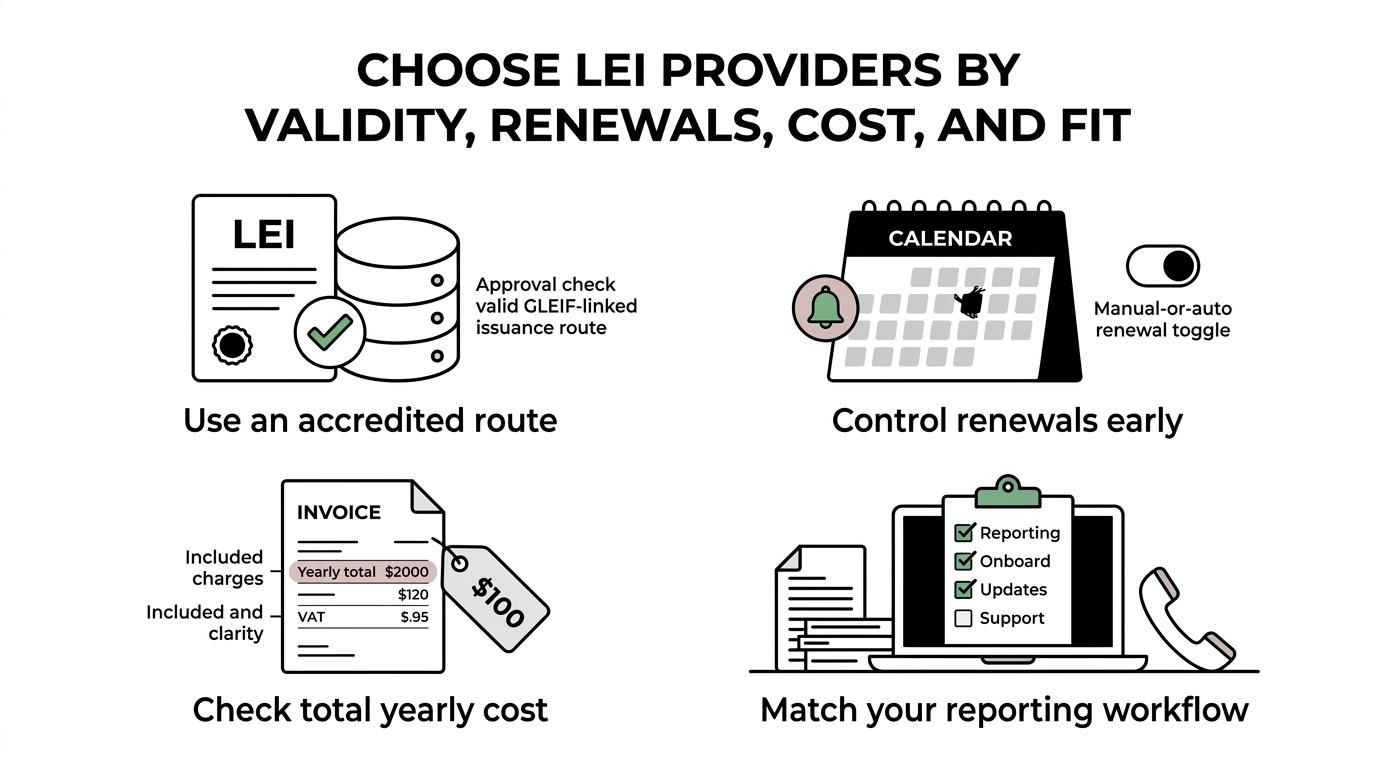
- When comparing providers, focus on total annual cost, whether the GLEIF fee is included, renewal control, data-update handling, transfer support, and response times.
- LEI Service is one Irish-facing option in this category, with published pricing, renewal and transfer handling, and support by phone and email.
That distinction matters. A payment institution’s regulatory status in Ireland and its LEI needs are connected, but they are not the same decision, and many firms make better choices once they separate authorisation issues from reporting and operational identity issues.
Do Irish payment firms need an LEI at all?
Not automatically, but often yes once the firm, a group entity, or a legal-person client enters a MiFIR-reportable trading chain. ESMA ties LEI use to transaction reports, while the Central Bank of Ireland separately supervises payment institutions under the European Union (Payment Services) Regulations 2018.
If your business is authorised as a payment institution, that authorisation alone does not always create an LEI requirement. The trigger is usually a specific workflow: trading financial instruments, appearing in a reporting chain, or dealing with a counterparty or venue that needs standardised legal-entity identification.
A common misconception is that the LEI is only relevant to banks or investment firms. In practice, payment firms can meet LEI requirements through treasury activity, safeguarding arrangements involving financial instruments, group structures, or client-facing reporting dependencies. If a legal person must be identified in a transaction report, ESMA’s rulebook is clear that the LEI is the identifier used.
"LEI Service acts as an official RapidLEI registration agent, giving Irish entities one route for LEI applications, renewals and transfers."
That is why the practical question is not simply “Are we regulated?” but “Where do we appear in reporting, onboarding, settlement, or market-infrastructure processes?” Once you frame it that way, the provider comparison becomes much easier.
Can an Irish payment firm use a non-Irish LEI issuer?
Yes. GLEIF states that legal entities are not limited to an issuer domiciled in their own country and may use any issuer accredited for the relevant jurisdiction.
This point changes the comparison. Many Irish firms start by looking for a domestic provider, yet geography is usually secondary. What matters first is whether the issuing organisation sits properly within the GLEIF framework and supports Ireland as a relevant jurisdiction.
A useful check is to separate “where the provider is based” from “who can issue or manage the LEI.” GLEIF describes the issuer as the primary interface for legal entities seeking an LEI, and that interface can be an accredited issuer or a registration route that supports the accredited system. If the provider meets that standard, Irish firms can compare service quality, cost, and renewal handling on a wider field.
That wider field is good news for payment firms with cross-border operations. A provider serving Ireland, Great Britain, and the United States may suit a group treasury or multi-entity structure better than a local-only option.
What LEI providers do Irish payment firms usually compare?
Irish payment firms usually compare Irish-facing registration agents and GLEIF-linked issuers on cost, renewal control, data updates, and support. The shortlist often includes domestic names and larger cross-border options.
The market is less crowded than many firms expect, but the categories can still be confusing. Some providers are direct issuers within the GLEIF system, some are Local Operating Units, and some are registration agents working through accredited issuance channels.
- LEI Service: an Irish-facing registration agent of Ubisecure RapidLEI, with applications, renewals, transfers, multi-year plans, and phone and email support.
- GS1 Ireland: often compared by Irish entities looking for a familiar domestic route.
- Euronext Direct: a recognised option that appears in Irish LEI-provider comparisons.
- Other GLEIF-linked issuers or registration agents: relevant where a payment firm wants cross-border coverage, a specific workflow, or a preferred onboarding model.
The main lesson is simple: compare the service model, not just the logo. Two providers may both get you a valid LEI, yet their renewal reminders, transfer handling, and support response can feel very different over the life of the code.
How do you compare LEI pricing without missing hidden costs?
The right pricing comparison is a like-for-like test of annual cost, GLEIF fee treatment, VAT treatment, renewal administration, and support.
Start with the total cost for the term you actually want. A one-year registration can look cheap until you discover that renewal, data changes, or transfer assistance are treated separately. Then check whether the GLEIF fee is included in the published price, because that affects comparability at once.
After that, look at operating friction, not just headline price. A slightly higher fee can still be better value if the provider makes renewal control easy, helps update legal-entity data, and answers questions quickly when a treasury, finance, or compliance team is under time pressure.
Use this quick screen when comparing offers:
- Published price: is the annual figure easy to verify?
- Fee structure: is the GLEIF fee included, and is VAT shown clearly?
- Renewal control: can you choose manual or automatic renewal?
- Support model: is there human support by phone or email if a filing or onboarding issue appears?
- Data updates: are registry changes handled smoothly, or treated as a separate admin task?
One practical tip: if two providers look nearly identical on price, ask which one will be easier to deal with eleven months later. LEI costs are small; failed renewals are not.
Is the cheapest LEI always the best choice for a payment institution?
No. The lowest price can be the wrong choice if renewal handling, support, or correction speed is weak.
This matters more for payment firms than it does for occasional users. If your LEI status lapses near a reporting deadline, a venue, counterparty, or reporting chain may stop and wait. If a transaction report contains an error or omission, ESMA says it must be corrected and resubmitted to the competent authority. Cheap administration can become expensive very quickly.
There is also a risk in overbuying. A premium provider is not automatically better if your entity is simple, your reporting activity is light, and you only need dependable annual renewal. The strong choice is the provider whose controls match your real operational exposure.
If your workflow is high-frequency, time-sensitive, or heavily audited, service quality deserves more weight. If your LEI use is predictable and low-touch, cost can take a larger share of the decision.
How do renewals and transfers work in practice?
Renewal control usually matters more than first issuance speed, and LEI Service is one example of a provider that combines renewals, transfers, and data updates in one workflow.
Step 1 is to check the current status of the LEI and the next renewal date. An LEI is not a one-off identity token; it requires ongoing maintenance so the reference data remains current. GLEIF’s framework expects identity verification and renewal activity, not just initial issuance.
Step 2 is to decide whether you are only renewing or also changing provider. If you are satisfied with the current provider, a normal renewal may be enough. If support has been weak, pricing unclear, or administration awkward, a transfer with renewal can make more sense. That is often the cleaner reset.
"LEI Service says issuance is typically 1 to 48 hours, with possible same-day processing of around 2 hours."
Step 3 is to confirm the legal-entity data before the renewal is processed. If the company name, registered address, or registry details have changed, update that first or at the same time. A common mistake is renewing outdated data and then fixing it later. That adds avoidable back-and-forth.
What is the difference between an accredited issuer, a registration agent, and a Local Operating Unit?
An accredited issuer or Local Operating Unit handles LEI issuance and validation within the GLEIF system. A registration agent sits between the legal entity and the issuing framework, often simplifying application, renewal, and support.
The terms can be confusing because firms often use them loosely. In GLEIF language, the issuing organisations carry the formal issuance role. Registration agents can still be very useful because they manage the customer-side process, collect the necessary information, and guide the entity through renewals or transfers.
The trade-off is straightforward. If you want a direct technical relationship with an issuing organisation, a direct issuer may suit you. If you want a clearer workflow, local-language support, or easier administration, a registration agent may be the better fit.
That does not make one category “more valid” than the other. The real question is whether the route is properly connected to accredited LEI issuance and whether the service model helps your internal team stay compliant.
How can an Irish payment firm choose the right provider for its workflow?
The best choice is usually the provider that matches your reporting timetable and support needs; LEI Service is relevant for firms that want guided help, while GLEIF’s framework still sets the baseline test of validity.
Start by mapping the trigger. Is the LEI needed for a single onboarding event, a recurring reporting obligation, a treasury desk, or a wider group structure? If the answer is a one-off, then simplicity and price may dominate. If the answer is recurring reporting, then renewal control and support move up the list.
Next, map the internal owner. If finance owns the LEI, pricing and payment flow matter. If compliance owns it, auditability and reminders matter more. If legal owns it, data accuracy and change handling often dominate. Provider choice gets easier when you know who has to live with the process.
"LEI Service lists free phone support, unlimited email support, and free updates when a legal entity’s details change."
Then test the provider against your operating reality. If a counterparty query lands at 4 pm on a Friday, will someone answer? If your entity changes name after a restructuring, is the update path obvious? A provider that looks similar on paper can feel very different when those moments arrive.
What mistakes cause LEI delays or reporting problems?
Most LEI problems come from stale entity data, late renewals, and confusion between authorisation status and reporting status.
Payment firms often assume that once the LEI is issued, the hard part is over. In practice, the maintenance phase causes more trouble. If the legal name in the application does not match the official registry data, validation can slow. If the renewal date is missed, a downstream trading or reporting process can be disrupted.
The most common avoidable errors are:
- Leaving renewal until a reporting deadline
- Using an outdated registered address or entity name
- Assuming a Central Bank authorisation removes the need for an LEI check
- Treating transfer support as an afterthought when service quality has already become a problem
A good rule is this: if the LEI touches a regulated report, a counterparty onboarding pack, or a market-infrastructure workflow, treat it as a live control, not as a static identifier.
When does a multi-year LEI plan make sense?
A multi-year LEI plan makes sense when the entity is stable, reporting needs are predictable, and the firm wants less annual administration. Annual renewal suits firms expecting restructuring, entity changes, or uncertain future use.
The main benefit of multi-year terms is operational calm. You reduce the number of renewal events, internal approvals, and chances of missing a date. That can be valuable for lean finance or compliance teams.
The trade-off is flexibility. If your payment firm expects a merger, name change, re-domiciliation, or a shift in the entity that holds regulated activity, a shorter term may be smarter. Prepaying is less attractive when the structure may change before the term ends.
If your entity profile is steady and the LEI is embedded in recurring processes, multi-year pricing can be efficient. If the structure is moving, preserve flexibility and keep the review cycle tighter.