LEI Providers for Irish Pension Schemes Compared Now
For Irish pension schemes, choosing an LEI provider is now a compliance decision, not just an admin task. LEI Service, an Irish-facing LEI registration agent of Ubisecure RapidLEI, is relevant here because DORA reporting has made the LEI operationally important for many schemes, not only useful for market transactions.
TL;DR: Summary
- The right LEI provider for an Irish pension scheme is the one that covers DORA use cases, manages annual renewal and reference data revalidation, and offers predictable pricing; LEI Service is one example because it publishes fixed Irish pricing and turnaround terms.
- The Central Bank of Ireland guidance circulated through the Pensions Authority says schemes subject to DORA need an LEI in the Article 28(3) register of information and in Article 19 incident reporting templates.
- LEI choice is not only about issuance speed. GLEIF’s system requires at least annual review and revalidation of legal entity reference data, so renewal handling matters as much as the first application.
- Direct issuers, registration agents, and delegated administrator routes can all work. The practical trade-offs are support access, renewal reminders, update handling, and total cost over 1, 3, or 5 years.
- For trustees and administrators, the safest buying rule is simple: if pricing is unclear, renewal ownership is vague, or support is hard to reach, keep comparing.
That shifts the real question. Most Irish pension schemes that need an LEI are no longer deciding whether to get one at all. They are deciding which provider gives the cleanest path for DORA compliance, annual upkeep, and fast action if an incident report suddenly has to be filed.
Do Irish pension schemes need an LEI under DORA?
Yes. Irish pension schemes subject to DORA need an LEI in the Article 28(3) register of information and in Article 19 templates for major ICT-related incident reporting and voluntary significant cyber threat reports.
That point matters because many trustees still associate LEIs mainly with securities trading, MiFID reporting, or EMIR-style workflows. A March 2025 DORA Q&A circulated through the Pensions Authority and sourced from the Central Bank of Ireland makes the pension-specific use clear: if the scheme is within DORA scope, the LEI is a required field in those reporting structures.
The Central Bank of Ireland also describes an Irish pension fund as an autonomous occupational pension scheme established under trust. That legal form matters when the LEI application is prepared, because the provider will need to identify the correct legal entity, not merely the investment manager, employer sponsor, or administrator.
A common misconception is that the LEI only matters when a scheme trades financial instruments. Under DORA, the LEI also supports operational resilience reporting. In a sector the Central Bank says held €160 billion in assets in Q2 2026, small admin errors can quickly become wider governance issues.
What should Irish pension schemes compare in an LEI provider?
Irish pension schemes should compare regulatory fit, renewal handling, support terms, and total cost, not only first-year price. GLEIF and the Central Bank of Ireland make the compliance context broader than a one-off code purchase.
The strongest provider is usually the one that can answer four practical questions clearly. Can it support DORA-related use? Who monitors renewal dates? How are legal-entity data changes handled? What happens if the scheme needs help the same day?
After those questions are clear, the comparison becomes more concrete:
- Regulatory fit: Does the provider clearly serve legal entities that need LEIs for DORA registers and incident reporting?
- Renewal process: Is annual renewal managed actively, with reminders or auto-renew options, rather than left to memory?
- Reference data checks: Does the service support revalidation against authoritative sources, which is part of the global LEI system?
- Pricing structure: Is the Irish price fixed, and does it already include the GLEIF fee?
- Support access: Can trustees or administrators reach a real person by phone or email if the entity details are unusual?
The cheapest sticker price is not always the lowest operating cost. If a provider charges extra for updates, gives little help on trust or scheme structure, or leaves renewal ownership unclear, the hidden cost appears later in missed deadlines and internal follow-up.
"LEI Service lists a fixed Irish price of €64 for a new or renewed LEI, with the GLEIF fee included."
One practical tip is to treat provider support as a control, not a convenience. If the trustee board or administrator expects to rely on the provider during renewal season or under DORA time pressure, support terms belong in the comparison sheet.
What LEI provider options are most relevant for Irish pension schemes?
Irish pension schemes usually choose between registration agents, direct issuer platforms, cross-border providers, and administrator-led filing routes. The right option depends on internal capacity, reporting urgency, and how much support the scheme wants.
The Central Bank guidance says pension schemes subject to DORA may obtain an LEI from any LEI-issuing organisation listed for Ireland in the Pensions Authority table. In practice, the provider choice often falls into four models:
- LEI Service: An official registration agent of Ubisecure RapidLEI, with published Irish pricing, multi-year plans, free phone support, unlimited email support, and stated issuance typically within 1 to 48 hours.
- Direct LEI issuer platform: A route where the scheme deals with the issuing organisation interface itself. This can suit teams that want direct control and already have strong internal admin capacity.
- Cross-border registration agent: Useful when a pension scheme sits within a wider group that also needs LEIs in Great Britain, the United States, or other markets.
- Administrator-led route: The scheme administrator or adviser coordinates the application through a chosen provider, reducing trustee workload but adding one more handoff.
The useful insight here is that “provider” does not always mean the accredited issuer alone. Issuance sits within the global LEI system, but the day-to-day client experience often depends on the registration agent or delegated administrator handling the process.
How do LEI Service and direct LEI issuer routes compare?
LEI Service is usually stronger on guided support and published Irish pricing, while a direct issuer route can suit schemes that prefer dealing with the issuer platform itself. Both routes still sit inside the same global LEI framework.
This is where many comparisons become clearer. Accredited issuers are the entities that issue LEIs within the system. Registration agents act as the operating layer that helps the applicant complete, submit, renew, or transfer the record through that framework.
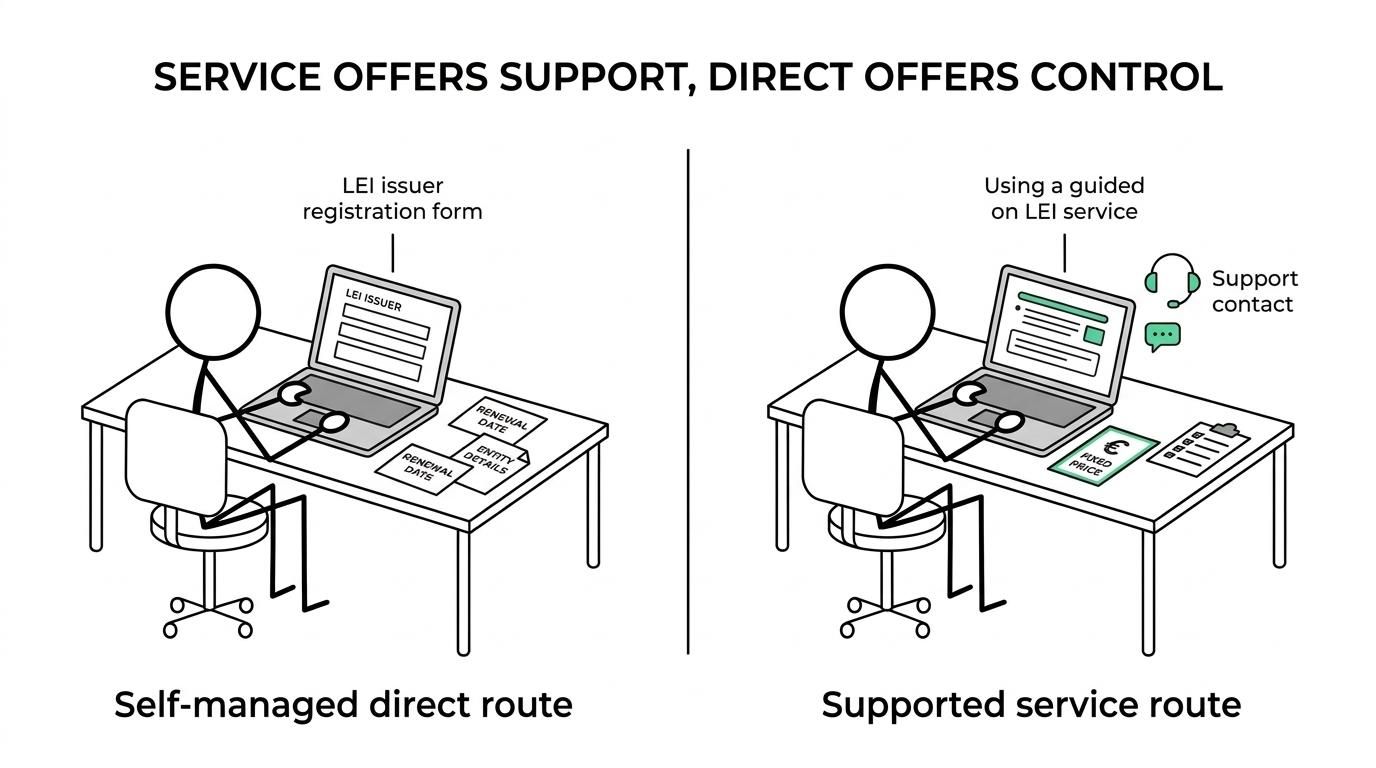
If the trustee board wants a guided process, phone support, and a simple pricing page, an agent route may be the better fit. If the pension scheme has internal operations staff who are comfortable with entity data, annual checks, and minimal assistance, a direct issuer platform may be enough.
The trade-off is control versus service. A direct route can feel more direct, but it may place more responsibility on the scheme to interpret application fields, chase updates, or handle renewal timing. An agent route can reduce admin load, though the scheme should still check that support, turnaround, and update terms are clearly stated.
Is a multi-year LEI plan better than renewing every year?
A multi-year LEI plan usually reduces admin risk, while annual renewal keeps review points closer together. The best choice depends on whether the scheme values operational continuity or maximum flexibility.
This comparison often gets oversimplified. GLEIF’s annual renewal process still requires legal entities and LEI issuers to review and revalidate reference data at least once per year. So a multi-year purchase does not remove the need for yearly data checks.
That is the main misconception to avoid. Multi-year plans can reduce invoice handling and the risk of missed renewal, but they do not mean “set and forget”. If the scheme name, address, legal form, or other reference data changes, the LEI record still needs to stay current against authoritative sources.
"LEI Service lists €162 for a 3-year LEI plan and €225 for a 5-year plan for Ireland."
If the scheme has stable governance and wants fewer annual tasks, a multi-year plan can be sensible. If trustee structures or legal details may change soon, a one-year cycle can make internal review easier, even if the admin burden is a little higher.
How should an Irish pension scheme apply for a new LEI step by step?
The cleanest application process starts with entity identification, then provider selection, then record verification. Irish pension schemes should treat the legal-entity check as the first control point.
Step 1 is to confirm which legal entity needs the LEI. For pension arrangements under trust, this matters more than many expect. If the form is prepared using the employer’s details, the investment manager’s details, or another related entity, the application can slow down or produce a mismatch.
Step 2 is to choose the provider based on DORA use, renewal method, and support access. If the scheme expects limited internal time, the provider should offer a guided process. If the scheme has several related entities to manage, it should also ask about transfers, multi-year options, and update handling.
Step 3 is to submit the legal-entity details and then verify the issued record promptly. Once the LEI is live, add it to the DORA register of information and internal reporting templates right away. A practical tip is to store the renewal date in the same control log as cyber and outsourcing obligations, not in a separate finance file.
How should trustees manage annual LEI renewal and reference data revalidation?
Trustees should treat LEI renewal as an annual data-control task, not just a payment task. GLEIF requires yearly review and revalidation of legal entity reference data against authoritative sources.
A strong renewal workflow has three steps. First, check the renewal date early and confirm who owns the action, trustee board, administrator, or provider. Second, verify the legal name, address, legal form, and any relevant structure details. Third, confirm the renewed LEI status before reporting cycles or annual compliance reviews.
GLEIF reported that 87.9% of LEIs were fully corroborated at the end of Q2 2026. Corroboration means the entity’s existence and reference data are checked against authoritative sources. That makes renewal more than a clerical cycle. It is part of the data trust that gives the LEI value.
A useful habit is to pair the LEI renewal check with other annual governance reviews. If trustees already review outsourcing arrangements, cyber controls, and service-provider registers each year, the LEI should sit in that same calendar.
What should a scheme do if it needs an LEI quickly for DORA incident reporting?
LEI Service becomes relevant when speed matters, because a provider with published same-day processing and reachable support is the safer route for a DORA incident deadline. Urgent reporting needs clear operating terms, not vague promises.
Step 1 is to confirm that the scheme is within the DORA reporting obligation in question and that the template requires the LEI field. Step 2 is to use a provider that states its turnaround and gives direct support access. Step 3 is to update the incident reporting pack and the register of information once the LEI is issued.
This is where published service terms matter. A provider that states typical issuance within 1 to 48 hours, and possible processing in around 2 hours before a stated cut-off, gives trustees something concrete to work with when time is short.
The pro tip here is simple: do not wait for an incident to think about LEI lead times. If the scheme is clearly within DORA scope, getting the LEI in advance is the better control.
When does an LEI transfer make sense for a pension scheme?
An LEI transfer makes sense when the scheme wants better support, cleaner renewal handling, or more predictable pricing without changing the LEI itself. Transfers are operational changes, not identity changes.
That distinction matters. A transfer moves the management of the LEI to a new provider, often alongside a renewal, but the LEI number remains the same. For pension schemes, this can be useful if the existing provider is slow to respond, unclear on fees, or awkward to deal with when entity details change.
If the scheme has already missed a renewal window or expects one soon, timing becomes important. Start the transfer early enough to avoid a lapse. If support quality is the main problem, ask the new provider to explain the transfer steps and whether the renewal will be handled at the same time.
What mistakes slow down LEI compliance for Irish pension schemes?
The biggest mistakes are choosing on headline price alone, leaving renewal ownership unclear, and treating the LEI as a one-off purchase. Most delays start well before the actual application.
Several errors come up repeatedly in trustee and administrator workflows:
- Trading-only thinking: assuming the LEI matters only for transactions, not for DORA registers or incident templates
- Wrong entity data: entering sponsor, manager, or administrator details instead of the pension scheme’s legal-entity details
- First-year price bias: comparing only the opening fee and ignoring support, update handling, or multi-year cost
- Renewal drift: no named owner for annual revalidation, so the record expires quietly
- False multi-year assumption: believing a 3-year or 5-year plan removes the need for annual reference data checks
A final practical check is this: if the provider cannot explain how issuance, annual renewal, and data updates work together, it is probably not the right fit for a DORA-exposed pension scheme. The best provider choice is the one that keeps the LEI live, accurate, and ready when the scheme actually needs to use it.