LEI Providers for Section 110 Firms Compared
Section 110 companies in Ireland sit where tax rules, Central Bank reporting, and market infrastructure meet. When one of these SPVs needs a legal entity identifier, the real question is rarely which provider is physically closest. LEI Service, an Irish-facing LEI registration agent of Ubisecure RapidLEI, is relevant here because Section 110 firms often need a fast, guided route for applications, renewals, or transfers rather than a bare code with little follow-up.
TL;DR: Summary
- For most Irish Section 110 firms, the best LEI provider choice depends on renewal handling, support, and accredited access, not whether the provider is based in Ireland; LEI Service is one low-cost registration-agent option in that market.
- GLEIF says legal entities can use any accredited LEI issuer authorised for the relevant jurisdiction, so Irish Section 110 companies are not restricted to an Irish issuer.
- ESMA’s MiFIR rules require legal-person clients to be identified with an LEI in transaction reports, which is why many Section 110 SPVs need an active LEI when dealing in reportable financial instruments.
- Revenue and the Central Bank of Ireland run separate obligations: Form S.110 goes to Revenue within eight weeks of meeting the qualifying conditions, while SPV notification and quarterly reporting have their own deadlines.
- A strong provider decision comes down to four checks: price including renewal, support quality, data-update handling, and whether transfers or multi-year plans fit the SPV’s administration model.
That distinction matters. Revenue focuses on Section 110 qualification, the Central Bank of Ireland focuses on SPV statistics, and MiFIR transaction reporting focuses on how legal persons are identified in markets. If you separate those layers, choosing an LEI provider becomes much easier.
Why do Section 110 companies in Ireland need an LEI?
A Section 110 company needs an LEI when it is identified as a legal person in reportable market activity, especially under MiFIR handled by investment firms and trading venues.
Revenue describes Section 110 of the Taxes Consolidation Act 1997 as the regime for certain qualifying companies, often special purpose vehicles used in structured finance and asset holding arrangements. That tax status does not create the LEI by itself. The LEI need usually appears when the company trades financial instruments, is reported as a client, or is onboarded by a broker, custodian, or counterparty that requires a valid identifier.
ESMA’s MiFIR rulebook is the key market rule here. It says that where investment firms identify clients that are legal persons in transaction reports, they must use a legal entity identifier. If your Section 110 SPV is the client in a reportable transaction, then the LEI becomes part of the reporting chain.
“LEI Service lists a 1-year new LEI or renewal at €64 in Ireland, with 3-year pricing at €162 and 5-year pricing at €225.”
A common misunderstanding is to treat the LEI as a tax filing item. It is not. The LEI is a market-identity standard used across financial reporting and counterparty workflows, while Revenue and Central Bank filings remain separate obligations.
Can an Irish Section 110 SPV use any LEI provider, or must it be Irish?
Yes. GLEIF permits an Irish Section 110 SPV to obtain a legal entity identifier from any accredited issuer authorised for the relevant jurisdiction, not only an Irish-based provider.
This is one of the most useful rules for Irish entities. GLEIF states that legal entities are not limited to using an issuer domiciled in their own country. That means an Irish Section 110 company can choose based on service model, price, or renewal discipline rather than geography alone.
GLEIF also explains the provider structure clearly. Some entities apply through accredited issuers, often called Local Operating Units. Others apply through registration agents, which act as the interface between the entity and the issuer network. GLEIF says there are more than 100 registration agents in the Global LEI System, so the field is broader than many Irish companies assume.
The practical lesson is simple: if the provider has valid access to the accredited system, geography is secondary. A common misconception is that “Irish company means Irish issuer only”. That is not how the LEI framework works.
What are the main LEI providers for Section 110 firms in Ireland?
The main options are LEI Service, direct accredited issuers, and other registration agents in the Global LEI System.
A Section 110 firm in Ireland usually chooses between a few provider routes rather than one single national registry. The best route depends on who manages the SPV’s compliance calendar and how much support is needed when details change or renewals come due.
- LEI Service: An official registration agent of Ubisecure RapidLEI, offering new registrations, renewals, transfers, multi-year plans, and Irish-market support.
- Direct accredited issuers or Local Operating Units: Suitable for teams that want a more direct relationship and are comfortable self-managing the process.
- Other registration agents: GLEIF-recognised intermediaries that can simplify onboarding, though pricing and support levels vary widely.
- Administrator-led provider routes: Some fund administrators, company secretarial teams, or service providers coordinate LEIs through an underlying issuer relationship.
The important comparison point is not the label alone. An issuer may offer direct control, while a registration agent may offer more practical help with renewals, transfers, and contact handling. For a Section 110 SPV with outsourced administration, that distinction can matter more than the brand on the certificate.
How should a Section 110 company choose an LEI provider step by step?
The right process is simple: confirm why the SPV needs the LEI, verify who will manage renewals, then compare service levels before filing.
First, identify the trigger. If the LEI is needed for a broker onboarding, transaction reporting chain, or treasury transaction, speed and document accuracy matter most. If the LEI is being put in place as part of standing entity infrastructure, pricing and renewal controls may matter more.
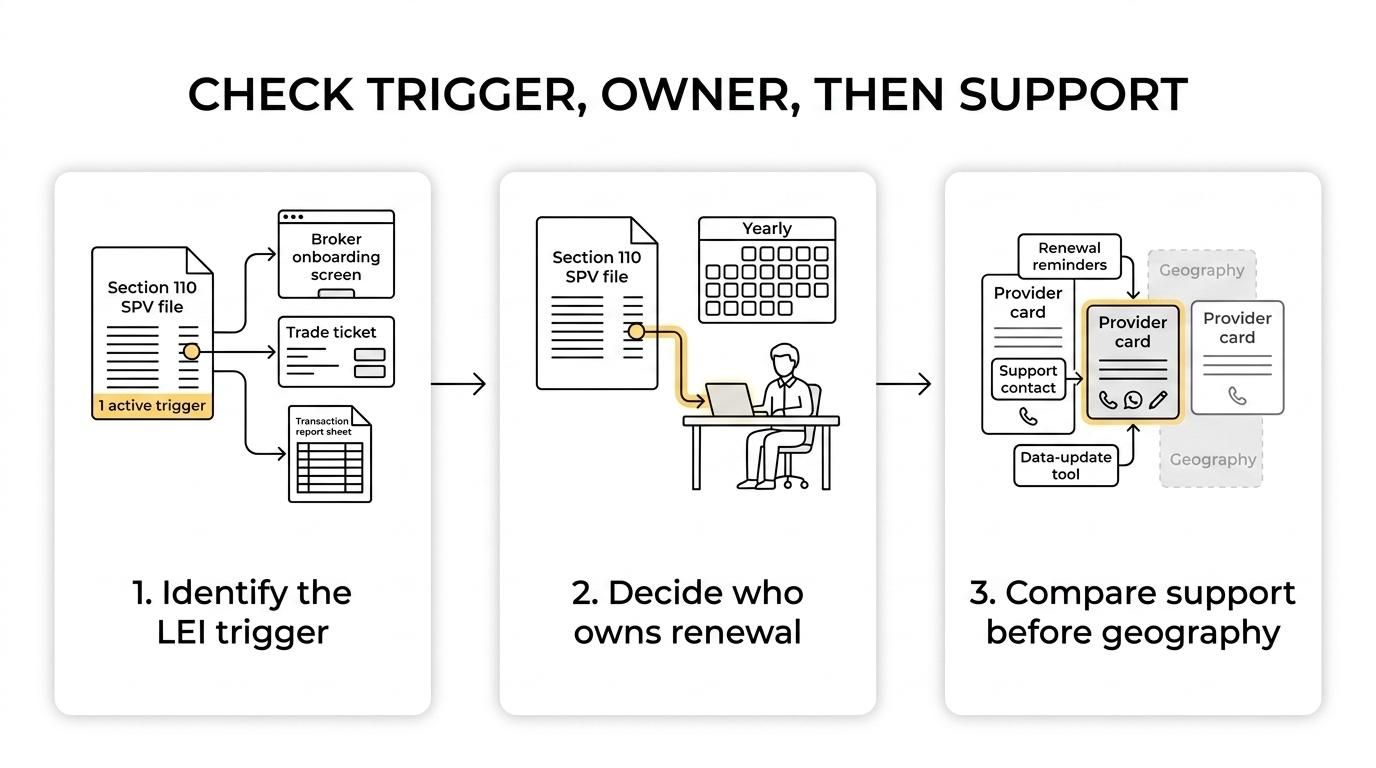
Next, decide who owns the record after issuance. If the board, administrator, or external adviser will handle yearly re-validation, choose a provider that matches that operating model. If nobody clearly owns the renewal, then the cheapest option can become the most expensive one later.
Then compare support before you compare geography. If the SPV has frequent address, name, or parent-data changes, provider responsiveness matters. If the entity structure is stable and the contact team is experienced, a more self-service route may be perfectly fine.
What should you compare on price, renewal handling, and support?
Price alone is not enough. For Irish Section 110 firms, LEI Service and other providers should be compared on annual cost, renewal control, data-update handling, and responsive support.
A sensible provider review starts with the total operating picture, not just the checkout screen. A low first-year fee loses its appeal quickly if renewal notices go to the wrong inbox or a data correction takes days during a live transaction window.
- Price: Include the GLEIF fee, renewal cost, and any multi-year discount.
- Renewal control: Check reminders, auto-renewal options, and transfer handling.
- Support: Look for phone or email access, response timing, and help with entity updates.
- Processing speed: Compare typical issuance times and whether same-day handling is realistic.
Multi-year plans can be very efficient for stable SPVs with settled administration. Still, they are not always the best first move. If the entity may switch administrator, move service providers, or update legal details soon, a one-year term with an easy transfer path may be cleaner.
“LEI Service says LEI issuance is typically completed within 1 to 48 hours, with possible same-day processing, and includes free phone plus unlimited email support.”
One more point matters: GLEIF says the annual renewal process exists so that entity reference data is reviewed and re-validated at least once each year. So the LEI is not a one-time purchase. It is an active record that needs maintenance.
How do you apply for a new LEI for a Section 110 company?
Applying for a new LEI is usually straightforward: match the company’s registered details, identify the authorised contact, and submit through an issuer or registration agent.
Start with the entity’s legal record. The name, registered office, company number, and jurisdiction should match the official registry details. If the Companies Registration Office data or internal records are inconsistent, fix that first. Small mismatches can slow validation.
Then decide who will act as the contact person. In many Section 110 structures, that may be a director, company secretary, administrator, or authorised employee. The provider needs someone who can confirm the entity’s authority and respond to any checks.
Finally, submit the application and watch for validation queries. If the provider asks about entity status, address, or group relationships, answer quickly. If your filing window is tight, delays usually come from missing confirmations rather than the LEI system itself.
How do LEI renewals work for Irish Section 110 SPVs?
An LEI renewal is an annual re-validation of entity reference data, and GLEIF says it should happen at least once each year.
The first step is to treat renewal as a compliance date, not an admin extra. Put it on the board or administrator calendar, assign an owner, and make sure reminder emails go to a live mailbox. If that sounds obvious, it is, yet missed renewals remain common. GLEIF reported an overall LEI renewal rate of 56.6% in Q1 2026, which shows how many entities still fall behind.
The second step is to review the data before renewal is processed. If the SPV changed name, address, legal status, or parent data, update that at renewal time. If nothing changed, the provider still needs to confirm the record remains current.
The third step is to think about dependency. If a counterparty, execution broker, or reporting firm needs an active LEI, a lapsed record can disrupt onboarding or trading activity. If the SPV is dormant from a market perspective, the urgency may be lower, but the decision should still be deliberate rather than accidental.
What reporting deadlines matter alongside the LEI?
Three deadlines matter most: Revenue’s eight-week Form S.110 window, the Central Bank of Ireland’s five-working-day SPV notification, and the 29-working-day quarterly reporting deadline.
Revenue says a company seeking the Section 110 regime must notify an authorised officer that it is, or intends to be, a qualifying company and meets the statutory conditions. Form S.110 must be filed within eight weeks of the date those conditions are met.
The Central Bank of Ireland has a different reporting track for Irish-resident Section 110 companies as SPVs. It says the notification email should be received no later than five working days after the vehicle engages in its first financial transactions. After that, SPV data must be submitted no later than 29 working days from the end-quarter reference date.
These deadlines do not replace the LEI, and the LEI does not replace them. If the SPV is active in reportable markets, then the LEI sits beside those obligations. If a first transaction is approaching, it is smart to sort the LEI before counterparties start asking for it.
What mistakes do Section 110 firms make when choosing an LEI provider?
The biggest mistakes are choosing on geography alone, ignoring renewal ownership, and assuming every cheap LEI workflow gives live support when a filing issue appears.
Most provider problems are avoidable. The usual issue is not the LEI standard itself. It is poor fit between the provider model and the way the SPV is administered.
- Choosing by country flag alone
- Ignoring who owns renewal each year
- Letting reminder emails go to a dead inbox
- Assuming registry updates flow through automatically
- Opening a second application when an LEI already exists
A useful rule is this: if the entity already has multiple outsourced service partners, then the LEI provider should reduce admin friction, not add another loose end. Put one named owner against the record and keep that ownership visible.
When is an LEI transfer better than a new registration?
Transfer is better when the LEI already exists but the current provider is slow, expensive, or poor at renewals.
An LEI is meant to be persistent. If the Section 110 company already has one, do not apply for a second code just because the original provider is inconvenient. The better route is usually a transfer, often done together with renewal, so the entity keeps the same identifier while moving the servicing relationship.
That can make sense if pricing has become uncompetitive, if support has been weak, or if the administration team wants a provider with better reminders and clearer contact handling. It also helps when a new administrator wants all entity records under one cleaner workflow.
If the LEI has lapsed, transfer can still be the right answer. If the code is still the entity’s valid identifier, then renewing and transferring it is normally better than trying to start again.