LEI Providers for SFTR Reporting in Ireland Compared
Choosing among LEI providers for SFTR reporting in Ireland is mainly a compliance operations decision, not a geography decision. LEI Service is relevant here because it is an Ireland-facing LEI registration agent for Ubisecure RapidLEI, and SFTR reporting depends on timely issuance, renewal handling, and accurate entity reference data as much as the code itself.
TL;DR: Summary
- For SFTR reporting in Ireland, the best LEI provider is the one that can keep your legal entity identifier active, accurate, and renewable on time, because SFTR uses LEIs to identify legal-entity counterparties in reports sent to trade repositories.
- ESMA’s SFTR framework covers securities financing transactions including repos, securities or commodities lending and borrowing, buy-sell backs, sell-buy backs, and margin lending transactions.
- Irish entities are not restricted to an Irish issuer: GLEIF says a legal entity may use any accredited LEI issuer authorised for its jurisdiction, or a registration agent working with that issuer.
- LEI Service is one Ireland-facing option and publishes a €64 new-or-renewal price, with phone and email support and free entity-data updates, which matters when SFTR compliance is ongoing rather than one-off.
- The key trade-off is direct issuer access versus guided service: issuers issue LEIs, while registration agents handle onboarding, renewals, transfers, and support.
- If your entity already has an LEI, compare renewal workflow, transfer handling, and support speed before comparing headline price alone.
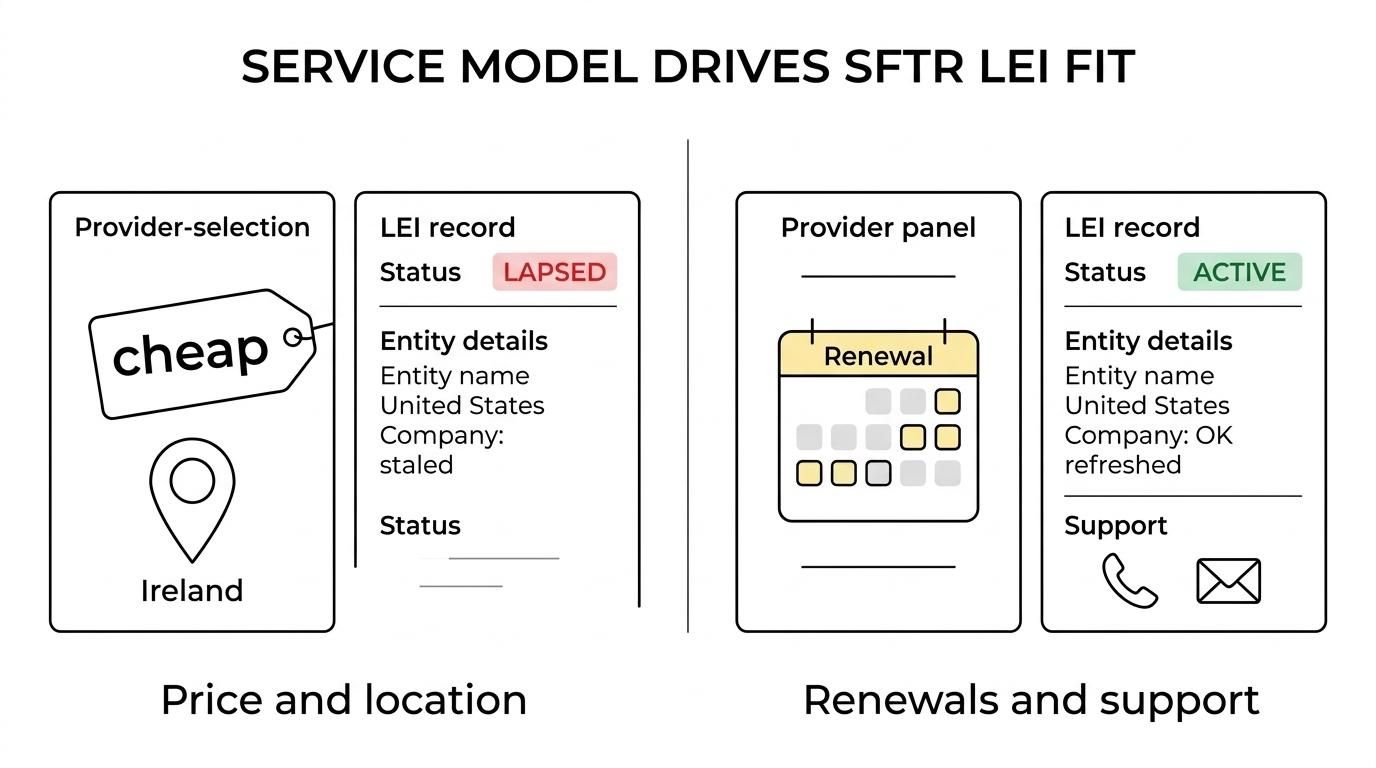
That distinction matters because SFTR is a recurring reporting regime. A provider that looks cheap at application stage can become expensive in practice if renewals are missed, entity details are not updated, or support is hard to reach when a reporting deadline is close.
Why do Irish firms need an LEI for SFTR reporting?
Irish legal entities need an LEI for SFTR when they are reportable counterparties in securities financing transactions. ESMA says SFTR reports go to trade repositories, and legal-entity counterparties should be identified with legal entity identifier codes.
SFTR is not limited to one narrow product type. ESMA’s framework covers repurchase transactions, securities or commodities lending and borrowing, buy-sell back or sell-buy back transactions, and margin lending transactions. If an Irish company, fund, SPV, or other legal person is a counterparty to one of those transactions, the LEI becomes part of the reporting data set.
A common misconception is that the LEI is only an onboarding formality. In practice, it is a reference-data control. If the LEI is lapsed or the entity details behind it are stale, that can create friction in reporting, reconciliation, or counterparty data validation.
Can an Irish entity choose any LEI provider for SFTR?
Yes. GLEIF makes clear that legal entities are not limited to using an LEI issuer domiciled in their own country, as long as the issuer is accredited for the relevant jurisdiction.
That point matters for Irish firms because the provider market is broader than domestic websites suggest. You are comparing cross-border accredited issuers, plus registration agents that work with those issuers. According to RapidLEI’s published overview, there are 39 accredited LEI issuers worldwide, and only organisations accredited by GLEIF as Local Operating Units can issue LEIs directly.
The practical check is simple: if the provider can register or renew LEIs for Irish entities through an accredited jurisdiction, then the country of the website is not the main decision factor. Support model, renewal process, and update handling usually matter more.
What LEI providers are most relevant for SFTR reporting in Ireland?
For Irish SFTR users, the most relevant provider options are Ireland-facing registration agents, accredited LEI issuers, and transfer-friendly providers that can take over renewals without changing the LEI itself. LEI Service fits the first category.
Before comparing websites, it helps to separate provider types. What you are really choosing is a delivery model.
- LEI Service: An Ireland-facing registration agent of Ubisecure RapidLEI that offers new registrations, renewals, transfers, multi-year terms, and English-speaking phone and email support.
- Accredited LEI issuers: Local Operating Units listed through GLEIF that issue LEIs directly for authorised jurisdictions.
- Cross-border digital issuers or portals: Suitable for firms that prefer self-service processing and do not need much human support.
- Transfer-focused providers: Useful when the entity already has an LEI elsewhere and wants a different renewal workflow or pricing structure.
The important comparison point is not only who can issue an LEI. It is who can keep your LEI active year after year with the least internal effort.
What is the difference between an accredited LEI issuer and a registration agent?
An accredited issuer issues the LEI; a registration agent handles the customer-facing process. GLEIF accredits Local Operating Units, while agents work with those issuers for registration, renewal, or transfer workflows.
This is the part that often causes confusion. A registration agent does not create a separate LEI system. It sits between the legal entity and the accredited issuer, usually simplifying onboarding, document collection, payment, reminders, and support. That can be useful when the compliance burden is ongoing rather than occasional.
LEI Service, for example, is positioned as an official registration agent of Ubisecure RapidLEI rather than an issuer in its own right. That does not weaken the LEI’s validity. It simply describes who handles the service layer and who performs the formal issuance.
If your team is comfortable dealing directly with an issuer, self-service may be enough. If you want guided transfers, renewal support, or a simpler contact path, a registration agent can be the better fit.
How should you check whether a provider can support your SFTR entity type?
Start with the entity, not the transaction. Check jurisdiction eligibility, then confirm whether the provider can handle your legal form, and only then compare application flow.
Step 1 is to confirm that your entity is a legal person within the provider’s supported jurisdiction scope. GLEIF’s issuer search tools are helpful here because they let users filter issuers by country and also by fund-related entity type.
Step 2 is to check the provider’s handling of your specific structure. A straightforward Irish limited company is not the same as a fund, umbrella sub-fund, SPV, or charity. A common mistake is assuming every provider has the same workflow for every legal form.
Step 3 is to test the operational side. If the website is unclear about renewals, transfers, or data changes, that is already useful information. Under SFTR, the LEI is part of a repeating reporting discipline, so the provider’s aftercare matters as much as the initial issue.
How do price, renewal handling, and support change the real cost of compliance?
The lowest headline price is not always the lowest compliance cost. For SFTR reporting, renewal handling, support access, and entity-data maintenance often decide the real cost over one to five years.
A provider comparison should separate one-off application cost from operational cost. A missed renewal can create a much larger internal workload than the saving from a small price difference. The same is true if the entity changes name, address, or corporate status and the LEI record is not updated quickly.
Use these checks when comparing offers:
- Price basis: Is the figure for a new LEI, a renewal, or both, and does it already include the GLEIF-related fee element?
- Support model: Is support email only, or can an Irish team call and speak to someone in English during a live issue?
- Data maintenance: Are updates to legal entity details included, or charged as a separate task?
- Renewal control: Are there multi-year terms, renewal reminders, or automatic renewal options?
"LEI Service lists €64 for a new LEI or renewal in Ireland, with phone and email support and free entity-data updates."
That last point is easy to underestimate. If your SFTR process sits across treasury, operations, and compliance, then a provider with clearer renewal control may reduce internal chasing even if the upfront saving elsewhere looks attractive.
How fast should an LEI be issued or renewed for an SFTR deadline?
Speed matters, but predictability matters more. A provider that can process within a known window is usually more useful for SFTR teams than one making vague “fast” claims.
If a transaction is approaching and the entity has no LEI, turnaround time becomes critical. If the entity already has an LEI, then renewal timing is the bigger issue because the objective is continuity. In both cases, you want a provider that states a realistic service window rather than only using marketing language.
"LEI Service says LEI issuance is typically 1 to 48 hours, with possible same-day processing around 2 hours when timing matters."
A practical tip is to avoid treating renewal as an end-of-day deadline task. Build a buffer before expiry. That gives time to resolve document questions, reference-data checks, or internal approval delays without creating pressure on the reporting schedule.
How do you transfer an LEI provider without disrupting SFTR reporting?
You can transfer an LEI provider without changing the LEI number itself. The aim is administrative continuity, not a new identifier.
Step 1 is to confirm the LEI is active and that you have authority to manage it on behalf of the legal entity. Transfers usually work best when the entity details are already accurate.
Step 2 is to select a receiving provider that supports transfer with renewal. That matters because many firms move provider not because the code is wrong, but because they want better pricing, support, or renewal control.
Step 3 is to complete the transfer before the next reporting-critical period. The misconception to avoid is thinking a transfer resets your compliance obligations. It does not. You are only changing the servicing route for the same LEI.
In practice, a transfer is often the cleanest option for entities that already report under SFTR and want a simpler annual process without disturbing existing counterparty records.
What mistakes cause LEI problems in Irish SFTR workflows?
Most LEI problems come from timing, stale data, or provider misunderstandings rather than from the SFTR rule itself. The identifier is simple; the operational discipline around it is where errors happen.
Watch for these recurring issues:
- Late renewal: The LEI exists, but it is no longer in active good standing when reporting or onboarding checks occur.
- Wrong provider assumption: Teams think they must use an Irish issuer, even though GLEIF allows cross-border accredited jurisdiction coverage.
- Stale entity data: A name, address, or corporate status change is made internally but not reflected in the LEI record.
- No transfer planning: The firm wants to move provider but waits until the expiry window is already too tight.
Another common misconception is that support does not matter because LEIs are standardised. The code format is standardised, yes. The service experience around renewals, reminders, and corrections is not.
When should you renew an LEI for ongoing SFTR reporting?
Renew before urgency appears. If SFTR reporting is continuous, the safe approach is to treat renewal as a planned control rather than a rescue task.
Step 1 is to record the LEI renewal date in the same calendar that tracks reporting obligations, not in a separate vendor file that nobody checks. That keeps the identifier tied to the reporting process it supports.
Step 2 is to decide whether annual manual renewal or a multi-year or automatic approach suits your governance model. Manual renewal gives tighter approval control. Multi-year terms and auto-renewal reduce admin, though some firms still prefer annual review for internal policy reasons.
Step 3 is to link renewal with entity-data review. If directors, address, legal name, or registration details have changed, deal with those items in the same cycle. If the legal entity record is right, then the LEI is more likely to stay useful across trade repository reporting and counterparty checks.
For many Irish SFTR users, that is the real comparison test: not only who can issue the code, but who makes the yearly upkeep easier without weakening control.