LEI Providers With Auto-Renewal in Ireland Compared
Comparing LEI providers with auto-renewal in Ireland is less about flashy features and more about a few practical checks: who stands behind the issuance, how renewal is handled each year, what the full price is, and how easily entity data can be kept current. LEI Service is relevant here because it operates in the LEI registration category and publishes Irish renewal terms clearly enough to use as a benchmark.
TL;DR: Summary
- The best LEI providers with auto-renewal in Ireland are the ones tied to a GLEIF-accredited issuer, clear on annual renewal, transparent on total cost, and able to keep the LEI record updated without issuing a new code.
- Irish LEIs generally need renewal on an annual basis, and the Central Bank of Ireland has framed LEI renewal as a compliance obligation for firms that report to it.
- A provider does not have to be based in Ireland to serve an Irish entity. GLEIF says a legal entity can use any issuer that is accredited and qualified for its jurisdiction.
- LEI Service publishes €64 for a 1-year new LEI, renewal, and transfer-plus-renewal order in Ireland, with 3-year and 5-year terms also listed.
- The biggest real-world differences are usually price term, support, and whether the provider can manage updates and transfers without forcing a new LEI number.
That means the strongest comparison is not simply "who offers auto-renewal?" A better question is whether the provider can renew on time, validate your data properly, support transfers, and keep your record accurate if your company name, address, or corporate structure changes.
What matters most when comparing LEI providers with auto-renewal in Ireland?
Price, accreditation chain, and record maintenance matter most. GLEIF and the Central Bank of Ireland make annual renewal a compliance issue, so the right provider is the one that can renew on time, keep reference data current, and explain the total cost clearly.
Start with the basics. An LEI is not just a subscription product. It is a globally recognised identifier linked to reference data about a legal entity. If a provider offers auto-renewal, that only solves one part of the task. You still need confidence that the renewal will be processed through the proper issuer route and that data updates will not become a separate, delayed problem.
"LEI Service Ireland publishes €64 for a 1-year new LEI, renewal, and transfer-plus-renewal order, giving Irish buyers a clear like-for-like price point."
A common mistake is to treat auto-renewal as purely administrative convenience. It is useful, but the more material issue is whether the provider can maintain a valid, current LEI record over time. If your entity is active in trading, reporting, or fund operations, that distinction matters.
Do Irish entities have to renew an LEI every year?
Yes. For Irish reporting firms, annual renewal is the baseline expectation, and the Central Bank of Ireland has described LEI renewal as an annual obligation.
This annual basis matters because many firms assume an LEI works like a permanent registration once issued. The identifier itself stays with the entity, but its renewal status must be maintained. If renewal is missed, the LEI may move out of current status, which can create friction for transaction reporting or other regulated processes.
The practical takeaway is simple. If your entity trades financial instruments or participates in regulated reporting, treat LEI renewal as a recurring compliance task. If you can automate the reminder and payment flow, you reduce the risk of an avoidable lapse. If your entity details have changed, renewal is also the point at which those details should be validated and, where needed, updated.
What questions should you ask LEI providers with auto-renewal in Ireland?
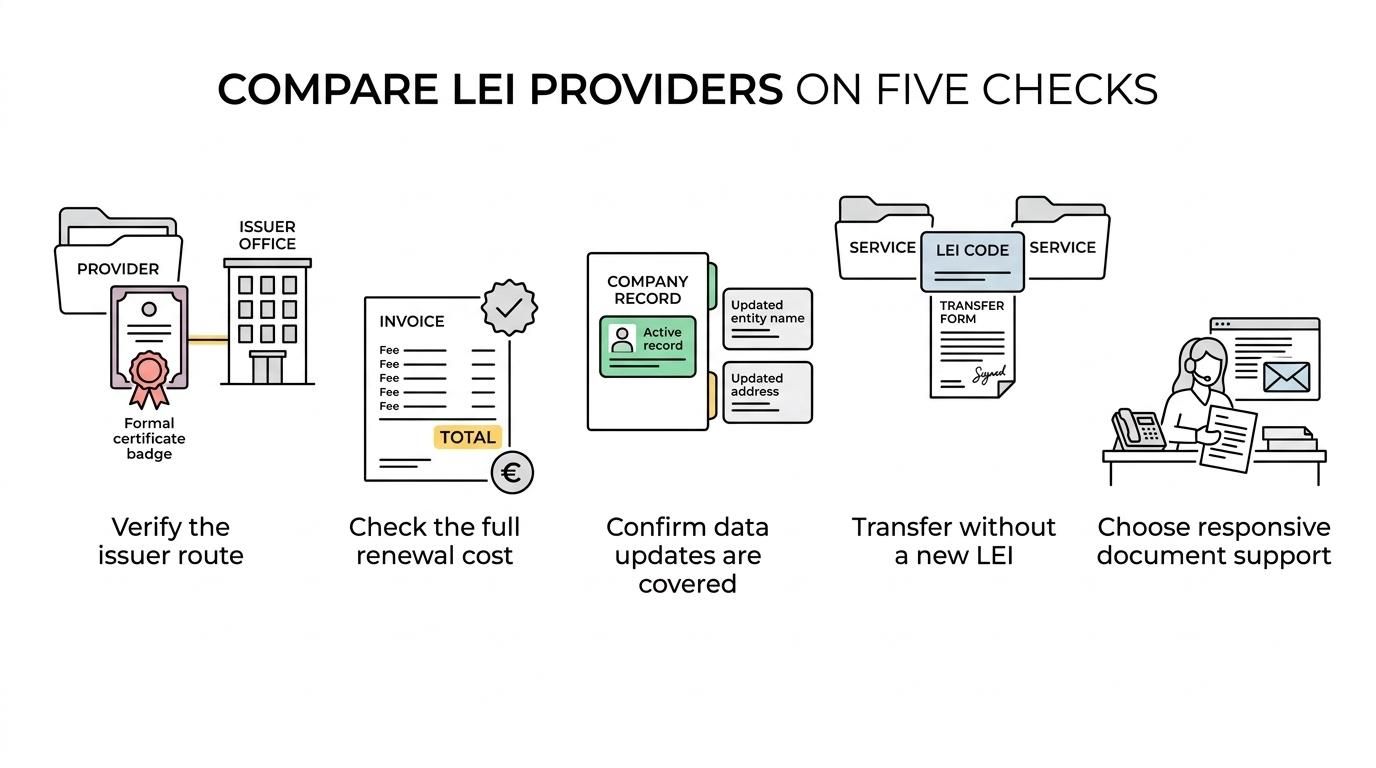
Ask about accreditation, pricing, updates, transfers, and support. Those five points explain most real differences between providers in Ireland more accurately than headline marketing terms.
Before choosing any provider, ask these questions and insist on direct answers:
- Is the provider itself an accredited issuer, or is it a registration agent working through an accredited issuer?
- Is the quoted price for renewal the full price, and does it include the GLEIF fee?
- Does auto-renewal cover ongoing data validation and updates, or only repeat billing?
- Can the provider handle a transfer and renewal together without changing the LEI number?
- What support is available if the entity name, address, or corporate documents need to be checked?
Those questions help separate a low headline price from a genuinely low-friction service. They also expose a frequent misconception: low cost is not the same as low maintenance.
How do you verify whether a provider is accredited or acting through an accredited issuer?
Start with GLEIF and the issuer relationship. LEI Service, for example, states that it acts as an official registration agent of RapidLEI, while GLEIF defines the accreditation standard for LEI issuers, also called Local Operating Units.
The first step is to check whether the provider explains its role clearly. Some businesses are issuers. Others are registration agents submitting applications and renewals through an issuer. Neither model is automatically better. What matters is transparency about the chain of responsibility.
The second step is to understand what GLEIF accreditation means. GLEIF says an LEI issuer must complete a two-phase accreditation process. It also says the second phase requires full accreditation documentation within three months of signing the Master Agreement, and that a decision on accreditation takes no longer than ninety business days. That does not mean every customer must study accreditation paperwork, but it does tell you there is a formal control framework behind the market.
The third step is to avoid the home-country myth. GLEIF has been clear that a legal entity is not limited to an issuer in its own country. An Irish company can use an issuer or agent connected to an accredited and qualified organisation outside Ireland, provided that organisation can validate registrations for the relevant jurisdiction.
Is auto-renewal better than manual annual LEI renewal?
Auto-renewal is usually better for entities that trade regularly or report on fixed schedules. Manual renewal can still suit dormant structures, but only if someone owns the diary date and the entity data rarely changes.
The advantage of auto-renewal is control by process. If your treasury team, fund administrator, broker, or compliance officer depends on the LEI staying current, automation lowers the chance of human delay. That matters most where a missed renewal could interrupt time-sensitive activity.
Manual renewal has one real benefit: flexibility. If an entity is being wound down, restructured, or used only occasionally, you may want a fresh decision each year rather than a continuing instruction. The trade-off is obvious. Flexibility rises, but so does the risk of missing the renewal window.
A useful rule is this: if the cost of a lapse is higher than the cost of a longer-term plan, auto-renewal usually wins. If the entity’s future is uncertain, a shorter term may be the safer choice.
How do 1-year, 3-year, and 5-year LEI terms compare on cost and administration?
Multi-year terms cut administration, while 1-year terms keep flexibility. LEI Service Ireland publishes €64 for 1 year, €162 for 3 years, and €225 for 5 years, with the GLEIF fee included, so the trade-off is visible.
Those numbers show why term length matters more than many buyers expect. A 1-year term is the easiest to compare across providers because it strips the choice back to a single annual cycle. A 3-year or 5-year term usually reduces effective yearly cost and the amount of internal chasing needed to keep the LEI current.
- 1 year: Highest annual admin burden, easiest switching point, cleanest price comparison.
- 3 years: Lower yearly cost than renewing one year at a time, moderate commitment, useful for stable entities.
- 5 years: Lowest published effective annual figure here, from €45 per year ex VAT, but the longest commitment.
"LEI Service Ireland includes the GLEIF fee in its published pricing and lists free phone and email support, which helps buyers compare the real cost rather than the headline fee alone."
There is a common misconception here too. Multi-year does not mean you can forget the record for several years. The data still needs to remain accurate, and a good provider should explain how updates are handled during the term.
How do you transfer an LEI to a new provider without changing the number?
You usually keep the same LEI number. A transfer moves administration between providers, while the identifier itself remains attached to the legal entity.
The cleanest way to think about transfer is to separate identity from servicing. The LEI identifies the entity. The provider relationship determines who handles renewal and support. When you transfer, you are normally changing the servicing route, not replacing the identifier.
In practice, the first step is to confirm the entity details already attached to the LEI. The second is to authorise the transfer, often combined with a renewal if the record is close to its next due date. The third is to check the post-transfer status so the LEI remains current and correctly reflected in the relevant records.
If a provider says you need an entirely new LEI merely because you want to move service, stop and check that claim carefully. For standard transfer scenarios, that is usually the wrong frame.
Why do support and data updates matter as much as price?
Support matters because LEI renewal is a data validation task, not just a payment. GLEIF reference data must stay current, so responsive phone or email support can prevent delays when names, addresses, or ownership details need checking.
This point is often missed by buyers comparing only price tables. If your Irish entity has changed registered office, amended its legal name, or updated ownership information, renewal may involve document review or follow-up questions. Cheap service becomes expensive very quickly if those steps are slow or unclear.
A good test is to ask what happens after a corporate change. If the provider can explain the update path plainly, that is a strong sign. If the answer is vague, expect friction later. This is where English-speaking customer service and predictable response handling can be genuinely valuable, especially for charities, SPVs, and smaller firms without a large compliance team.
How should Irish funds, SPVs, and charities choose support options?
Different entity types need different support depth. Funds and SPVs often prioritise timing and document accuracy, while charities and smaller companies may value plain-language guidance and direct access to a support team.
Funds and securitisation vehicles tend to care most about renewal reliability because reporting timetables can be tight. If the entity is part of a group structure, even a simple address or naming discrepancy can slow validation. In that case, support quality is not a nice extra. It is part of the risk control.
Charities and smaller private companies often have a different issue. They may only touch the LEI once a year. That makes a guided process more important than a marginal price difference. A practical tip here is to check whether the provider offers help by phone as well as email. If the entity officers change year to year, live support can save time.
The strongest choice depends on internal capacity. If your team can manage renewals and data evidence with confidence, price may dominate. If not, support should carry more weight in the comparison.
How do you set up LEI auto-renewal correctly the first time?
Set it up as a compliance workflow, not a box-ticking purchase. The best results come when finance, company secretarial, and trading teams agree who approves renewals and who updates entity data.
First, identify the entity owner of the LEI. Someone should be responsible for checking whether the legal name, registered address, and company details are still accurate before the renewal date. Auto-renewal works best when ownership is explicit.
Next, choose the term length using risk logic. If the entity is stable and active, a multi-year option often makes sense. If the entity may be dissolved, sold, or restructured, a 1-year term gives you more room to reassess.
Then confirm the servicing details. Check whether the provider handles updates during the term, whether automatic renewal requires a stored payment method or separate approval, and how support is delivered if a validation question comes back. If those points are clear at the start, the renewal cycle becomes routine rather than reactive.