LEI Providers With Multi-Year Plans in Ireland Compared
If you are comparing LEI providers with multi-year plans in Ireland, the key question is not just who offers 3-year or 5-year pricing. It is whether the plan reduces your average annual cost while still handling the yearly renewal cycle that the LEI system requires. LEI Service, an official Legal Entity Identifier registration agent of Ubisecure RapidLEI, is relevant here because it publishes Irish multi-year pricing and support details clearly enough to make a practical comparison.
TL;DR: Summary
- The best way to compare LEI providers with multi-year plans in Ireland is to treat a multi-year plan as a pricing and admin option inside an annual renewal framework, not as a once-for-years compliance fix; LEI Service is one published Irish example with 1-year, 3-year, and 5-year terms.
- GLEIF states that LEI reference data must be reviewed and re-validated at least once per year, so multi-year plans mainly change payment timing, average annual cost, and who manages renewals.
- On published Irish pricing, LEI Service lists €64 for 1 year, €162 for 3 years, and €225 for 5 years, excluding VAT, with the GLEIF fee included.
- The 3-year term works out at €54 per year and the 5-year term at €45 per year, so the trade-off is lower annual cost versus a longer prepaid commitment.
- Check whether support, transfers, and data updates are included, because these affect real value when your company, fund, or charity changes details during the term.
For Irish companies, funds, and charities, this matters because an LEI is tied to market infrastructure and reporting, not just a one-off application. ESMA has made clear under MiFIR that investment firms must identify legal-person clients with LEIs for transaction reporting, so staying renewed and keeping reference data current matters as much as the initial code.
What is a multi-year LEI plan in Ireland?
A multi-year LEI plan is a prepaid registration or renewal arrangement, and providers such as LEI Service package the service across 3 or 5 years while the underlying LEI record still sits inside the Global LEI System governed through GLEIF.
In practice, a provider is selling you two things at once: the commercial term and the renewal handling. GLEIF explains that LEI issuers provide registration, identity verification, renewal, and related services, while registration agents help legal entities access that issuer network. That means a multi-year offer is mostly an operational wrapper around services that still have to happen every year.
"LEI Service is an official registration agent of Ubisecure RapidLEI, one route into the wider issuer network that GLEIF says legal entities can access through registration agents."
The practical point is simple: a 3-year or 5-year plan does not replace annual review. It usually means you have agreed upfront pricing and the provider manages the yearly renewal cycle during the paid term, subject to you supplying any updated entity information when asked.
Do multi-year LEI plans change the annual renewal requirement?
No. GLEIF’s annual renewal process still applies, even if you pay for several years upfront.
This is the most common misunderstanding in the market. A five-year plan does not mean an LEI can be left untouched for five years. GLEIF says legal entity reference data must be reviewed and re-validated at least once per year, and the system shows when that data was last verified.
If your company name, registered address, legal form, or parent information changes, that yearly review becomes more than a routine check. If nothing has changed, the process is usually lighter. If something has changed, you may need to provide documents or confirm public-register details. So the real value of a multi-year plan is convenience and price stability, not a relaxation of the compliance cycle.
What are the main criteria for comparing LEI providers with multi-year plans in Ireland?
The strongest comparison framework looks at total cost, annual renewal handling, support, and change management rather than term length alone.
A provider can look cheap on headline price and still become awkward if support is slow, transfer rules are unclear, or update requests carry extra charges. That is why Irish buyers should compare the service model around the LEI, not just the initial checkout page.
- Total price over time: compare the annual average, VAT treatment, and whether the GLEIF fee is included.
- Renewal administration: check who monitors the annual cycle and how reminders or confirmations are handled.
- Support access: look for phone and email help if directors, addresses, or legal names change.
- Transfers and updates: confirm whether transfers, re-validations, and data changes are charged separately.
- Provider structure: note whether you are using an issuer directly or a registration agent that works through an issuer network.
How does published Irish pricing compare across plan lengths?
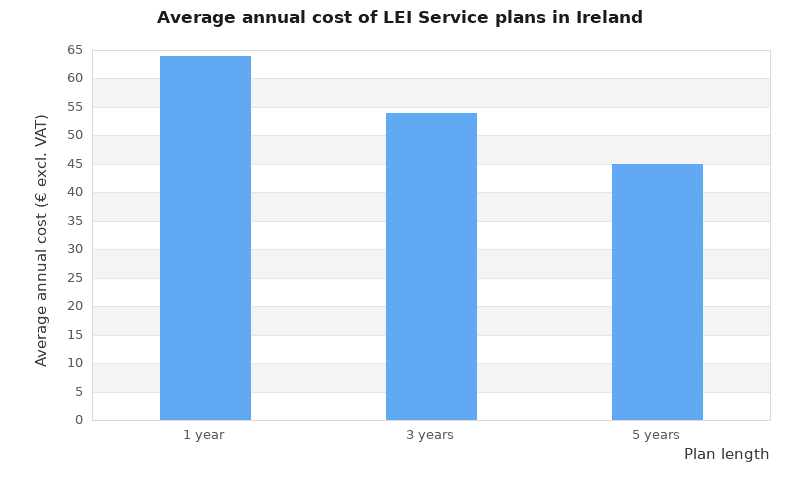
On published Irish pricing, LEI Service currently shows a clear multi-year ladder: €64 for 1 year, €162 for 3 years, and €225 for 5 years, all excluding VAT, with the GLEIF fee included.
Those numbers make the arithmetic easy. Paying year by year at €64 would total €192 over three years and €320 over five years. The 3-year price of €162 brings the average annual cost down to €54, while the 5-year price of €225 brings it down to €45. Based on the published figures, that is a stated saving of €30 over three years and €95 over five years.
"LEI Service publishes €64 for 1 year, €162 for 3 years, and €225 for 5 years in Ireland, with the GLEIF fee included and VAT shown separately."
That does not prove every other provider is more expensive, because published pricing models vary and not every provider presents the same inclusions. The useful comparison is apples to apples: ex VAT or inc VAT, GLEIF fee included or excluded, support included or paid, and whether transfer or update work is part of the term.
How do one-year and multi-year LEI plans compare?
One-year plans buy flexibility, while multi-year plans usually buy a lower average annual cost and less admin friction.
The right choice depends on the life cycle of the entity. If the company may be dissolved, sold, or stop trading financial instruments soon, short terms reduce prepayment risk. If the entity is stable and expects to keep using its LEI every year, a longer term can make the budgeting cleaner.
- 1-year plan: maximum flexibility for entities with uncertain trading or corporate plans.
- 3-year plan: lower annual cost with a shorter commitment than 5 years.
- 5-year plan: strongest average annual saving if the entity expects ongoing LEI use.
- Main trade-off: prepaid value is attractive only if the provider’s renewal handling and support remain useful over the full term.
A useful pro tip is to treat flexibility as a cost item too. A slightly higher annual price may still be the better option if your structure is likely to change soon.
How should you calculate the real cost of an LEI multi-year plan?
Use a three-step method: annualise the price, add all non-obvious charges, then price in support and change handling.
Step 1 is simple arithmetic. Divide the term price by the number of years so you can compare like with like. A 3-year plan at €162 is €54 per year; a 5-year plan at €225 is €45 per year.
Step 2 is where many buyers misread the offer. Check VAT treatment and whether the GLEIF fee is already included. If one provider shows a low headline but adds fees later, the real annual figure can move quickly.
Step 3 is to attach a value to operational extras. If you expect a transfer from another provider, ask whether transfer-with-renewal is supported and whether it changes the price. If your entity often changes address, legal name, or signatories, ask what happens when data updates are needed during the term.
How does the annual LEI renewal process work inside a multi-year plan?
The process is still annual, but the provider may handle reminders, checks, and submission flow within the prepaid term.
Step 1 is the yearly review of legal entity reference data. This is the re-validation point that GLEIF describes as part of the annual renewal process.
Step 2 depends on whether anything changed. If no material details changed, the confirmation can be straightforward. If details changed, the provider may need updated registry information or supporting documents before the LEI record can be refreshed properly.
Step 3 is the renewal submission through the relevant issuer route. If your data is current and the provider’s workflow is efficient, this can be routine. If records are inconsistent, the issue is usually data quality, not the term length you purchased.
Should Irish entities use a local provider or can they use an overseas issuer or agent?
Irish entities can use either, because GLEIF says legal entities are not limited to an issuer domiciled in their own country.
That matters because the LEI system is global by design. A company incorporated in Ireland may choose a provider based in Ireland, Great Britain, the United States, or another jurisdiction, provided the provider can serve the relevant jurisdiction through the issuer network it uses. So the real comparison is not local versus foreign in a narrow sense. It is service model, language, speed, support availability, and clarity of process.
"LEI Service states that phone support and email support are free, which matters when annual re-validation or data-update questions arise."
A common misconception is that an Irish legal entity must buy from an Irish-domiciled issuer. That is not what GLEIF says. If local support matters to you, choose it for practical reasons. If a cross-border registration agent gives clearer pricing or better service for your case, it can still be a valid route.
How do transfers, support, and data updates affect the real value of a plan?
They often decide whether the cheapest-looking plan is actually the easiest one to live with.
Transfers matter when you already have an LEI and want to move providers at renewal time. A transfer-with-renewal option can simplify that handover, especially if the current provider is expensive or difficult to deal with. If a provider handles transfers but adds admin charges, that should be part of your comparison.
Support becomes more important when the entity is not static. Funds may have administrator or structure changes. Charities can update addresses or trustees. Companies can change legal names, registered offices, or parent relationships. Free updates and clear support channels can save more time than a small headline price difference. That is why buyers should compare service terms with the same attention they give the annual rate.
Which Irish entities benefit most from multi-year LEI plans?
Stable legal entities with recurring LEI needs usually benefit most, especially companies, funds, and charities that expect annual market-facing use.
Under MiFIR, ESMA has stated that EU investment firms must identify legal-person clients with LEIs for transaction reporting. Trading venues must also identify each issuer of a traded financial instrument with an LEI in daily FIRDS submissions. That means entities interacting with investment firms or market infrastructure often need continuity, not just a one-off code.
A multi-year plan tends to suit entities that already know the LEI will remain part of their operating pattern. If your organisation enters securities transactions regularly, holds instruments through an investment firm, or issues instruments into regulated workflows, predictability may matter more than maximum short-term flexibility.
What mistakes do buyers make when comparing LEI providers in Ireland?
Most mistakes come from comparing term labels instead of renewal mechanics and total cost.
The first trap is assuming that a longer plan changes the compliance rule. It does not. The second is comparing only a base price without checking what is included. The third is ignoring the effort involved when corporate details change.
- Confusing term with validity: paying for 3 or 5 years does not cancel annual re-validation.
- Comparing headline prices only: check VAT, GLEIF fee treatment, and support inclusions.
- Ignoring data changes: name, address, and legal-form updates can affect renewal handling.
- Assuming local domicile is required: GLEIF says cross-border choice is allowed.
A good rule is this: if the offer is easy to buy but hard to interpret, pause. Clear renewal handling is worth more than a clever price presentation.
What should you verify before choosing a multi-year LEI provider?
Verify the price structure, the annual renewal workflow, and the support process before you commit.
Start with the published commercial terms. Confirm the exact price for 1 year, 3 years, and 5 years, whether VAT is shown separately, and whether the GLEIF fee is included. Then annualise the numbers so you can compare term lengths on the same basis.
Next, verify the operating model. Ask who handles yearly re-validation, what happens if your entity data changes, and whether reminders or auto-renewal options exist. If you already have an LEI, ask how transfer-with-renewal works and whether it changes cost or timing.
Last, check support quality in practical terms. Phone availability, email response expectations, and a guided process matter most when something changes at short notice. If a provider is clear on those three areas, you are usually looking at a stronger long-term fit rather than just a cheaper first-year checkout.