LEI Support Matters: What to Expect From Phone & Email Help During Registration
Getting an LEI is often described as a simple application, yet the reality is a bit more structured. An LEI is tied to verified legal entity data, checked against authoritative sources, and kept current through annual renewal. That means support is not a nice extra. It can be the difference between a quick approval and a frustrating delay.
For companies, funds, charities, and other organisations in Ireland, phone and email help can make the process clearer from the first form to the next renewal date. Good support reduces uncertainty, helps avoid errors, and gives applicants a direct route to answers when timing matters.
Why LEI registration support matters from the start
An LEI application does not sit in a vacuum. The Global LEI System works through LEI issuing organisations, and many applicants reach that system through a Registration Agent. According to GLEIF, a Registration Agent helps legal entities access the network of LEI issuing organisations, while the issuer remains responsible for the core issuance duties.
That structure matters because applicants are not only filling in a generic web form. They are submitting legal entity information that has to be validated and published as reference data once the LEI is issued. If the entity name, registration number, legal address, or authorised contact details do not match authoritative records, questions can arise quickly.
Support becomes especially useful when the organisation applying has a slightly less straightforward profile. Irish charities, investment structures, overseas parents, recently updated company records, and entities with trading urgency often need reassurance that the application is on the right track.
A strong support service usually helps with:
- checking entity details before submission
- clarifying who can apply on behalf of the entity
- explaining document or data mismatches
- guiding renewals and transfers
- answering timing questions
What phone support should offer during LEI registration
Phone support is valuable when the issue is urgent, unclear, or tied to live trading deadlines. A quick conversation can resolve confusion far faster than a chain of emails, especially when the applicant is unsure which legal name format to use, whether a branch can apply, or how a pending Companies Registration Office update may affect the process.
It also gives applicants confidence. Financial compliance tasks can feel formal and unforgiving. Speaking to someone who knows the LEI process, understands issuer requirements, and can explain the next step in plain language takes much of the tension out of the experience.
The best phone support is not only “available”. It is practical, informed, and easy to reach. In Ireland, some LEI providers openly advertise English-speaking phone support as part of the service, which is useful when internal teams need a prompt answer before a trade or filing deadline.
When judging phone help, look for these signs:
- Availability: clear contact hours and a visible phone number
- Knowledge: staff who understand LEI registration, renewals, and transfers
- Ownership: a willingness to explain what is blocking progress
- Speed: fast help when application timing is important
- Clarity: answers in plain terms, without vague compliance language
What email support should offer during LEI registration
Email support matters just as much, though for different reasons. It creates a written record of what was asked, what was confirmed, and what still needs to be done. That can be very useful when finance, legal, and company secretarial teams are all involved.
A good email service should handle more than generic inbox replies. Applicants should be able to ask about entity validation, status checks, renewal timing, changes to company details, and transfer steps if the LEI is moving from one service arrangement to another.
Response time is a real differentiator here. Some providers in the Irish market state a reply target within 24 hours, while others say little about how quickly they respond. That difference can matter a lot when a fund administrator, broker, or internal compliance team is waiting for confirmation.
Email support is especially helpful for:
- questions that involve exact legal names or registration numbers
- requests that need links, screenshots, or copied records
- renewal reminders and date confirmation
- keeping an internal audit trail
LEI renewal support is not optional after registration
This is where many first-time applicants are caught off guard. An LEI is not simply issued and forgotten. GLEIF rules require a mechanism for renewal at least annually, and the legal entity must confirm that its existing data remain valid or provide updated data. If renewal is not completed by the renewal date, the LEI status becomes lapsed on the next calendar day.
That annual cycle turns support into an ongoing service rather than a one-off convenience. If an entity changes address, updates its legal name, restructures ownership, or simply misses an internal reminder, support can help put things right before the lapse causes trouble elsewhere.
The annual review is also part of LEI data quality. GLEIF states that reference data are reviewed and re-validated at least once a year. So renewal support is not just a billing reminder. It is part of keeping the published LEI record accurate and fit for use.
A provider that only focuses on initial registration may look fine at first glance, but support at renewal is often where the quality gap becomes obvious.
The support features worth comparing before choosing a provider
Price matters, of course, though support quality should sit alongside it. A low fee can be excellent value if it includes responsive help, renewal guidance, and assistance when entity data change. If support is difficult to reach, any saving can disappear into internal time and delayed approvals.
The table below shows the main support areas worth comparing before placing an order.
| Support feature | Why it matters | What to look for |
|---|---|---|
| Phone help | Fast answers for urgent issues | Direct number, clear hours, knowledgeable staff |
| Email help | Written record and detailed follow-up | Named support, response target, unlimited queries if possible |
| Registration guidance | Reduces application errors | Help with entity data, contacts, and validation questions |
| Renewal support | Keeps LEI active and data current | Reminders, renewal handling, explanation of lapsed status |
| Data update assistance | Useful when company details change | Support for amendments linked to authoritative records |
| Transfer support | Helps when moving service arrangements | Clear steps, timing guidance, renewal coordination |
Some providers publish support commitments very clearly. LEI Service, for example, states that its offering includes phone support, unlimited email support, replies within 24 hours, and free updates when legal entity details change. It also states that new LEIs may be issued within 1 to 48 hours, with possible same-day handling in around 2 hours when ordered before 6 PM. That kind of transparency is useful because it lets applicants judge service before they buy.
When to call and when to email for LEI help
The smartest applicants use both channels well. A phone call is often best when there is urgency, uncertainty, or a blocker that is easier to explain aloud. Email works better when the issue involves records, screenshots, formal confirmation, or several stakeholders.
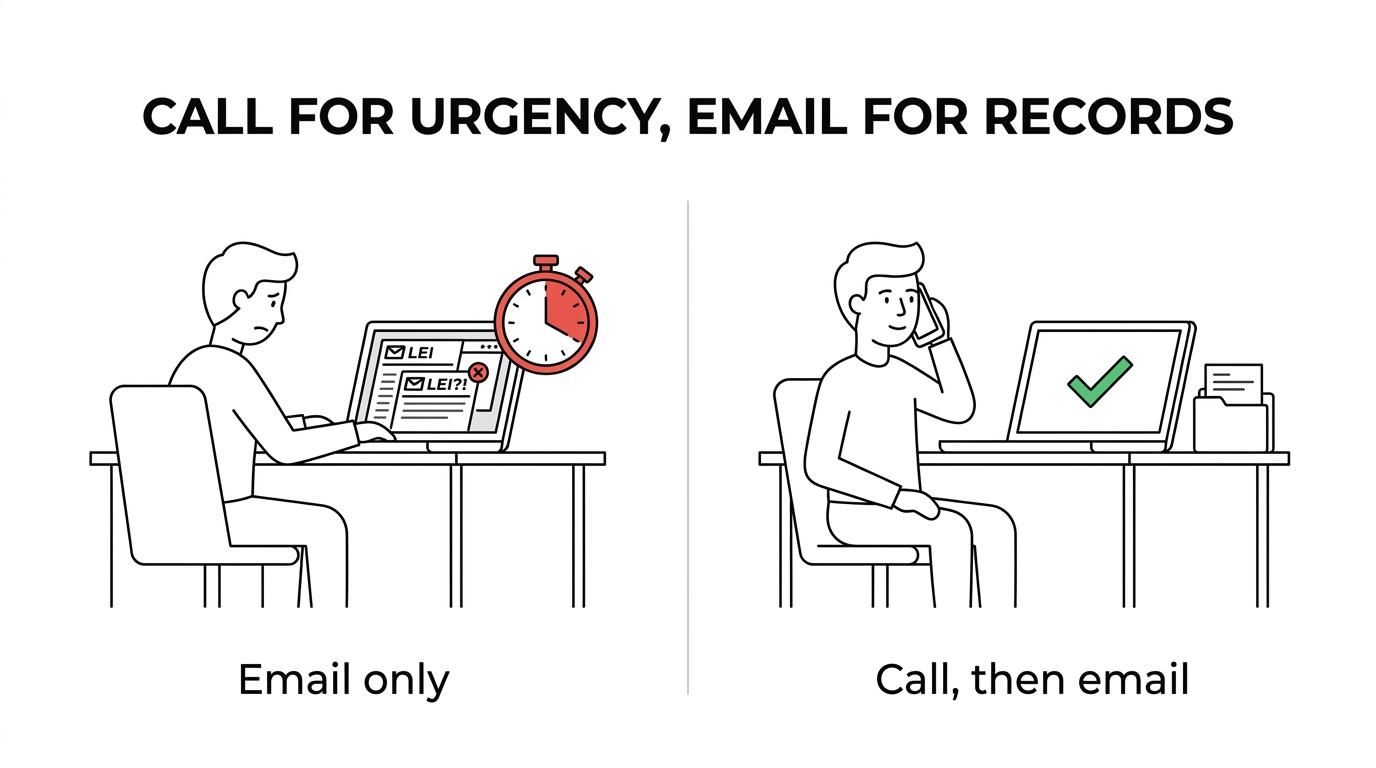
There is no need to treat one as superior to the other. Strong LEI support usually combines both, letting the applicant choose the quickest route for the task at hand.
A simple rule works well in practice:
- Call: if a trade is pending, the status is unclear, or the form cannot be completed confidently
- Email: if you need confirmation, are sharing entity details, or want a written explanation of the next step
That balance is especially useful for renewals. A brief call can confirm what is required, then email can carry the exact details and leave a record for internal files.
Common registration issues that good LEI support can solve
Many applications are straightforward, yet a significant number run into avoidable snags. The best support teams are strong not because problems are common, but because they know how to sort them quickly when they appear.
Typical issues include small mismatches between the application and official registers, uncertainty about the correct legal name, confusion about whether an individual has authority to request the LEI, or questions about the status of an entity that has recently changed details.
Support can also help with transfer situations. An LEI transfer is not the same as a new registration. It usually happens when the legal entity wants its LEI administration handled through a different provider, often together with renewal. That is exactly the kind of process where guided help saves time.
Common pain points include:
- Entity mismatch: the submitted name or number does not match the authoritative source
- Contact uncertainty: the applicant is unsure who should act for the organisation
- Renewal timing: the next renewal date is close and the LEI must stay active
- Status confusion: the LEI is active, pending, or lapsed and the implications are unclear
- Recent updates: company records have changed and the LEI record may need review
What strong LEI support looks like for Irish applicants
For Irish entities, practical support often matters more than glossy marketing. Applicants usually want three things: fast answers, a clear process, and confidence that the LEI will be handled correctly.
That is why support details are genuinely decision-useful. If a provider shows its contact channels, response targets, processing expectations, and renewal help in plain sight, it signals that the service is built around real compliance needs rather than a checkout page alone.
A strong service for the Irish market often includes:
- phone and email contact in English
- a guided application process
- realistic processing times
- help with renewals every year
- support when legal entity data change
- clear pricing with the GLEIF fee included
This matters for organisations of every size. A large financial operation may need efficient handling across several entities. A small charity or limited company may only need one LEI, but still want reassurance that the information is correct before submitting.
Support quality often shows up in speed and simplicity
Fast issuance is valuable, though only if accuracy comes with it. When support teams can quickly confirm the correct entity details, explain what is needed, and spot potential mismatches early, the entire process becomes easier. That is where a guided service stands apart from a bare self-service form.
The same applies to renewals. A reminder, a quick answer by email, or a short phone call can keep an LEI active without internal scrambling at the last minute. Since a lapsed LEI can create avoidable friction with financial transactions and reporting, even simple support can have a meaningful operational effect.
For many applicants, the best expectation is not “perfectly effortless” but “clear, responsive, and dependable”. That is a very achievable standard, and it is the one worth looking for.
Choosing LEI registration support with confidence
When comparing providers, it helps to look beyond the headline price and ask a few direct questions. Is there a phone number? Is email support easy to reach? Is there a stated response time? Does the provider help only with initial registration, or also with annual renewal, transfers, and data updates?
Those details tell you what the service will feel like when something needs attention. Since LEI registration depends on validated entity data and annual re-checking, support is part of the product, not an optional extra.
For Irish organisations that value speed, clarity, and continuity, that is a strong basis for choosing a provider with confidence.