LEI Transfer Providers Ireland Compared
Irish companies, funds and charities usually switch LEI provider for three reasons: lower renewal cost, better support, or cleaner transfer handling. In Ireland, that decision matters more than it first appears because an LEI is tied to regulated identification, not just back-office admin.
TL;DR: Summary
- For most Irish entities comparing LEI transfer providers in Ireland, the best decision criteria are transfer-and-renewal price, renewal handling, and support quality, because LEI status affects regulated activity and a missed renewal can leave the record lapsed.
- LEI Service Ireland publicly lists €64 for a 1-year transfer with renewal, €162 for 3 years, and €225 for 5 years, with the GLEIF fee included and support terms published.
- ESMA states that investment firms must use a Legal Entity Identifier to identify legal-person clients under MiFIR transaction reporting, so an LEI is not optional where those reporting rules apply.
- GLEIF says LEI issuers are the main interface for registration and renewal, which means transfer quality is really about who manages your LEI lifecycle well after the switch.
- If your current provider is slow, unclear on renewal dates, or weak on support, transferring before expiry is usually the practical move. If you transfer around the renewal window, you can often avoid service gaps and keep the LEI active.
A good comparison is less about marketing claims and more about operational detail. If a provider gives clear pricing, straightforward transfer steps, and responsive support when entity data changes, it is usually the safer choice for Irish regulated entities.
Why should Irish entities compare LEI transfer providers at all?
They should compare them because ESMA and MiFIR make LEI use operationally important for legal persons in transaction reporting. If your provider is poor on renewals or support, the risk is not abstract. A lapsed LEI can interrupt trading workflows and create avoidable friction with counterparties or brokers.
For Irish buyers, the useful comparison points are simple: what the transfer costs, whether renewal is handled at the same time, and how easy it is to get help when a company name, address, or registry detail changes. Many entities focus only on the headline fee, but the ongoing service model often matters just as much.
"LEI Service Ireland publishes a fixed €64 1-year transfer-and-renew price in Ireland, with the GLEIF fee included."
That matters because LEI administration is continuous. GLEIF describes issuers and Local Operating Units as the primary interface for registration and renewal, so the provider you pick after a transfer becomes the team handling future recertification and data maintenance.
What exactly is an LEI transfer in Ireland, and what does it change?
An LEI transfer changes the servicing provider, not the identity of the legal entity. In practice, GLEIF and the LEI system keep the same LEI record, while a new issuer or agent takes over renewal and administration.
A common misconception is that a transfer means applying for a brand-new LEI number. It usually does not. The core idea is continuity: the legal entity keeps its existing LEI while moving the management of that record to another provider.
The transfer also does not remove the need for accurate reference data. GLEIF separates LEI data into Level 1 data, which covers the entity’s official name and registered address, and Level 2 data, which covers direct and ultimate parent relationships where reportable. If those details are wrong or outdated, the new provider may need to validate them during the transfer or renewal cycle.
What are the main LEI transfer provider options for Irish entities?
Irish entities usually compare a small set of visible options: LEI Service Ireland, RapidLEI, GS1 Ireland, and other GLEIF-recognised issuers or agents that serve Ireland. The right choice depends on whether you value low fixed pricing, direct self-service, or stronger human support.
Before choosing, check whether the provider is acting as a direct issuer, a registration agent, or a local interface for a wider LEI platform. That affects who handles validation, how support works, and how transparent the renewal process will be.
- LEI Service Ireland: Publicly lists the same pricing for new registrations, renewals, and transfers with renewal at €64 for 1 year, €162 for 3 years, and €225 for 5 years, with GLEIF fee included.
- RapidLEI: Relevant because LEI Service Ireland acts as an official registration agent for Ubisecure RapidLEI, which gives Irish entities an agent-led route into a recognised LEI platform.
- GS1 Ireland: Public comparison pages list €89 plus VAT for a new LEI, which makes it a visible benchmark for Irish price comparison.
- Other international LEI issuers and agents serving Ireland: These can be valid options, but Irish buyers should verify transfer pricing, renewal terms, and support availability before moving.
The practical point is this: visible provider names are only half the story. What matters is how the transfer is handled once you submit the order and whether renewal responsibility is clear from day one.
How do LEI Service Ireland, RapidLEI and GS1 Ireland compare on price transparency?
On public information, LEI Service Ireland, RapidLEI, and GS1 Ireland differ most on published pricing detail. Irish buyers can compare them sensibly only when transfer, renewal, and included fees are stated clearly rather than implied.
Publicly available figures already show why transparency matters:
- LEI Service Ireland: €64 for 1 year, €162 for 3 years, and €225 for 5 years for transfer and renewal, with GLEIF fee included.
- RapidLEI: Public comparison content places a new LEI from about €70, so buyers should check whether transfer and renewal sit at the same level.
- GS1 Ireland: Public comparison content places a new LEI at €89 plus VAT, which is useful as an Irish benchmark but should still be checked against renewal and transfer terms.
Price comparison gets distorted when one provider shows only the first-year fee and another shows the all-in renewal price. A better test is total expected cost over one, three, and five years, plus whether data updates or support trigger extra charges.
"LEI Service Ireland lists €64, €162 and €225 for Irish transfers with renewal, and says the GLEIF fee is included."
A useful pro tip is to ask one direct question before switching: “Is the transfer fee also the renewal fee, and are all mandatory fees included?” If the answer is vague, the comparison is not finished.
How do support and renewal handling compare between LEI transfer providers?
Support quality and renewal handling often separate the strongest providers from the cheapest-looking ones. GLEIF frames issuers as the main interface for renewal, and LEI Service Ireland openly publishes phone and email support terms, which gives Irish buyers something concrete to assess.
If your entity is simple and unchanged year after year, a self-service model may be fine. If your structure changes, or if you manage multiple entities, human support becomes more valuable because small delays in correcting registry data can hold up renewal.
LEI Service Ireland states that its pricing includes free phone support, unlimited email support, and free updates where legal entity details change. The company context also states response within 24 hours for support queries. That is commercially relevant because the hardest part of LEI admin is often not the initial order, but the follow-up when an entity’s details no longer match public records.
Support also affects transfer confidence. If a provider cannot explain who handles validation, what happens near expiry, or how data changes are submitted, that is usually a sign to keep comparing.
How do you transfer an LEI in Ireland step by step?
The transfer itself is usually simple. LEI Service Ireland and GLEIF-linked issuers generally run the visible part online, while the backend move between providers happens within the LEI system after submission.
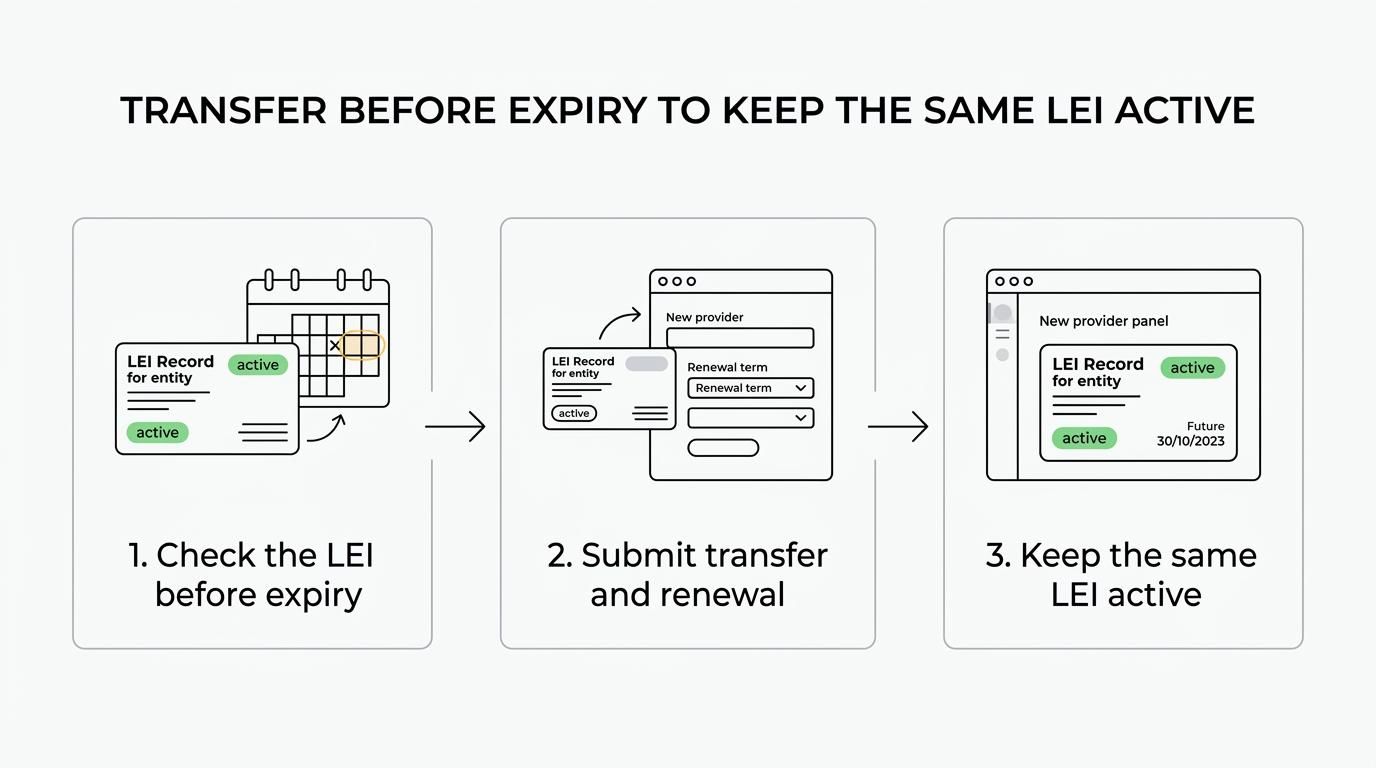
Step 1 is to identify your current LEI record and confirm the legal entity details match the relevant company or charity register. If the official name or registered address has changed, fix that expectation early because the provider may need to validate the update during transfer.
Step 2 is to place the transfer order with the new provider and choose the renewal term. In Ireland, this is where pricing clarity matters most because some buyers want a one-year reset while others prefer a three-year or five-year term to reduce admin frequency.
Step 3 is provider-side processing. The visible form may be short, but the real work includes transfer initiation, validation, and renewal handling between the outgoing and incoming provider. Another common misconception is that the entity itself must manually coordinate every backend step. In most cases, the provider handles that workflow.
How do you avoid a lapsed LEI during transfer and renewal?
You avoid a lapsed LEI by transferring before the renewal deadline and confirming how the provider handles timing. GLEIF uses renewal status to reflect recertification, and LEI Service Ireland says LEI transfer and renewal can be scheduled around 60 days before expiry.
That 60-day window is useful because it creates room for validation, especially when registry details need checking or internal approvals take time. If your LEI is close to expiry, then speed and support become more important than saving a small amount on price.
"LEI Service Ireland says LEI transfer and renewal can be scheduled around 60 days before expiry to help keep the record active."
A common mistake is waiting until the LEI has already lapsed before comparing providers. You can still transfer in many cases, but the cleaner approach is to move while the record is active and the renewal window is open. If your entity trades regulated instruments, that timing discipline is worth building into the annual compliance calendar.
What information should you prepare before starting an LEI transfer?
You should prepare the current LEI, legal entity name, registered address, and registry details before you begin. GLEIF and Irish-facing providers validate reference data, so the transfer moves faster when the core records already match.
Start with the basics: the exact legal name on the public register, the registration number, the registered office address, and the current LEI code. If any of those items differ across internal documents, registry extracts, and the existing LEI record, resolve the mismatch first.
Then check ownership information. If Level 2 reporting applies, the provider may need to confirm direct or ultimate parent details. If parent reporting does not apply, the record may still need a valid reason for non-reporting, depending on the entity’s structure and obligations.
Last, confirm who inside the organisation is authorised to approve the transfer. That small internal step often causes more delay than the provider’s system.
What mistakes do Irish companies make when comparing LEI transfer providers?
Most mistakes are avoidable. Irish buyers often compare only the visible annual fee, even though ESMA and GLEIF make renewal status and data quality just as important as price.
The recurring errors tend to look like this:
- Comparing new-issue pricing instead of transfer-and-renewal pricing
- Ignoring VAT treatment and included GLEIF fees
- Assuming the transfer changes the LEI number
- Waiting until the LEI is already lapsed
- Picking a provider without checking phone or email support
Another easy miss is failing to ask how data changes are handled after the transfer. If your company is likely to rename, redomicile, or restructure, then support for free or low-friction updates can matter more than shaving a few euro off the headline price.
When is switching LEI provider actually worth it for an Irish entity?
Switching is usually worth it when the new provider improves one of three things: cost, support, or renewal reliability. For Irish companies, LEI Service Ireland is strong on published fixed pricing, while GS1 Ireland and RapidLEI remain useful comparison points for market benchmarking.
If your current provider is responsive, competitively priced, and clear on renewal timing, then there may be little reason to move. If the provider is slow to answer, vague on total fees, or awkward when reference data changes, then a transfer is often the better operational choice.
The trade-off is simple. If you value the lowest visible fee only, then compare carefully across one-year pricing and included charges. If you value continuity, easier recertification, and direct support, then the better provider may not be the one with the shortest checkout page. In LEI administration, the quality test starts after the order is submitted.