What Documents Are Needed for an LEI?
Applying for an LEI in Ireland is often simpler than people expect. In many cases, there is no large pack of special LEI paperwork to assemble. What matters most is that the entity’s official details match the public record exactly.
That point is especially relevant for Irish companies, charities and other organisations that already appear on a recognised register. If the name, registered office, registration number and related data are clear and current, the application can move quickly. If those records are incomplete, outdated or inconsistent, extra proof may be requested before the LEI is issued.
LEI application documents in Ireland: what is usually required
The starting point for any LEI application is accurate reference data. GLEIF, which oversees the global LEI system, states that legal entities must provide correct reference data to the issuing organisation. In some cases, the LEI issuer can retrieve much of that information directly from the relevant local register, meaning the applicant may only need to provide the local identity number to begin.
For an Irish entity, that local identity number is often the key to the whole process. A CRO number for a company, or a charity registration number where relevant, can allow the provider to find the entity and validate its legal identity. That is why many applications are less about uploading documents and more about matching the entity to an official record.
The core LEI data generally covers two levels:
- Level 1 identity data
- Official legal name
- Registered address
- Registration authority details
- Entity status
Level 2 data may also be relevant where parent relationships must be reported. That does not affect every Irish applicant, but larger group structures may need to consider it at the application or renewal stage.
Irish company LEI documents: what the registry already tells the provider
For most Irish limited companies, the Companies Registration Office is the central source used to check identity details. CRO records hold core statutory information, and that is often enough to support an LEI application when the company record is clear and current.
This is where accuracy matters. The CRO’s company registration framework includes details like the exact company name, registered office, director and secretary details, and subscriber information. If the entity applying for the LEI enters a trading name instead of the legal name, or uses an old address, the mismatch can trigger manual validation.
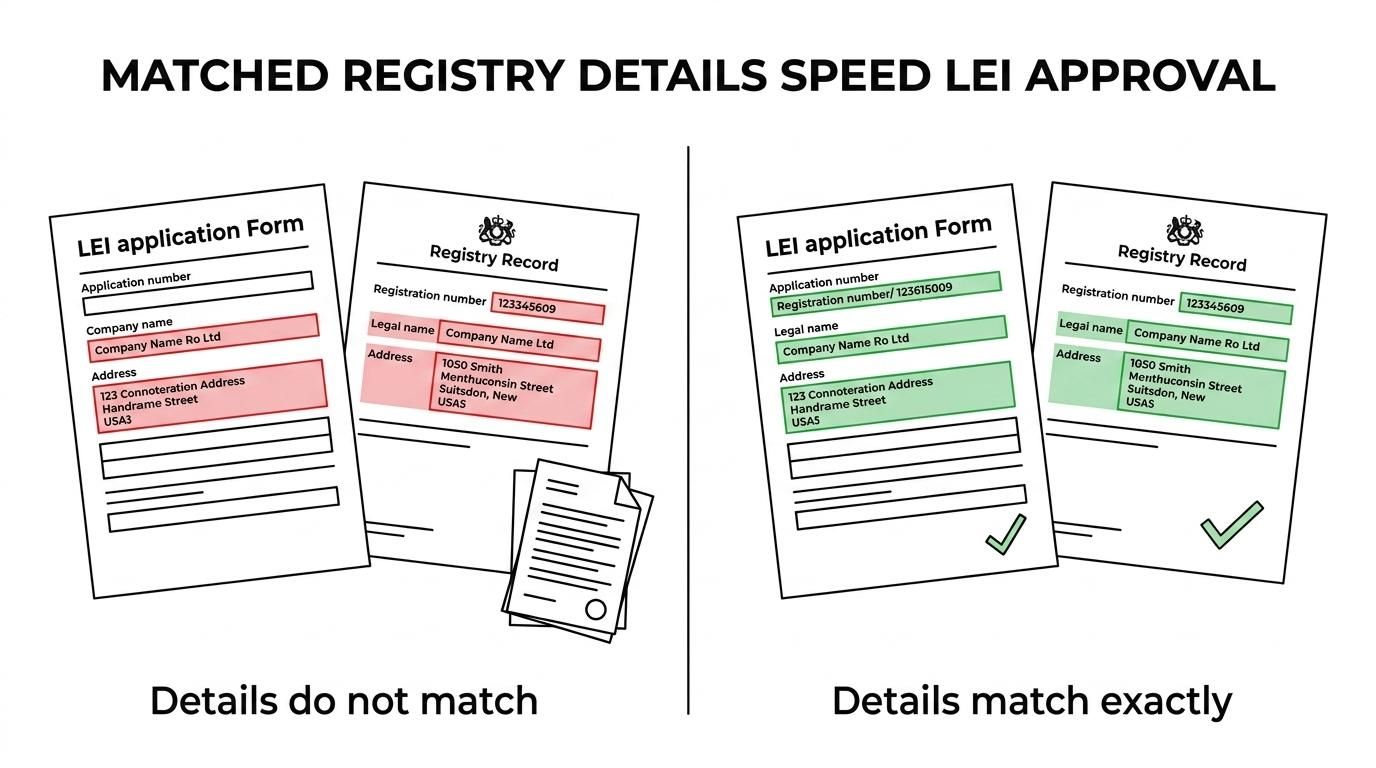
A practical way to think about it is this: the LEI provider is not looking for a fancy document set. It is looking for evidence that the applicant is the same legal entity shown on the official register.
| Item checked for an Irish company LEI | Usually enough from public registry? | Extra proof sometimes needed? |
|---|---|---|
| CRO number | Yes | Rarely |
| Exact registered company name | Yes | If application uses a different spelling or trading style |
| Registered office address | Yes | If the CRO record is outdated |
| Entity status | Yes | If recent changes are not yet reflected |
| Authorised applicant details | Not always | Yes, where authority is unclear |
| Parent relationship data | Not always | Yes, for group structures and reporting exceptions |
The registered office deserves special care. The CRO requires a physical location rather than a PO box, and any change must be formally filed. If an LEI application uses an address that does not match the CRO record, the provider may ask questions straight away.
Common documents for company LEI applications in Ireland
Even when the public register does most of the heavy lifting, some supporting material can still be useful. This tends to happen where recent filings are pending, the entity has changed name, or the applicant is acting on behalf of the company.
Typical supporting items include:
- CRO number: the quickest way to identify the company
- Certificate of incorporation: helpful if registry data is unclear or recently updated
- Proof of registered office: relevant if there is a recent address change
- Authority proof: used where the applicant’s right to act for the company is not obvious
- Board resolution or letter of authorisation
- Recent registry extract
- Identification details for the authorised contact
An authority proof document is one of the most common extra requests. If the person submitting the application is not clearly linked to the entity through public records, the LEI provider may need evidence that they are permitted to apply.
Charity LEI documents in Ireland: where extra proof is more common
Irish charities can be a little different. Some have strong public registration trails, while others have records spread across more than one source. That is why charity applications more often require a few supporting documents, even when the process remains straightforward overall.
Where the registry match is incomplete, the provider may need documents that show legal form, governance and authority. For many charities, the governing document becomes especially important because it helps confirm how the organisation is constituted and who has power to act.
A charity application often relies on a combination of identifiers and supporting records rather than a single source.
Common items for Irish charity LEI applications can include:
- Registered Charity Number
- CRO registration number, if the charity is also a company
- Governing document or constitution
- Registered office or principal address details
- Trustee or director details
- Revenue charity exemption reference, where available
If the charity is incorporated and its CRO record is up to date, the application may look very similar to a company application. If it is unincorporated or has limited public data, the supporting paperwork becomes more important.
When extra LEI documents are needed for complex entity structures
Some entity types nearly always attract a closer review. Funds, trusts, certain partnerships and other more complex legal structures may need extra documents before an LEI can be issued.
That does not mean there is a problem. It simply reflects the fact that these entities may not appear on a single public register in the same way as an ordinary Irish company.
Authority proof for LEI applications
Authority proof is often requested when the applicant’s connection to the entity is not obvious from the public record. This could be a signed authorisation, a board minute, a trustee resolution, or another document that shows the person has the right to act.
Constitutional and formation documents for LEI validation
Where the legal form is not easy to verify from a public database, the provider may ask for a trust deed, partnership agreement, fund formation document, or constitution. The aim is to confirm the entity’s legal existence and core identity details.
Parent relationship documents for Level 2 LEI data
If an entity is part of a group, Level 2 data may also come into play. In that case, the provider may request information about the direct or ultimate accounting parent, or a valid reason why parent data is not reported.
Why LEI applications in Ireland get delayed
Delays often happen for simple reasons rather than difficult legal ones. A company may enter its trading name instead of its registered name. A charity may use an address from its website rather than the one shown on its official records. An applicant may assume that because they work for the entity, no separate proof of authority will be needed.
Those are all fixable issues, but they slow things down.
The most common triggers for extra checks are:
- Name mismatch: the legal name entered does not match the register exactly
- Address mismatch: the registered office or principal address is inconsistent
- Old registry data: recent changes have not yet appeared publicly
- Unclear authority: the applicant is not visibly linked to the entity
- Complex legal form: more than one document is needed to prove identity
A careful pre-check can save a great deal of back and forth. That is one reason many applicants prefer a guided process, especially when timing matters.
How to prepare LEI documents before applying in Ireland
A strong application starts with a quick review of the public record. Before submitting anything, confirm the exact legal name, registration number, address and status shown on the relevant register. For Irish companies, that usually means the CRO record. For charities, it may mean checking both the charity register and the CRO position where relevant.
If there has been a recent change, it is wise to wait until the register reflects it, or be ready to provide proof. A newly changed address or updated name can be perfectly valid, but if the public data has not caught up, manual review becomes more likely.
It also helps to decide in advance who will submit the application. If that person is not a listed director, secretary, trustee or equivalent officer, gather authority proof before starting. That single step can reduce delays more than almost anything else.
A practical checklist for LEI document readiness
Most Irish applicants can prepare in a few minutes if they focus on the essentials first.
- Check the registry entry: confirm the exact legal name and registration number
- Check the address: use the registered office or official principal address only
- Check the applicant: make sure the person applying can show authority if asked
- Check recent changes: name changes, address updates and restructures often need review
- Check entity type: charities, trusts and funds may need formation documents
If everything matches, the application can be surprisingly quick. If something does not match, it is usually better to correct it before submission rather than wait for a validation query.
What most Irish entities really need for an LEI
For the majority of Irish companies, the essential requirement is not a special LEI-only document pack. It is exact, current registry information that matches the application perfectly.
For charities and more complex entities, a few extra documents may be needed, mainly to confirm legal form, governance and authority to act. Even then, the process is still built around the same idea: prove that the legal entity exists, identify it clearly, and link the applicant to it properly.
That is why the best preparation is usually quite simple. Have the correct registration number ready. Use the precise legal name. Check the registered office. Keep authority proof close at hand if the structure is less straightforward. With those points in order, getting an LEI in Ireland is usually far more efficient than many applicants first assume.