What Happens if Your LEI and CRO Names Do Not Match
When an Irish company applies for or renews a Legal Entity Identifier, the name on the LEI record is not a branding choice. It needs to reflect the entity’s official registration details. If the LEI record and the Companies Registration Office record do not match, the issue is usually fixable, but it can slow validation and raise questions during review.
That matters because an LEI is used for regulated financial identification and reporting. It is not a replacement for domestic company registration details, and it does not override what appears on the Irish register. The LEI record needs to stand on the same official footing as the CRO entry.
A mismatch can be as simple as punctuation, or as significant as using a trading name instead of the legal company name. Either way, the safest approach is to treat it early, before it interrupts a transaction, a renewal, or a reporting deadline.
Why LEI data must match CRO records
GLEIF, the global body that supports the LEI data system, makes public LEI data available free of charge through its search tools. Within that system, Level 1 data identifies the legal entity by core reference details, including the official legal name and the registered address. Those are not minor fields. They are central to how the entity is recognised across markets and reporting frameworks.
For Irish companies, the Companies Registration Office is the main domestic source for those legal identity details. When an LEI application is checked, the validation authority information linked to the record helps connect the LEI to the relevant official register. In practice, that means the CRO entry is highly relevant when the name or address is reviewed.
If the LEI says one thing and the CRO says another, the records can no longer support each other cleanly.
What happens when LEI and CRO names do not match
In many cases, the first result is delay. An automated check may fail, and the application, renewal, or transfer may move into manual checking. That does not always mean refusal. It does mean that extra evidence may be needed before the record can be issued or updated.
The second result is uncertainty. If a broker, bank, fund administrator, or reporting team sees a mismatch between the public LEI record and the Irish register, they may ask for clarification before moving ahead. In regulated settings, a small inconsistency can create avoidable friction.
A name mismatch may also appear alongside an address mismatch, especially after a recent company change. Since Level 1 data includes both the official legal name and registered address, one outdated field can point reviewers towards another.
| Type of mismatch | Typical outcome | Why it matters |
|---|---|---|
| Trading name used instead of legal company name | Manual review or request for correction | LEI records identify the legal entity, not the brand it trades under |
| CRO recently updated, LEI still shows old name | Renewal or amendment needed | Public records no longer match |
| Minor spelling or punctuation difference | Manual checking | Validation can fail even when the entity is the same |
| Registered address differs | Extra review | Address is a core Level 1 data field |
| Group or branch name entered by mistake | Possible rejection until corrected | The LEI must belong to the exact legal person applying |
Common reasons for an LEI and CRO name mismatch
Most mismatches come from ordinary business activity rather than anything dramatic. Companies rebrand, convert, move office, register a business name, or copy details from internal systems that do not mirror the CRO wording exactly. Problems often appear when someone enters the name they use every day rather than the name that exists in the register.
Irish entities also run into trouble when a business name is more visible than the underlying company name. That is common, sensible, and perfectly lawful, but it can still cause confusion in an LEI application.
- Trading name entered instead of the registered company name
- Recent company change: the CRO record has been updated, but the LEI has not yet been renewed or amended
- Missing “Limited”, “Ltd”, “Designated Activity Company”, or another legal suffix
- Old registered office: the address on the LEI record still reflects a previous CRO filing
- Punctuation or spacing differences
- Group branding: a parent or brand label was used instead of the exact legal entity name
Trading names, business names and official legal names in Ireland
A registered business name is not the same thing as the legal name of the company behind it. In Ireland, a business name may be registered with the CRO where a person or company trades under a name other than its own legal name. Revenue and gov.ie guidance both reflect that wider registration framework.
That distinction catches many applicants out.
If a company trades publicly as “ABC Investments” but the actual incorporated entity is “ABC Investments Ireland Limited”, the LEI should be based on the official legal entity name, not the shortened market-facing version. The same point applies where the business name looks nothing like the company name. The LEI identifies the legal person, not the shopfront name.
Why a business name can still create LEI confusion
A business name can appear across invoices, websites, letterheads, and customer communications. Staff may know it better than the formal company title. When an LEI application is prepared under time pressure, that familiar name can slip into the form. If it is not the exact legal entity name recognised by the CRO, validation issues can follow.
The fix is usually straightforward, but prevention is better. The company should always pull the exact legal name from the current CRO record before submitting the application.
How name mismatches affect LEI applications, renewals and transfers
A first-time LEI application is often where the problem appears, because the record is being created from scratch. If the legal name does not match the CRO entry, the application may be paused while the details are checked manually. Some cases need supporting documents to confirm the entity identity.
Renewals can also surface old problems. A company may have changed name or address since the LEI was first issued. If that update has not been reflected in the LEI data, the renewal process may trigger a review. Since annual renewal is meant to keep the record current, mismatches become harder to ignore at that stage.
Transfers between service providers can reveal the same issue. A transfer does not change the legal identity of the entity, but a review of the record may show that the LEI data is no longer consistent with the CRO register. In that situation, the transfer and renewal may need to proceed together with a data update.
Recent EU reporting rules continue to rely on the LEI under ISO 17442 as the identifier for legal persons in regulated reporting. That gives the issue extra weight. A mismatch is not only an administrative wrinkle. It can affect how reliably the entity is identified in financial reporting chains.
- Application timing: manual checking can slow issuance
- Market access: banks or brokers may request clarification before processing activity
- Renewal accuracy: outdated data can hold up annual renewal
- Reporting confidence: regulated filings work best when official registers and LEI data support the same identity record
How to fix an LEI and CRO name mismatch
The first step is simple. Compare the current CRO record with the public LEI record, field by field. Focus on the official legal name, the registered address, and the company number or other registration reference used by the validation authority. GLEIF’s public LEI search makes the LEI side easy to inspect.
Then decide which record is correct. If the CRO record reflects the company’s present legal status and the LEI is wrong or out of date, the LEI should be corrected through the relevant provider or registration agent. If the CRO record itself is outdated because a company change has not yet been filed or completed, the domestic register needs to be put right first.
Should you update the CRO record first?
If the company has formally changed its name or registered office but the CRO process is still incomplete, the LEI record should not be updated to a status that the official register does not yet support. The LEI system relies on recognised source data. That means the CRO record generally comes first where a legal change is involved.
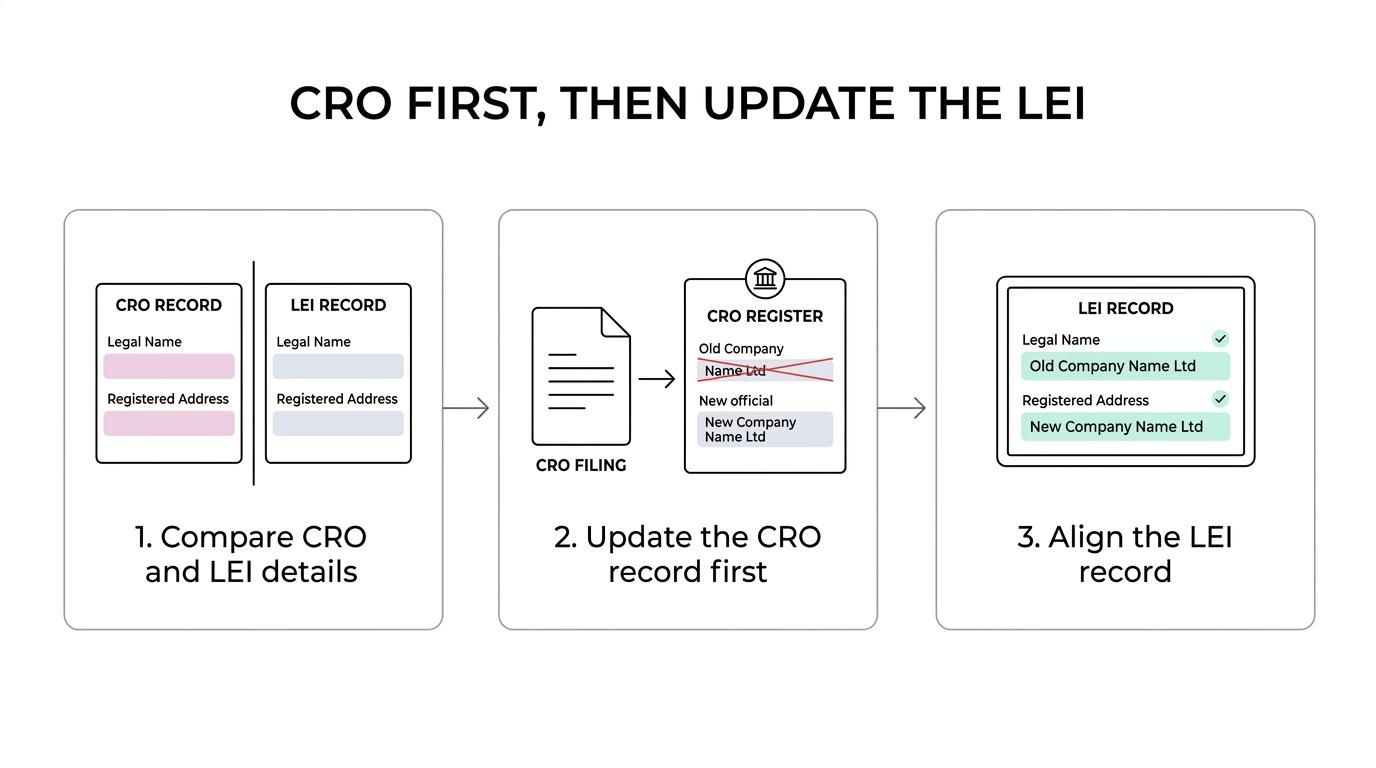
Once the CRO has been updated, the LEI can be renewed or amended to mirror the official position.
A practical fix usually follows this order:
- Check the current CRO entry for the exact legal name and registered office.
- Check the public LEI record for the same fields.
- Identify whether the mismatch is in the LEI record, the CRO record, or both.
- If the CRO record is correct, request an LEI update, renewal, or transfer with corrected data.
- If the CRO record is not current, complete the relevant CRO filing first.
- Keep supporting documents ready in case manual checking is needed.
A specialist LEI registration agent can often help with that process, especially where the issue appears during renewal or where time matters for trading activity.
Details to check before you submit an LEI application
Most mismatches are preventable with a short pre-submission review. The aim is not complexity. It is accuracy.
Before filing, check the official register rather than copying details from a website, invoice, or internal CRM. Those sources may reflect trading language rather than the exact legal identity recognised for validation.
- Exact legal company name
- Legal suffix in full or accepted register form
- Registered office address
- CRO registration number
- Current status of any recent name change
- Business name versus company name
- Group entity versus applicant entity
One more point deserves attention. A clean LEI record does more than satisfy a form. It supports a reliable public identity for the entity across trading, reporting, and due diligence checks. When the CRO record and the LEI record match properly, the process tends to move faster, the review burden is lighter, and the entity’s official profile is easier for others to trust.