What Happens to an LEI After an Irish Company Closes
When an Irish company closes, many people assume its LEI is cancelled at once and vanishes from the public record. That is usually not what happens.
An LEI exists to identify a legal entity over time, not only while it is actively trading. So when a company shuts down, the more useful question is not whether the LEI disappears, but what the LEI record now says about that entity’s legal and operational position.
That distinction matters in Ireland because a company can stop trading before it is dissolved, apply for strike-off and still remain on the register for a period, or be dissolved and later restored. Each stage can affect the LEI record in a different way.
LEI status after an Irish company closes
A closed Irish company and its LEI are not the same thing. The company is the legal person. The LEI is the identifier attached to that person in the global LEI data system.
Because of that, the LEI record usually stays visible even after closure. Public LEI data is meant to show market participants what became of the entity, not erase the entity from view. In practice, that means the record may remain searchable while its status fields change.
The first point to grasp is simple: a company can be inactive in law or in business terms, while the LEI record continues to exist as a historical and reference record.
| Company situation | Likely LEI position | What that usually means |
|---|---|---|
| Company has stopped trading but is still on the CRO register | LEI may remain linked to an active entity; renewal may still be due | Closure in a practical sense has not yet become dissolution |
| LEI renewal date has passed, but the company still exists | Registration status may be LAPSED | The identifier was not renewed on time, but the entity is not known to have ceased operating |
| Company has been dissolved or is no longer legally registered and/or operating | Entity status may move to INACTIVE | The legal entity behind the LEI has ceased to exist or ceased operating |
| Company was struck off and later restored | Existing LEI record may need to be updated and renewed | The entity may be treated as continuing once restoration is effective |
The word “likely” matters here. LEI data depends on public sources and updates, so there can be a short gap between a company event in Ireland and the reflected LEI status.
The difference between LAPSED and INACTIVE in LEI data
A great deal of confusion comes from treating LAPSED and INACTIVE as if they meant the same thing. They do not.
GLEIF separates the status of the entity from the status of the registration. A company may still exist even though its LEI renewal has been missed. Equally, a company may have ceased to exist, while the LEI record remains publicly visible to show that fact.
The most useful way to read these terms is this:
LAPSED: the LEI registration was not renewed by theNextRenewalDate, and public sources do not show that the entity has ceased operatingINACTIVE: the entity assigned the LEI is no longer legally registered and/or operating, including closure, merger, acquisition, or other end of existenceEntityExpirationReason: the recorded reason the legal entity ceased to operate
This is why a lapsed LEI does not automatically mean a dead company.
It may simply mean the company still exists but nobody renewed the LEI by the due date. That can happen with companies, funds, charities, and other entities that are still on the relevant register but have paused market activity or overlooked renewal.
What Irish company closure means for the entity behind the LEI
Irish company law adds another layer. A company can close in a business sense before it closes in a legal sense.
A non-trading company might stop operations, settle its affairs, and seek strike-off. Until dissolution actually happens, the company may still exist on the register. Revenue guidance also points non-trading companies towards seeking strike-off rather than leaving the company in place indefinitely.
The Companies Registration Office makes a further distinction that matters a lot for LEI records: a dissolved company has no legal existence. So if the company behind the LEI has been dissolved, that is much more significant than a missed renewal.
A company in Ireland may cease through liquidation or through strike-off. Voluntary strike-off is common where the company has no assets or liabilities that prevent the process, but it is not immediate.
After a paragraph of law, the practical states look like this:
- ceased trading
- strike-off application submitted
- strike-off notice published
- dissolved
- restored to the register
Those stages often explain why an LEI has not yet changed to reflect what directors or advisers informally describe as “closed”.
What happens during Irish voluntary strike-off and dissolution
Where a company applies for voluntary strike-off, the CRO process has a waiting period built into it. After a valid application is published in the CRO Gazette, the company will normally be dissolved within 90 days unless an objection is received.
That means there is a period when the business may be winding down, the strike-off is under way, but the company is not yet dissolved. During that period, the LEI may still reflect the entity as existing, depending on the latest public data available to the LEI system.
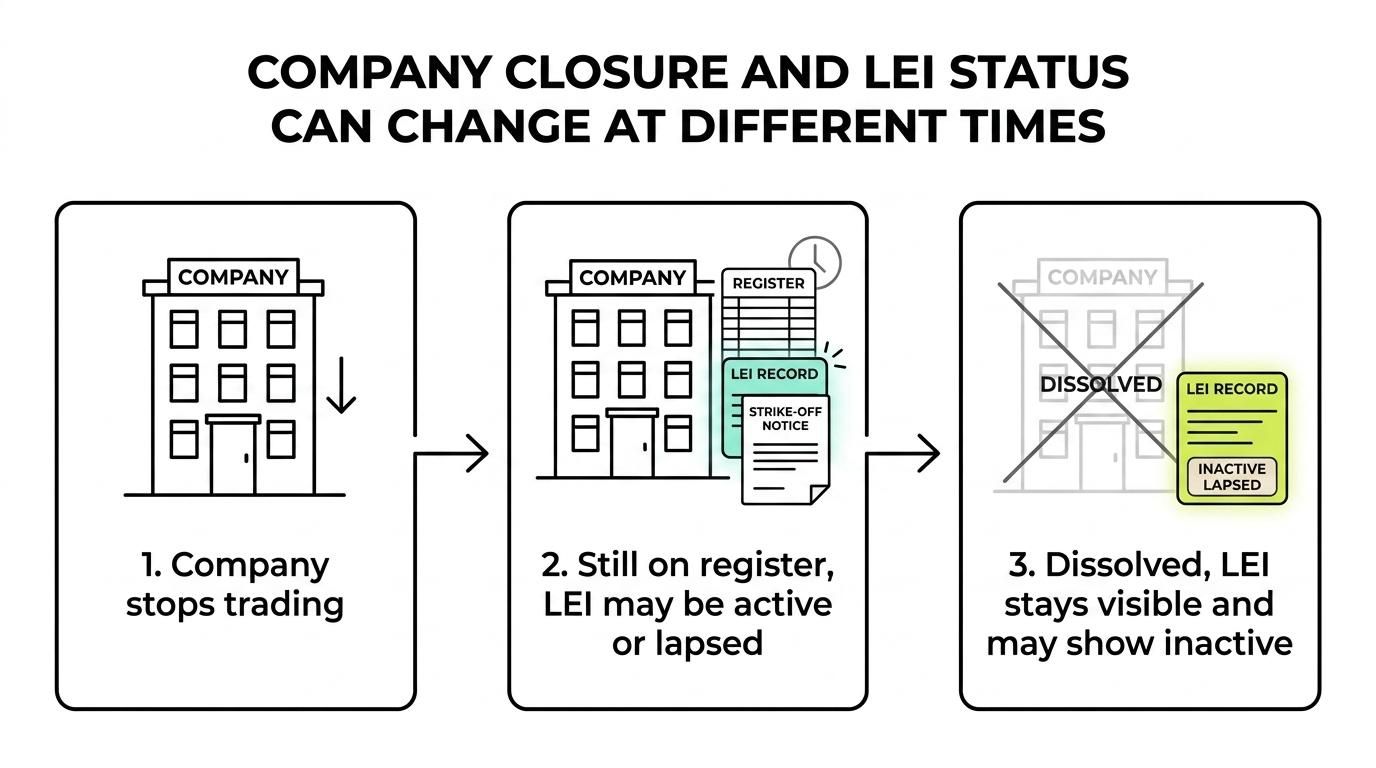
Any person may object within that 90 day period by filing the relevant objection form. So even a planned closure is not always a straight line from application to dissolution.
A simple sequence helps:
- The company stops trading or decides to close.
- It applies for strike-off or enters another formal termination route.
- Public notice is issued and the objection period runs.
- Dissolution takes effect if the process completes.
That timing explains why the phrase “the company has closed” can mean different things to directors, accountants, counterparties, and LEI data users.
Why the LEI usually stays visible after dissolution
The LEI system is built for transparency and reference, not disappearance.
If records simply vanished when a company ended, market participants would lose a valuable audit trail. Counterparties, regulators, investors, and compliance teams need to see whether an entity once existed, whether it later ceased operating, and whether it was replaced, merged, or restored.
GLEIF’s search tools show both Entity Status and Registration Status as separate fields. The detail page can also show items such as Expiration Date, Expiration Reason, and Replaced By. That design tells you something useful straight away: the record is expected to carry history.
That persistence is deliberate.
For Irish companies, it is especially useful where a business stopped long ago but the legal record, trading history, or liability position still matters. The CRO states that liabilities incurred before dissolution remain liabilities of the company after dissolution. So the legal story does not simply evaporate on the strike-off date, and the LEI record is part of the wider documentary trail.
What restoration of an Irish company can mean for the LEI
A dissolved company is not always gone forever. In Ireland, a company struck off and dissolved can in some cases be restored to the register. CRO guidance says restoration following strike-off may be possible by administrative action within 12 months, or by court order within 20 years, depending on the circumstances.
That has a major implication for LEIs. Where the same legal entity is restored, the earlier LEI record is still the relevant identifier history, because the entity has not become a brand new legal person in the ordinary sense. CRO guidance also states that on restoration after strike-off, the company is deemed to have continued in existence as if it had not been struck off.
So the focus shifts from “getting a new LEI” to checking whether the existing LEI should be updated, renewed, or brought back into a current state based on the restored public record.
If a restored company expects to trade financial instruments again, a sensible review usually includes the following:
- Check the CRO position: confirm that restoration has taken effect and the register reflects the company correctly
- Check the LEI record: review both entity status and registration status rather than looking at only one field
- Check renewal timing: see whether the
NextRenewalDatehas passed and whether the LEI is lapsed - Check reference data: make sure the legal name, registered address, and registration details match current public records
This is one area where speed helps. If a company is coming back into regulated activity, waiting until the last minute can hold things up.
How to check an LEI for a closed Irish company
The easiest place to start is the public LEI search facility. No account is required, and the record can usually tell you more than the headline status alone.
Look at the legal name first and confirm you have the correct entity. Then review the status fields carefully. If Registration Status shows LAPSED, that tells you about renewal. If Entity Status shows INACTIVE, that tells you about the company’s existence or operation.
After that, check any expiration-related fields. An EntityExpirationReason may show why the entity ceased operating. If there has been a merger or replacement event, the record may also point to a successor identifier.
When checking an Irish company, it is also worth comparing the LEI record with the CRO register. The LEI data tells one part of the story. The Irish company register tells another. Taken together, they usually give a reliable picture.
Common mistakes when reviewing a closed company’s LEI
One common mistake is assuming that a missed LEI renewal proves the company has been dissolved. It does not. LAPSED can apply even where the legal entity still exists and remains on the register.
Another mistake is assuming that closure in everyday speech means closure in company law. A firm may have ceased all business activity months before dissolution is completed. During that gap, the LEI record may still point to an entity that formally exists.
A few points are worth keeping in mind:
- Do not equate
LAPSEDwith dissolved: it refers to renewal status, not necessarily legal extinction - Do not assume strike-off is immediate: in a voluntary strike-off, dissolution normally follows publication and the 90 day period, unless there is an objection
- Do not treat dissolution as permanent in every case: some Irish companies can be restored
- Do not expect the LEI to vanish: the record usually remains visible as part of the public reference trail
For directors, trustees, fund managers, finance teams, and counterparties, that distinction can save time and avoid unnecessary rework. A proper status check nearly always beats guesswork, especially where a company may return to activity or where an old entity still appears in trading, reporting, or compliance files.